



North Carolina Warehouse Lease Overview
North Carolina's industrial real estate market has grown into a major southeastern logistics hub, driven by the I-85 corridor between Charlotte and Greensboro, the Charlotte metro's population growth, and the Triangle region's tech and life sciences economy. Charlotte has established itself as a regional distribution center serving the mid-Atlantic and southeastern consumer markets, while the Triangle generates demand for specialized storage, cold chain, and high-value distribution serving research and pharmaceutical operations.
The Port of Wilmington adds a maritime dimension to North Carolina's industrial market, creating demand along the I-40 corridor between Wilmington and Raleigh. North Carolina has no sales tax on commercial lease payments and no transfer tax on commercial leases, creating a favorable cost environment compared to states that tax commercial rents. County-level property tax assessment with mandatory reappraisal cycles affects NNN lease economics over multi-year terms.
$26
Recording fee
$1 per $500
Transfer tax
Required
Notarization
0
Witnesses required
North Carolina Requirements
North Carolina warehouse leases are governed by general contract law. No specific industrial lease statute applies, but the county property tax assessment framework and the I-85 corridor market dynamics create important lease considerations. NNN structures are standard in most North Carolina industrial parks.
North Carolina Specific Note
North Carolina property taxes are assessed at the county level, and counties must reappraise property at least every eight years, though some counties reappraise more frequently. A reappraisal during a lease term can significantly increase the property tax passthrough on a NNN lease. Review the county's reappraisal schedule and last reappraisal date before committing to a multi-year NNN lease.
Document Requirements
- Physical specifications: Document certified clear height, dock door count and type, floor load rating, and sprinkler system specifications as lease exhibits
- County property tax base year: North Carolina counties reappraise regularly; establish a base year and cap on NNN tenant property tax liability for increases during the lease term
- I-85 corridor access: For Charlotte-to-Greensboro corridor facilities, address truck route access, interchange proximity, and any local truck restrictions affecting operations
- Permitted use: Define industrial use precisely under the applicable city or county zoning code; Charlotte and Raleigh have active zoning enforcement
- Tenant improvements: Address TI allowance structure, permit responsibility, and ownership of improvements at lease expiration in the active North Carolina construction market
How to Execute a North Carolina Warehouse Lease
Executing a warehouse lease in North Carolina requires understanding the distinct Charlotte, Triangle, and secondary market dynamics, as well as the county reappraisal cycle that affects NNN property tax obligations. These steps apply across North Carolina industrial markets.
Identify the Target North Carolina Market
Evaluate whether Charlotte-area, Triangle-area, Triad, or coastal markets best fit your operations. Each has different rent levels, vacancy rates, and logistics infrastructure. The I-85 corridor offers the best southeastern distribution access; the Triangle serves tech and pharma supply chains.
Review County Tax History and Reappraisal Schedule
Obtain property tax bills from the county assessor and confirm the last reappraisal date and next scheduled reappraisal. North Carolina's mandatory reappraisal cycle can trigger significant NNN tax increases. Establish a base year and cap in the lease.
Confirm Zoning and Permitted Use
Contact the applicable city or county planning department. Charlotte, Raleigh, and Greensboro have active industrial zoning enforcement. Confirm that your specific operations are permitted under the applicable industrial zone classification.
Negotiate NNN Terms with Reappraisal Protection
Review CAM history for two or more years. Negotiate a cap on controllable CAM and a property tax base year with a cap on increases. Address what happens to the NNN tax passthrough if a reappraisal occurs during the lease term.
Execute and Distribute Copies
Both parties sign the fully negotiated lease. Set up utilities and any required business licenses with the applicable city or county. Store executed copies securely.
North Carolina Fees & Costs
Typical costs for filing in North Carolina. Actual fees may vary by county.
| Fee / Tax | Amount |
|---|---|
| Recording Fee | $26 |
| Transfer Tax | $1 per $500 |
| Notarization | $5 - $25 per signature |
| Certified Copy | $1 - $10 per page |
| Attorney Review (optional) | $150 - $500 |
North Carolina Tax Implications
North Carolina has no state sales tax on commercial real estate lease payments and no transfer tax on commercial lease transactions. These characteristics create a favorable cost environment for warehouse tenants compared to states that tax commercial rents. North Carolina does impose a corporate income tax on business income, and commercial tenants operating in the state pay this on in-state profits.
Property taxes are the dominant NNN variable in North Carolina warehouse leases. County assessors value industrial real estate at the county level, and North Carolina law requires reappraisal at intervals of no more than eight years. Major markets including Mecklenburg County and Wake County conduct reappraisals on defined cycles, and a reappraisal occurring during a lease term can significantly increase the property tax passthrough. NNN tenants should review when the last reappraisal occurred and when the next is scheduled.
CAM charges in North Carolina warehouse leases typically include parking lot maintenance, landscaping, property management, and common area utilities. Newer Class A facilities in the I-85 corridor often have more structured and predictable CAM because of professional institutional ownership. Negotiate annual reconciliation requirements and an audit right. For larger facilities, a cap on controllable CAM increases provides meaningful protection over a five-year term.
Sample North Carolina Warehouse Lease
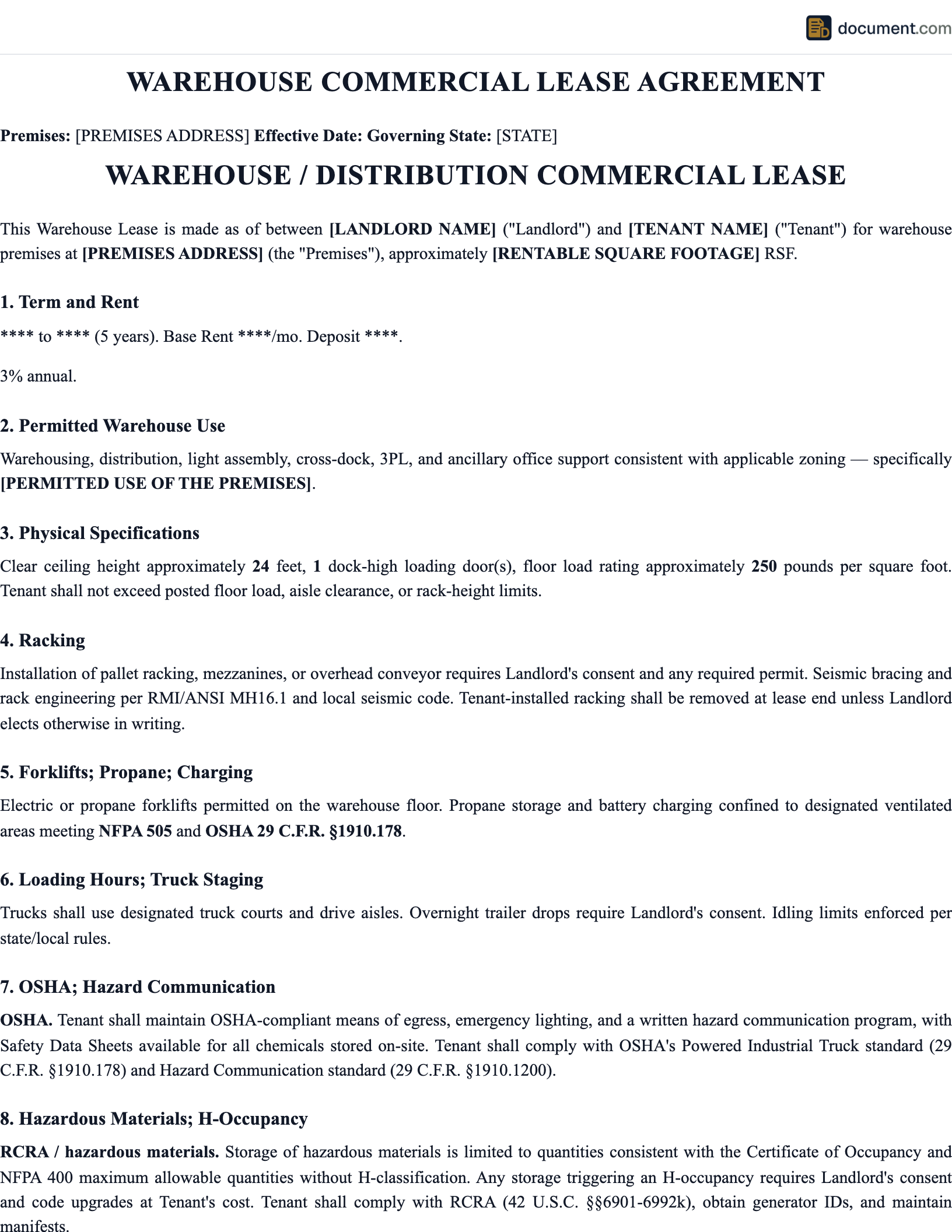
Preview of our North Carolina-specific template. Your document will include all fields required for recording in any North Carolina county.
WAREHOUSE LEASE AGREEMENT
STATE OF NORTH CAROLINA
Legal Document
PARTY INFORMATION
Name: [Full Legal Name]
Address: [North Carolina Address]
County: [County]
PROPERTY DESCRIPTION
County: [County] State: North Carolina
Legal Description: [Per Recorded Plat]
Parcel No.: [APN]
North Carolina Warehouse Lease FAQ
Common questions about filing in North Carolina, including requirements, fees, and tax implications.
Official North Carolina Resources
Official state resources for verifying requirements and finding your local recording office.
Important Considerations
North Carolina's I-85 corridor from Charlotte to Greensboro has become one of the most active industrial development corridors in the Southeast, drawing national logistics operators and e-commerce distribution center expansions. Vacancy rates in Class A corridor facilities have been tight, and tenants seeking large-format modern warehouse space often compete with multiple other users. Renewal options negotiated at initial execution are more valuable here than in secondary North Carolina markets.
The North Carolina Triangle market, concentrated around the I-40/I-540 corridors near Research Triangle Park, has evolved toward specialized warehouse and distribution uses tied to the pharmaceutical, biotech, and tech industries. Cold storage, controlled-substance-compliant facilities, and high-security distribution are in demand. Tenants in this market should confirm that their facilities meet any regulatory requirements for their stored goods, including FDA or DEA compliance for pharmaceutical distribution operations.
North Carolina has a brownfields program administered by the Department of Environmental Quality that provides liability protection for developers who remediate contaminated industrial sites. Tenants leasing space in brownfield-redeveloped properties should review the specific liability protections that apply to their use and confirm they are covered under the brownfields agreement between the state and the property owner. This is particularly relevant in the Triad, where former textile and furniture manufacturing sites have been redeveloped as industrial parks.
North Carolina Market Note
North Carolina's combination of the Charlotte and Triangle metros, I-85 corridor access, no commercial rent tax, and Port of Wilmington creates a legitimate southeastern logistics hub. Rents remain lower than Charlotte, Atlanta, and other Southeast markets on average, though Class A I-85 corridor space has become premium. Model full NNN occupancy cost including county reappraisal exposure before committing to multi-year terms.
Related Documents
Depending on your situation, you may need additional documents alongside this one. Below are commonly related documents that are frequently used together in real estate transactions.
Important Considerations
Before proceeding with your document, there are several important factors to consider. Each real estate transaction is unique, and understanding the specific requirements and implications of your situation will help ensure a smooth and legally compliant process.
Real estate laws and regulations are subject to change, and local requirements may differ from state-level rules. It is always advisable to verify current requirements with your local recording office before submitting any documents for recording.
If your transaction involves complex circumstances such as multiple parties, commercial properties, trusts, estates, or interstate elements, consulting with a licensed real estate attorney is strongly recommended. An attorney can provide guidance specific to your situation and help you avoid potential legal issues.
Keep copies of all documents related to your real estate transaction in a safe place. Recorded documents become part of the public record, but having your own copies ensures you can reference the terms and conditions at any time. Digital copies stored securely are also recommended as a backup.
Professional Recommendation
While our templates are designed to be comprehensive and legally compliant, we recommend having your completed document reviewed by a licensed attorney before recording, especially for high-value transactions or complex situations. Many attorneys offer flat-fee document review services that provide peace of mind at a reasonable cost.
Related Documents
Depending on your situation, you may need additional documents alongside this one. Below are commonly related documents that are frequently used together in real estate transactions.
Create your North Carolina Commercial Warehouse Lease Agreement in under 5 minutes.
Answer a few questions and download a North Carolina-compliant document, ready for the state agency.