



New York Warehouse Lease Overview
New York State offers dramatically different industrial real estate markets depending on geography. The New York City metro, particularly the outer boroughs of Queens, Brooklyn, and the Bronx, is one of the most expensive and supply-constrained urban industrial markets in the country, driven by last-mile delivery demand. Long Island offers suburban industrial product at lower rents. Upstate markets including Albany, Buffalo, Rochester, and Syracuse operate as independent regional distribution hubs with rents a fraction of downstate costs.
New York warehouse leasing carries complexity unique to this market: the Commercial Rent Tax in Manhattan, multi-level property tax obligations, strong union presence in many logistics facilities, and local zoning administered by hundreds of independent municipalities in upstate markets. Tenants must evaluate which New York market they are in because the financial and legal frameworks differ significantly between the New York City metro and upstate industrial markets.
$40
Recording fee
$2 per $500
Transfer tax
Required
Notarization
0
Witnesses required
New York Requirements
New York warehouse leases carry complexity that varies significantly by location within the state. NYC leases require attention to local taxes and union considerations; upstate leases are more straightforward but still involve multi-level property tax obligations. NNN structures dominate most markets.
New York Specific Note
New York property taxes are assessed at multiple levels including county, city, town, and school district. In the New York City market, the Department of Finance assesses commercial property and values can change significantly. Upstate NNN tenants should review current tax bills at all taxing levels. In Manhattan, the Commercial Rent Tax adds to occupancy cost for leases above the $250,000 annual rent threshold.
Document Requirements
- Physical specifications: Document certified clear height, dock door count, floor load rating, and sprinkler type in lease exhibits
- Property tax base year: New York property taxes are high and assessed at multiple levels; establish a base year and cap on NNN tenant liability for increases
- NYC Commercial Rent Tax (if applicable): For Manhattan locations exceeding the $250,000 annual rent threshold, address CRT obligations explicitly in the lease
- Labor and union provisions: For NYC-area facilities, address union recognition, labor peace agreements, or any operational restrictions that may apply to the specific property
- Permitted use: Define industrial use precisely given NYC zoning classifications (M1/M2/M3) or the applicable municipality's industrial zone requirements
How to Execute a New York Warehouse Lease
Executing a warehouse lease in New York requires understanding which of New York's distinct markets you are in. NYC-metro and upstate leases have very different financial structures. These steps apply generally across New York but highlight considerations specific to each market.
Identify the Correct New York Market
Determine whether NYC outer boroughs, Long Island, Hudson Valley, or an upstate market best fits your logistics needs. Each has different rents, availability, tax profiles, and lease structures. NYC urban last-mile space commands very different terms than Albany-area regional distribution space.
Research Property Tax and Local Tax Obligations
Obtain current property tax bills at all taxing levels for the specific parcel. For Manhattan locations, confirm Commercial Rent Tax applicability. For NYC industrial properties, request the current NYC Department of Finance assessment.
Confirm Zoning and Permitted Use
In NYC, confirm M1/M2/M3 zoning classification. Outside NYC, contact the applicable city, town, or village planning department. Confirm that your intended operations are permitted under the applicable industrial zone.
Negotiate NNN Terms and Tenant Protections
Review multi-year CAM history. Negotiate a property tax base year with a cap on increases. In the NYC market, security deposit requirements can be substantial and may be negotiable. Address renewal options given limited expansion availability in tight NYC submarkets.
Execute the Lease
Both parties sign the fully negotiated lease. For NYC properties, ensure any required landlord consents or board approvals are obtained. Establish utilities and any required labor compliance registrations. Keep executed copies in a secure location.
New York Fees & Costs
Typical costs for filing in New York. Actual fees may vary by county.
| Fee / Tax | Amount |
|---|---|
| Recording Fee | $40 |
| Transfer Tax | $2 per $500 |
| Notarization | $5 - $25 per signature |
| Certified Copy | $1 - $10 per page |
| Attorney Review (optional) | $150 - $500 |
New York Tax Implications
New York City imposes a Commercial Rent Tax on Manhattan commercial tenants paying annual base rent exceeding $250,000. The current rate is 3.9% on taxable rent, with applicable exemptions. This is a tenant obligation unique to Manhattan that does not apply in other New York City boroughs or upstate. All New York commercial tenants are subject to standard state and local income taxes on business income sourced in New York.
Property taxes in New York State are assessed at multiple levels. In New York City, the Department of Finance assesses commercial real estate. Outside the city, county assessors handle valuation, and the tax bill reflects county, city/town, and school district levies separately. New York property taxes are high throughout the state, though upstate industrial rates are generally lower on a per-square-foot basis than NYC values would suggest.
CAM charges in New York warehouse leases vary significantly by market. NYC outer borough leases typically include high insurance premiums, property management fees, and maintenance. Upstate New York CAM commonly includes snow removal (significant given Buffalo and Syracuse winters), parking lot maintenance, and landscaping. Negotiate annual reconciliation requirements and audit rights regardless of market.
Sample New York Warehouse Lease
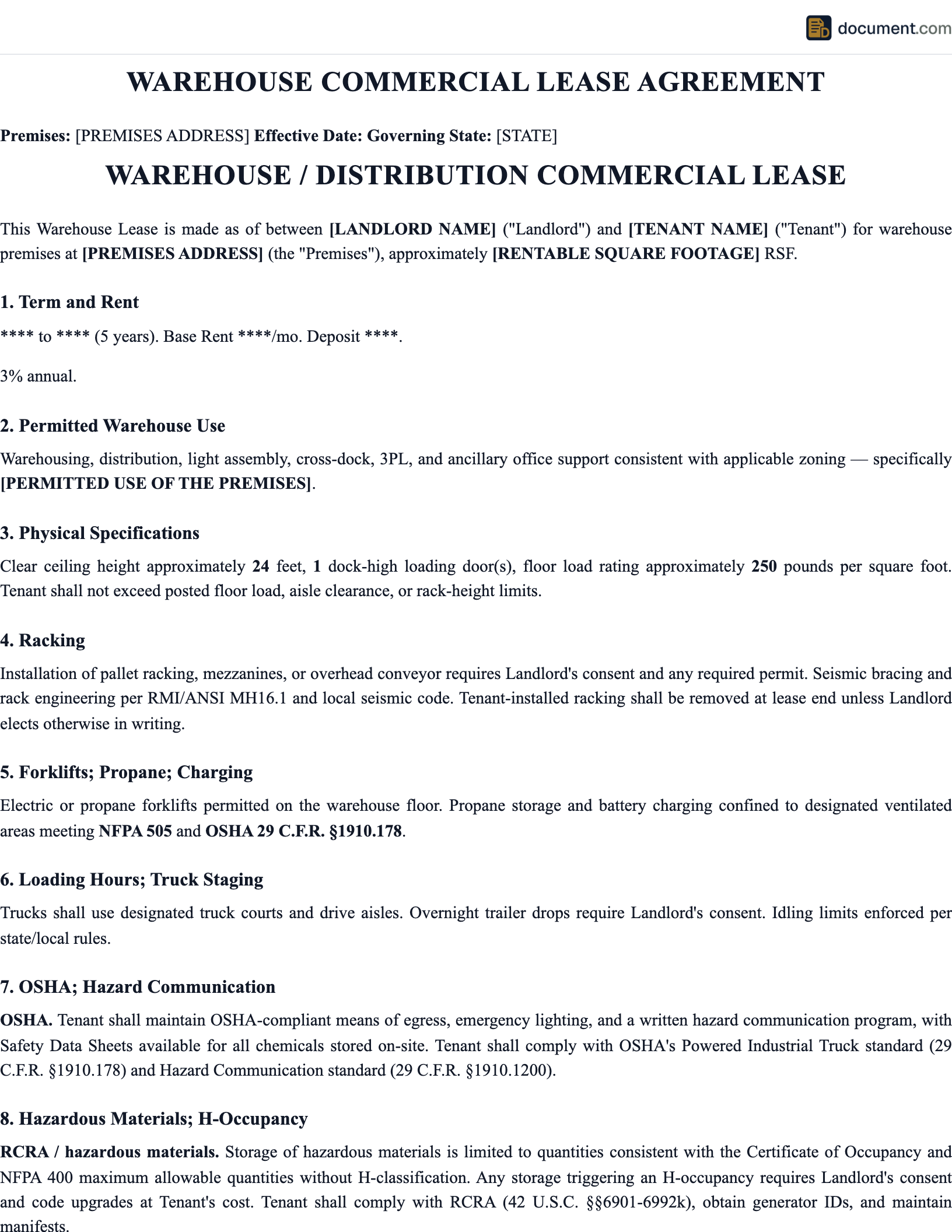
Preview of our New York-specific template. Your document will include all fields required for recording in any New York county.
WAREHOUSE LEASE AGREEMENT
STATE OF NEW YORK
Legal Document
PARTY INFORMATION
Name: [Full Legal Name]
Address: [New York Address]
County: [County]
PROPERTY DESCRIPTION
County: [County] State: New York
Legal Description: [Per Recorded Plat]
Parcel No.: [APN]
New York Warehouse Lease FAQ
Common questions about filing in New York, including requirements, fees, and tax implications.
Official New York Resources
Official state resources for verifying requirements and finding your local recording office.
Important Considerations
New York City outer borough warehouse tenants face ongoing rezoning pressure as the city has converted industrial zones to mixed-use development in some areas. While active M2 and M3 zones are generally protected, tenants in transitional areas should confirm the long-term industrial character of their location before signing long-term leases. Losing industrial zoning in your area can affect future renewal negotiations significantly.
Upstate New York industrial tenants in Buffalo, Rochester, or Syracuse markets benefit from lower rents but should understand that these markets have experienced population and economic pressures that have left significant legacy industrial vacancy. Due diligence on building condition is especially important in older upstate industrial properties where deferred maintenance may not be immediately apparent. PILOT arrangements are available in some upstate New York economic development zones and can significantly reduce effective occupancy cost.
New York State has enacted some of the most progressive employment laws in the country, and warehouse operators must budget for compliance costs. Paid family leave, sick leave requirements, salary history bans, and the New York WARN Act (with lower employee thresholds than the federal WARN Act) all affect warehouse operating costs. For large distribution center operations, consult a New York employment attorney before executing any long-term lease to understand the full labor compliance cost.
New York Market Note
New York's industrial market spans from among the most expensive urban industrial real estate in the country to competitively priced upstate regional distribution hubs. Match your logistics needs to the right New York market before committing to a lease. NYC outer borough last-mile space justifies premium rents for consumer proximity; upstate hubs offer cost-effective regional distribution access. Model the full cost including labor, taxes, and compliance before comparing New York to alternative markets.
Related Documents
Depending on your situation, you may need additional documents alongside this one. Below are commonly related documents that are frequently used together in real estate transactions.
Important Considerations
Before proceeding with your document, there are several important factors to consider. Each real estate transaction is unique, and understanding the specific requirements and implications of your situation will help ensure a smooth and legally compliant process.
Real estate laws and regulations are subject to change, and local requirements may differ from state-level rules. It is always advisable to verify current requirements with your local recording office before submitting any documents for recording.
If your transaction involves complex circumstances such as multiple parties, commercial properties, trusts, estates, or interstate elements, consulting with a licensed real estate attorney is strongly recommended. An attorney can provide guidance specific to your situation and help you avoid potential legal issues.
Keep copies of all documents related to your real estate transaction in a safe place. Recorded documents become part of the public record, but having your own copies ensures you can reference the terms and conditions at any time. Digital copies stored securely are also recommended as a backup.
Professional Recommendation
While our templates are designed to be comprehensive and legally compliant, we recommend having your completed document reviewed by a licensed attorney before recording, especially for high-value transactions or complex situations. Many attorneys offer flat-fee document review services that provide peace of mind at a reasonable cost.
Related Documents
Depending on your situation, you may need additional documents alongside this one. Below are commonly related documents that are frequently used together in real estate transactions.
Create your New York Commercial Warehouse Lease Agreement in under 5 minutes.
Answer a few questions and download a New York-compliant document, ready for the state agency.