



New Hampshire Warehouse Lease Overview
New Hampshire's industrial real estate market is driven primarily by its role as an overflow market for the Boston metro and by the logistics advantages of having no income tax and no sales tax. Southern New Hampshire cities including Nashua, Manchester, and Salem sit within practical delivery range of Boston, creating consistent demand from businesses seeking Boston market access without Massachusetts costs. The I-93 and I-89 corridors link major New Hampshire population centers to the regional freight network.
Portsmouth adds a distinct dimension through its port access. The Port of New Hampshire handles bulk cargo and some container traffic, and industrial facilities near the Piscataqua River corridor attract demand from import-export businesses and commodity storage operators. New Hampshire winters are significant and warehouse leases must address heating systems, dock access in winter conditions, and snow removal responsibility more carefully than leases in southern states.
$26
Recording fee
$7.50 per $1,000
Transfer tax
Required
Notarization
0
Witnesses required
New Hampshire Requirements
New Hampshire warehouse leases are governed by general contract and commercial real estate law. The state has no specific commercial leasing statute but relies on common law principles. The high property tax environment and significant winters create provisions that must be carefully negotiated.
New Hampshire Specific Note
New Hampshire property taxes are high by national standards and are assessed at the local municipality level, not by county. Towns and cities have independent tax rates that vary significantly. NNN warehouse tenants should obtain the current tax bill and at least three years of history, and negotiate a base year with a cap on annual increases before signing any multi-year NNN lease.
Document Requirements
- Physical specifications: State ceiling height, dock door count and type, floor load rating, and sprinkler type as lease exhibits
- Property tax base year: New Hampshire property taxes are among the highest nationally; establish the base year and cap tenant liability for NNN increases
- Snow removal responsibility: Assign responsibility for truck court, dock approach, and parking lot clearing with defined response time standards for New Hampshire winters
- Portsmouth port access: For waterfront or port-access facilities, explicitly describe any rights to tidal or waterway access in the leased premises description
- Permitted use: Define the specific industrial use precisely to prevent landlord objection to future operational changes
How to Execute a New Hampshire Warehouse Lease
Executing a warehouse lease in New Hampshire requires attention to the state's high property taxes, significant winter weather, and the specific logistics demands of Boston-overflow operations. These steps apply to southern New Hampshire industrial parks and Portsmouth-area facilities.
Evaluate Boston Market Access
Map drive times to your key Boston-area customers or suppliers from prospective New Hampshire locations. Southern markets near Nashua and Manchester offer the best access; northern New Hampshire trades lower rent for longer delivery windows.
Review Property Tax History
Obtain the current municipal property tax bill and three years of history from the town or city assessor. New Hampshire property taxes can add substantially to NNN occupancy costs, and rates vary significantly by municipality.
Inspect for Winter Readiness
Check the heating system type, last service date, dock seals, and roof condition. Review the snow removal contract for the property. New Hampshire winters require active dock approach management to maintain year-round access.
Negotiate NNN Terms with Tax and CAM Caps
Review CAM history for two or more years. Negotiate a cap on controllable CAM and a base year for property taxes. Annual CAM reconciliation with supporting documentation should be a required lease provision.
Execute and Distribute Copies
Both parties sign. Utilities set up in the tenant name where required. Store executed copies in a secure location.
New Hampshire Fees & Costs
Typical costs for filing in New Hampshire. Actual fees may vary by county.
| Fee / Tax | Amount |
|---|---|
| Recording Fee | $26 |
| Transfer Tax | $7.50 per $1,000 |
| Notarization | $5 - $25 per signature |
| Certified Copy | $1 - $10 per page |
| Attorney Review (optional) | $150 - $500 |
New Hampshire Tax Implications
New Hampshire has no general sales tax and no income tax on wages, making commercial lease payments free of state tax in most commercial arrangements. This tax environment is a significant advantage for businesses comparing New Hampshire to Massachusetts, which imposes a 6.25% sales tax on many commercial real estate lease transactions.
Property taxes are the dominant financial variable in New Hampshire NNN warehouse leases. Because New Hampshire funds state and local government primarily through property taxes (lacking income and sales taxes), effective rates are among the highest in the country. Tax rates are set independently by each municipality. NNN tenants should review the specific town or city rate, obtain the current tax bill, and negotiate a base year with a cap on annual property tax increases before signing any multi-year lease.
CAM charges in New Hampshire warehouse leases commonly include snow removal, parking lot maintenance, and property management fees. Heating fuel costs must be clearly addressed: New Hampshire warehouses face substantial heating demand from November through April. If the landlord provides heating, specify the fuel type and cost responsibility. If the tenant takes utilities directly, confirm separate metering and that there are no shared heating systems that would complicate cost allocation.
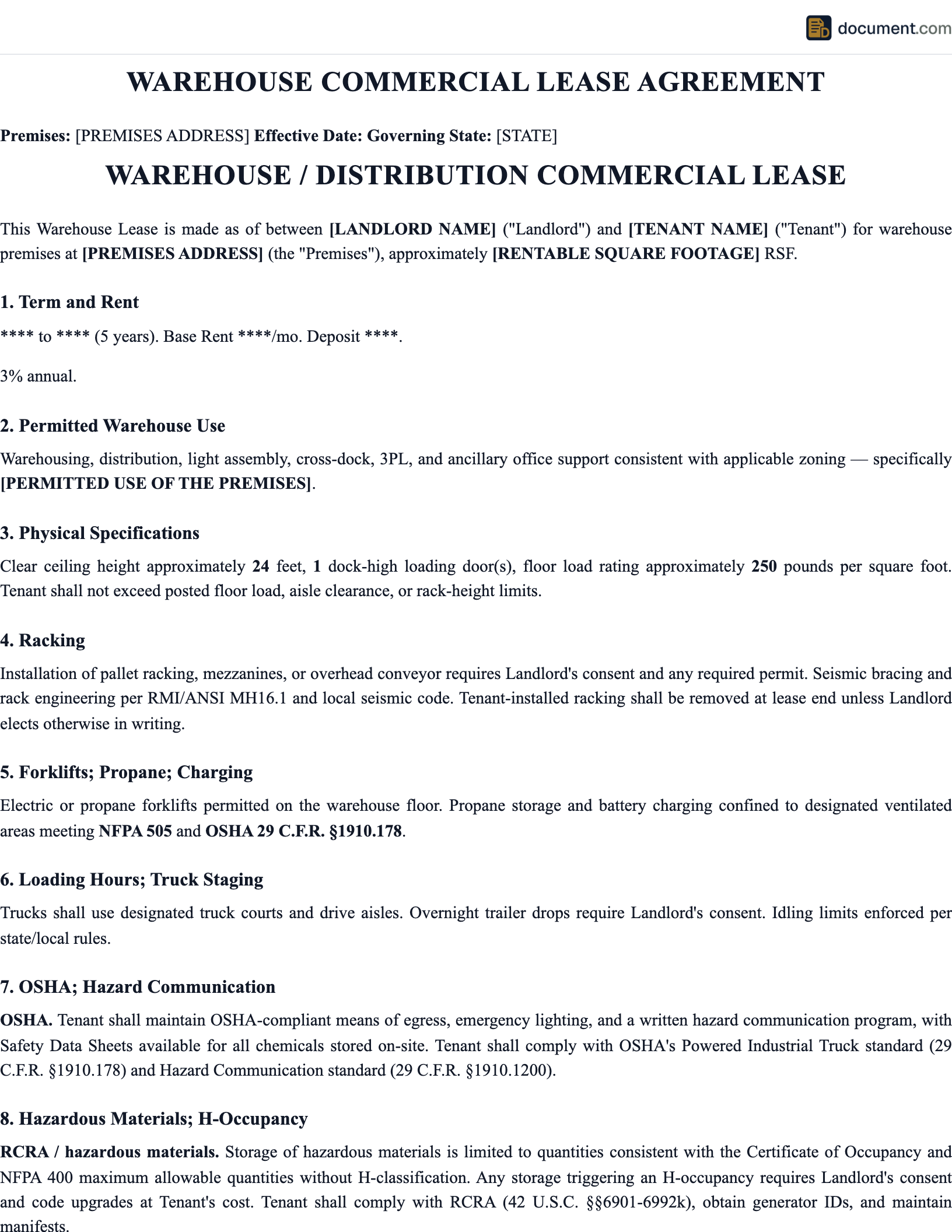
Sample New Hampshire Warehouse Lease
Preview of our New Hampshire-specific template. Your document will include all fields required for recording in any New Hampshire county.
WAREHOUSE LEASE AGREEMENT
STATE OF NEW HAMPSHIRE
Legal Document
PARTY INFORMATION
Name: [Full Legal Name]
Address: [New Hampshire Address]
County: [County]
PROPERTY DESCRIPTION
County: [County] State: New Hampshire
Legal Description: [Per Recorded Plat]
Parcel No.: [APN]
New Hampshire Warehouse Lease FAQ
Common questions about filing in New Hampshire, including requirements, fees, and tax implications.
Official New Hampshire Resources
Official state resources for verifying requirements and finding your local recording office.
Important Considerations
New Hampshire warehouse tenants in southern markets should understand that the combination of Boston overflow demand and limited new supply has tightened the market significantly over recent years. Landlords in well-located southern New Hampshire industrial facilities have less incentive to offer concessions than they once did. Tenants who need to expand or extend leases face rising rents. Negotiating renewal options at the time of initial execution is more important here than in slower-growing New England markets.
Portsmouth-area industrial tenants should confirm whether planned operations include any waterfront or tidal area activity, as New Hampshire has specific permitting requirements for activities affecting tidal waters and wetlands. The New Hampshire Department of Environmental Services administers these permits. Operations near the Piscataqua River may require state approval before commencing, and due diligence should include confirming whether any proposed modifications or expansions trigger these requirements.
New Hampshire has no county government for most purposes, meaning permit inquiries, zoning confirmations, and tax information must go directly to the applicable city or town. This can slow due diligence in smaller towns with limited planning department staff. Build additional time into the pre-execution due diligence schedule for lease negotiations in smaller New Hampshire municipalities, particularly for sites outside established industrial parks.
New Hampshire Market Note
New Hampshire's combination of no income tax, no sales tax, good I-93 access to Boston, and Portsmouth port access makes it a legitimate logistics location for businesses serving New England. The high property taxes are real, but when modeled against Massachusetts sales tax on commercial rent and Massachusetts income tax on business profits, New Hampshire's total occupancy and operating cost can compare favorably for many distribution operations.
Related Documents
Depending on your situation, you may need additional documents alongside this one. Below are commonly related documents that are frequently used together in real estate transactions.
Important Considerations
Before proceeding with your document, there are several important factors to consider. Each real estate transaction is unique, and understanding the specific requirements and implications of your situation will help ensure a smooth and legally compliant process.
Real estate laws and regulations are subject to change, and local requirements may differ from state-level rules. It is always advisable to verify current requirements with your local recording office before submitting any documents for recording.
If your transaction involves complex circumstances such as multiple parties, commercial properties, trusts, estates, or interstate elements, consulting with a licensed real estate attorney is strongly recommended. An attorney can provide guidance specific to your situation and help you avoid potential legal issues.
Keep copies of all documents related to your real estate transaction in a safe place. Recorded documents become part of the public record, but having your own copies ensures you can reference the terms and conditions at any time. Digital copies stored securely are also recommended as a backup.
Professional Recommendation
While our templates are designed to be comprehensive and legally compliant, we recommend having your completed document reviewed by a licensed attorney before recording, especially for high-value transactions or complex situations. Many attorneys offer flat-fee document review services that provide peace of mind at a reasonable cost.
Related Documents
Depending on your situation, you may need additional documents alongside this one. Below are commonly related documents that are frequently used together in real estate transactions.
Create your New Hampshire Commercial Warehouse Lease Agreement in under 5 minutes.
Answer a few questions and download a New Hampshire-compliant document, ready for the state agency.