
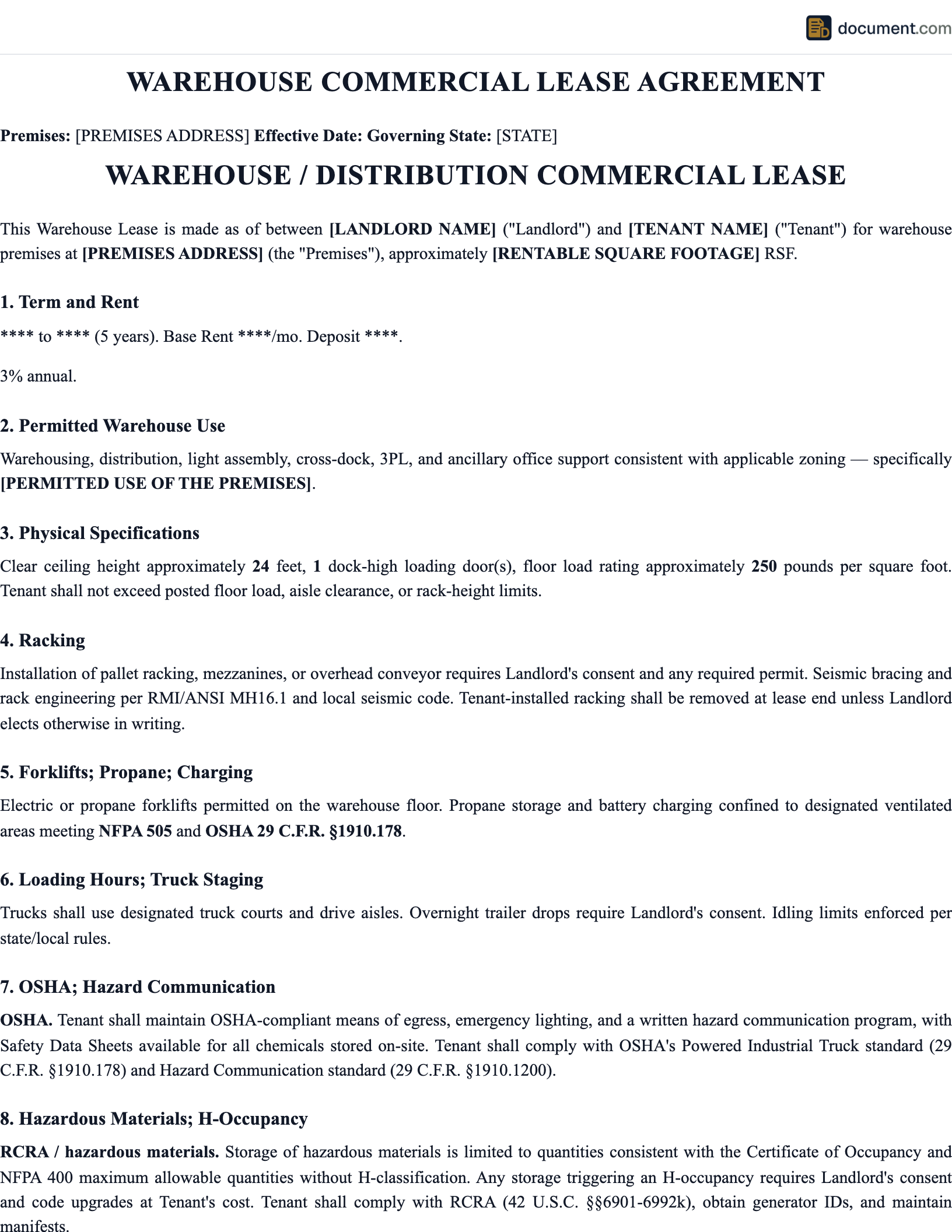



Montana Warehouse Lease Overview
Montana has one of the smallest industrial real estate markets among western states, and that limited supply shapes virtually every warehouse lease negotiation in the state. Billings, the state's largest city, anchors the most significant concentration of industrial space, supported by BNSF rail access and proximity to oil field operations in the Bakken and Williston Basin areas. Missoula, Great Falls, and Bozeman have smaller but growing industrial inventories, with Bozeman experiencing unusual demand pressure from its rapidly expanding population.
Agricultural storage is a major driver of Montana's warehouse market. Grain elevators, hay storage, farm equipment storage, and fertilizer warehousing create consistent demand across rural Montana counties where industrial inventory outside of storage-related uses is almost nonexistent. Leases for agricultural storage facilities involve different physical requirements than urban distribution warehouses and often include provisions for seasonal use, outdoor equipment staging, and dust management that would be unusual in a Kansas City or Denver industrial park.
$12
Recording fee
None
Transfer tax
Required
Notarization
0
Witnesses required
Montana Requirements
Montana does not impose a real estate transfer tax on commercial lease transactions. The state has no general sales tax, so lease payments are not subject to sales tax either. A Montana warehouse lease is governed by contract law and commercial real estate custom rather than a specific industrial leasing statute.
Montana Specific Note
Heating system provisions are critical in Montana warehouse leases. Specify who is responsible for furnace and boiler maintenance, minimum building temperature requirements during winter months, and who pays for fuel. Failure to address these terms creates serious disputes in markets like Great Falls and Havre where heating costs are substantial and outages can damage stored goods.
Key Lease Provisions
- Heating system: Type of heating, fuel source, minimum temperature standard, and maintenance responsibility
- Snow removal: Responsibility for dock approach, truck court, parking area, and roof snow management
- Agricultural use terms: Any restrictions or allowances for agricultural commodities, dust, odor, and outdoor equipment storage
- Zoning confirmation: Verify with local city or county that the intended use is permitted under the current zoning classification
- Rail access (if applicable): Explicitly include rail siding rights in the leased premises description if rail service is part of the business operation
How to Execute a Montana Warehouse Lease
Executing a warehouse lease in Montana requires particular attention to physical conditions and seasonal operations. These steps apply to industrial space in Billings, agricultural storage in rural counties, and distribution facilities in Missoula or Great Falls.
Inspect for Winter Readiness
Before signing, verify the condition of the heating system, roof insulation, and dock seals. Ask for documentation of the last heating system service and any roof repairs. Montana winters can expose deficiencies that are not obvious in summer.
Confirm Zoning and Permitted Use
Contact the city or county planning office to verify the parcel is zoned for your use. Agricultural storage, oil field equipment storage, and light manufacturing may all be treated differently under Montana county zoning ordinances.
Negotiate Heating and Snow Removal Terms
These provisions are more material in Montana than in most other states. Reach written agreement on who pays for fuel, what minimum temperature the landlord maintains, and who handles snow removal from truck courts and dock approaches before signing.
Draft and Execute the Lease
Use a Montana-specific warehouse lease form. Both parties sign. Keep executed copies in a secure location. Recording with the county clerk and recorder is optional for leases between the parties but provides public notice if the landlord later sells or refinances.
Document Baseline Conditions
Photograph the space at move-in, including any existing damage, roof condition, heating equipment, and dock areas. Attach the inspection record to the lease. This baseline protects both parties at the end of the term.
Montana Fees & Costs
Typical costs for filing in Montana. Actual fees may vary by county.
| Fee / Tax | Amount |
|---|---|
| Recording Fee | $12 |
| Transfer Tax | None |
| Notarization | $5 - $25 per signature |
| Certified Copy | $1 - $10 per page |
| Attorney Review (optional) | $150 - $500 |
Montana Tax Implications
Montana has no state general sales tax and no real estate transfer tax, which simplifies the cost structure of a commercial warehouse lease compared to many other states. Montana does impose property taxes at the county level, assessed by county treasurers. In NNN warehouse leases, tenants typically pay their pro-rata share of property taxes, so reviewing current tax bills before signing is important.
CAM charges in Montana warehouse leases can be heavily influenced by winter-related costs: snow removal, heating fuel, and ice management. These expenses vary significantly between years and can spike in heavy snow years. Tenants should negotiate CAM caps on controllable expenses and request a three-year CAM history to understand the range of costs before agreeing to NNN terms.
Utility costs deserve particular attention in Montana. Heating fuel, whether natural gas or propane, is a significant expense for warehouse tenants running year-round operations. Leases should clearly specify whether the landlord or tenant pays for heating fuel and how utility accounts are established. In rural areas where only propane is available, the cost differential from natural gas is substantial.
Sample Montana Warehouse Lease
Preview of our Montana-specific template. Your document will include all fields required for recording in any Montana county.
WAREHOUSE LEASE AGREEMENT
STATE OF MONTANA
Legal Document
PARTY INFORMATION
Name: [Full Legal Name]
Address: [Montana Address]
County: [County]
PROPERTY DESCRIPTION
County: [County] State: Montana
Legal Description: [Per Recorded Plat]
Parcel No.: [APN]
Montana Warehouse Lease FAQ
Common questions about filing in Montana, including requirements, fees, and tax implications.
Official Montana Resources
Official state resources for verifying requirements and finding your local recording office.
Important Considerations
Montana warehouse tenants should understand that the thin industrial market means landlords hold substantial leverage in most negotiations. Building quality varies widely, particularly in older Billings industrial parks and rural agricultural storage facilities. Conducting a professional building inspection before signing a multi-year lease is money well spent, especially for older buildings where deferred maintenance on roofs, heating systems, and dock equipment may not be obvious during an initial walkthrough.
Oil field equipment storage in western Montana and Billings creates specialized lease requirements. Equipment storage for Bakken Basin operations often involves oversize loads, outdoor staging areas, heavy equipment weight loads on yard surfaces, and potential environmental exposure from machinery leaks. A standard commercial warehouse lease will not address these needs adequately. Tenants in this space should work with a Montana commercial real estate attorney to draft provisions covering yard use, weight limits, environmental indemnification, and restoration obligations.
Montana's rural market means that some warehouse facilities are located on land with water rights or agricultural easements that can affect industrial use. Before signing, confirm that the property is not subject to conservation easements, agricultural use restrictions, or water rights agreements that might limit your ability to operate as planned.
Montana Market Note
Montana has no state income tax on business income earned within the state, which is a meaningful advantage for businesses evaluating Montana as a warehouse and distribution location. Combined with no sales tax on lease payments, the total occupancy cost calculation in Montana can compare favorably to neighboring Idaho or Wyoming even when base rents are higher on a per-square-foot basis.
Related Documents
Depending on your situation, you may need additional documents alongside this one. Below are commonly related documents that are frequently used together in real estate transactions.
Important Considerations
Before proceeding with your document, there are several important factors to consider. Each real estate transaction is unique, and understanding the specific requirements and implications of your situation will help ensure a smooth and legally compliant process.
Real estate laws and regulations are subject to change, and local requirements may differ from state-level rules. It is always advisable to verify current requirements with your local recording office before submitting any documents for recording.
If your transaction involves complex circumstances such as multiple parties, commercial properties, trusts, estates, or interstate elements, consulting with a licensed real estate attorney is strongly recommended. An attorney can provide guidance specific to your situation and help you avoid potential legal issues.
Keep copies of all documents related to your real estate transaction in a safe place. Recorded documents become part of the public record, but having your own copies ensures you can reference the terms and conditions at any time. Digital copies stored securely are also recommended as a backup.
Professional Recommendation
While our templates are designed to be comprehensive and legally compliant, we recommend having your completed document reviewed by a licensed attorney before recording, especially for high-value transactions or complex situations. Many attorneys offer flat-fee document review services that provide peace of mind at a reasonable cost.
Related Documents
Depending on your situation, you may need additional documents alongside this one. Below are commonly related documents that are frequently used together in real estate transactions.
Create your Montana Commercial Warehouse Lease Agreement in under 5 minutes.
Answer a few questions and download a Montana-compliant document, ready for the state agency.