



Missouri Warehouse Lease Overview
Missouri sits at the center of the national freight network, and that geography shapes its warehouse leasing market in concrete ways. Kansas City straddles the state line and serves as one of the country's busiest freight rail junctions, with connections to Union Pacific, BNSF, and KC Southern lines. St. Louis adds river barge access on the Mississippi and Mississippi River intermodal terminals that feed container traffic from New Orleans north. Both markets have seen sustained demand from e-commerce operators, automotive suppliers, and agricultural product distributors.
Missouri has no state income tax on warehouse operations conducted through most pass-through entity structures, which draws logistics businesses that might otherwise locate in Illinois or Kansas. That tax advantage is frequently cited in site selection. On the lease document side, Missouri relies on general contract law and commercial real estate custom rather than a dedicated industrial leasing statute. That means the parties define most terms themselves, which makes a thorough, specific lease agreement essential for avoiding disputes over maintenance obligations, utility costs, and permitted use.
$24
Recording fee
None
Transfer tax
Required
Notarization
0
Witnesses required
Missouri Requirements
Missouri does not impose a documentary transfer tax on commercial leases, but the lease itself must be properly executed to be enforceable and, when recorded, must meet county recorder formatting standards. Leases with terms of one year or less do not need to be recorded to be enforceable between the parties, but recording provides constructive notice to subsequent purchasers or lienholders.
Missouri Specific Note
Missouri zoning authority rests with municipalities and counties, not the state. Before finalizing a warehouse lease, verify the specific zoning classification with the city or county planning department. Kansas City, St. Louis, and Springfield each have distinct industrial zoning codes that govern truck access, building setbacks, and permitted storage types. A use that qualifies in one jurisdiction may require a conditional use permit in another.
Key Lease Provisions
- Physical specifications: Ceiling clear height, dock door count and type, floor load rating, and truck court depth should all be stated in writing
- Permitted use clause: Define the specific industrial use with enough precision to prevent landlord objection to future operational changes
- Maintenance allocation: Clearly assign responsibility for roof, HVAC, dock levelers, sprinkler systems, and parking areas
- Utility metering: Confirm whether electric, gas, and water meters are separately submetered or shared, and state how costs are allocated
- Missouri Fire Marshal compliance: High-piled storage (above 12 feet) may require fire marshal review and sprinkler upgrades; address who pays for required changes
- Property tax base year: In NNN leases, establish the base year tax amount and any cap on tenant liability for increases
How to Execute a Missouri Warehouse Lease
Executing a warehouse lease in Missouri follows a practical sequence. The steps below apply whether the property is in an established Kansas City industrial park, a St. Louis freight hub, or a rural agricultural storage facility in southwest Missouri.
Verify Zoning and Permitted Use
Contact the city or county planning department to confirm the parcel is zoned for your specific industrial use. Request a copy of the certificate of occupancy and confirm it matches your intended operations.
Document Building Specifications
Before signing, walk the space and record ceiling clear height, dock door type and count, floor load capacity, sprinkler system type, and HVAC coverage. Attach these as an exhibit to the lease so there is no dispute later.
Review Property Tax History
Obtain three years of county property tax records for the parcel. Missouri assessment is done by county, and rates vary significantly between Jackson County, St. Louis County, and smaller counties. Use this to set a fair NNN base year.
Negotiate and Draft the Lease
Use a Missouri-specific warehouse lease form that addresses all key industrial provisions. Both parties should review the draft carefully, and tenants should consider retaining a commercial real estate attorney for leases over 10,000 square feet or terms exceeding three years.
Execute and Distribute Copies
Both parties sign the executed lease. Keep original copies in a secure location. For leases over one year that you wish to record, submit to the county recorder of deeds in the county where the property is located with the applicable recording fee.
Missouri Fees & Costs
Typical costs for filing in Missouri. Actual fees may vary by county.
| Fee / Tax | Amount |
|---|---|
| Recording Fee | $24 |
| Transfer Tax | None |
| Notarization | $5 - $25 per signature |
| Certified Copy | $1 - $10 per page |
| Attorney Review (optional) | $150 - $500 |
Missouri Tax Implications
Missouri imposes no state-level transfer tax on commercial lease transactions, which is a meaningful cost advantage compared to neighboring states. However, warehouse tenants in NNN leases should carefully review how property tax obligations are structured. Missouri property taxes are assessed at the county level, and the effective tax rate in Jackson County (Kansas City metro) is higher than rates in many rural counties. Tenants who sign NNN leases are typically responsible for their pro-rata share of real property taxes, and annual increases can add thousands of dollars to occupancy costs.
CAM charges in Missouri industrial leases often include costs that tenants do not anticipate: snow plowing and ice removal, which can be significant in Kansas City and St. Louis winters; parking lot resurfacing reserves; and property management fees. Negotiate a CAM reconciliation clause that requires the landlord to provide an annual accounting, and consider capping controllable CAM increases at 3 to 5 percent per year.
Utility cost allocation is the other major variable. Large distribution facilities in Missouri may pay directly for electricity, natural gas, and water, or costs may be included in a gross or modified gross rent. For facilities with heavy refrigeration or climate control requirements, the lease should clearly state whether those utility costs are the tenant's responsibility and how submetering is handled. Missouri has no state income tax, which is relevant for businesses evaluating total operating costs across locations.
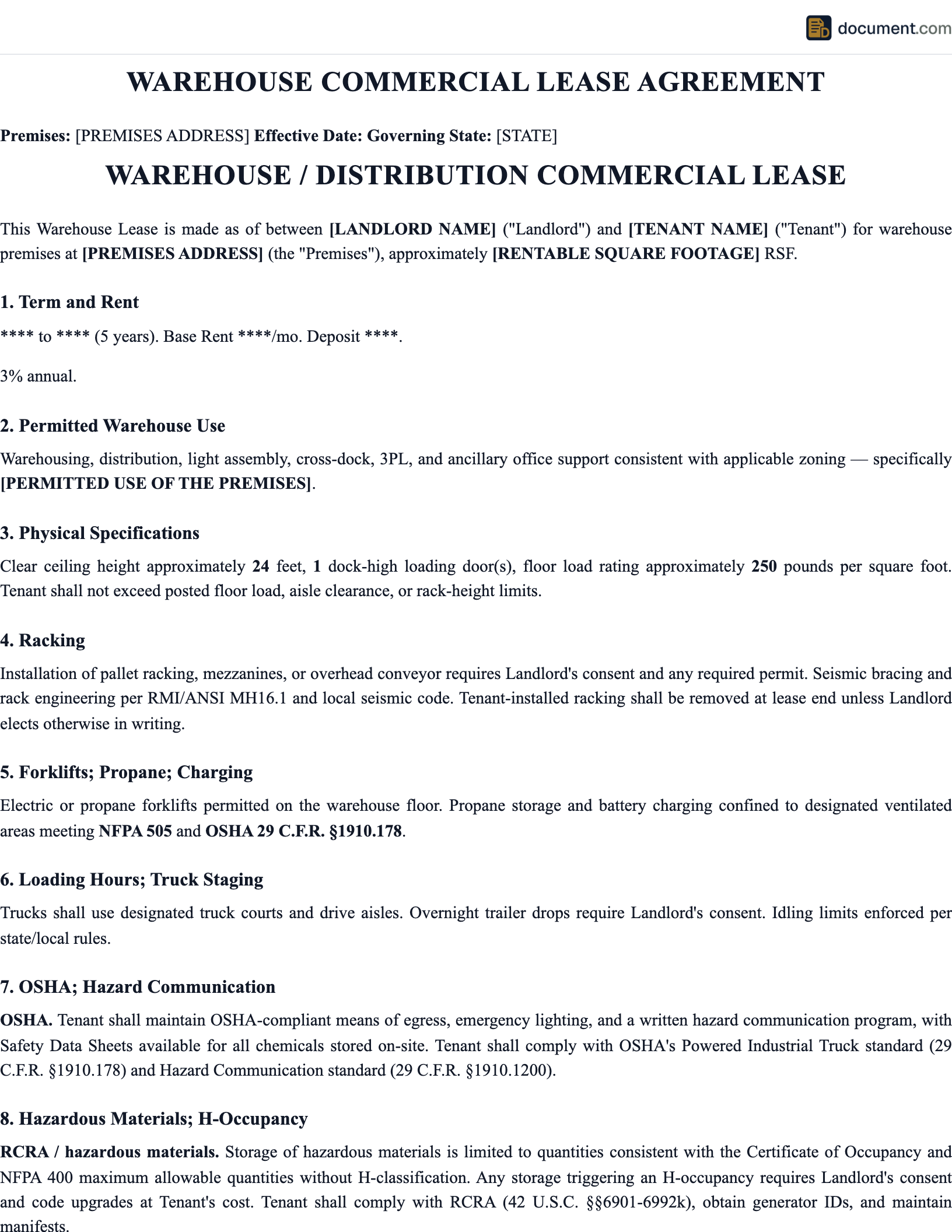
Sample Missouri Warehouse Lease
Preview of our Missouri-specific template. Your document will include all fields required for recording in any Missouri county.
WAREHOUSE LEASE AGREEMENT
STATE OF MISSOURI
Legal Document
PARTY INFORMATION
Name: [Full Legal Name]
Address: [Missouri Address]
County: [County]
PROPERTY DESCRIPTION
County: [County] State: Missouri
Legal Description: [Per Recorded Plat]
Parcel No.: [APN]
Missouri Warehouse Lease FAQ
Common questions about filing in Missouri, including requirements, fees, and tax implications.
Official Missouri Resources
Official state resources for verifying requirements and finding your local recording office.
Important Considerations
Missouri warehouse tenants should pay particular attention to the Mark Twain National Forest region in the Ozarks, where timber and agricultural businesses often seek storage facilities with unusual requirements: wide door clearances for farm equipment, non-climate-controlled bulk storage, and gravel or compacted dirt floors rather than finished concrete. Standard industrial lease forms may not anticipate these conditions, and both parties benefit from a use-specific rider.
Kansas City's position as a Class I rail hub creates demand for warehouse facilities with direct rail siding access. If your operation depends on rail service, confirm in the lease that rail access rights are included in the leased premises, not just the landlord's property generally. Rail access easements in Missouri can be complex, and a lease that does not explicitly grant rail rights may leave a tenant with no enforceable claim if the landlord later restricts access.
Environmental due diligence matters in older Missouri industrial areas. The St. Louis industrial corridor and some Kansas City inner-ring industrial properties have documented soil contamination from historical manufacturing. Before leasing in these areas, ask the landlord for Phase I environmental assessment results and negotiate an environmental indemnification clause that protects the tenant from liability for pre-existing conditions.
Missouri Market Note
Missouri's no-income-tax advantage attracts logistics businesses, but that benefit only materializes if the business is structured correctly. Sole proprietors, S-corps, and LLCs may be treated differently under Missouri tax law. Consult a Missouri tax professional alongside your real estate attorney when structuring a significant warehouse lease, particularly if you are relocating from a higher-tax state.
Related Documents
Depending on your situation, you may need additional documents alongside this one. Below are commonly related documents that are frequently used together in real estate transactions.
Important Considerations
Before proceeding with your document, there are several important factors to consider. Each real estate transaction is unique, and understanding the specific requirements and implications of your situation will help ensure a smooth and legally compliant process.
Real estate laws and regulations are subject to change, and local requirements may differ from state-level rules. It is always advisable to verify current requirements with your local recording office before submitting any documents for recording.
If your transaction involves complex circumstances such as multiple parties, commercial properties, trusts, estates, or interstate elements, consulting with a licensed real estate attorney is strongly recommended. An attorney can provide guidance specific to your situation and help you avoid potential legal issues.
Keep copies of all documents related to your real estate transaction in a safe place. Recorded documents become part of the public record, but having your own copies ensures you can reference the terms and conditions at any time. Digital copies stored securely are also recommended as a backup.
Professional Recommendation
While our templates are designed to be comprehensive and legally compliant, we recommend having your completed document reviewed by a licensed attorney before recording, especially for high-value transactions or complex situations. Many attorneys offer flat-fee document review services that provide peace of mind at a reasonable cost.
Related Documents
Depending on your situation, you may need additional documents alongside this one. Below are commonly related documents that are frequently used together in real estate transactions.
Create your Missouri Commercial Warehouse Lease Agreement in under 5 minutes.
Answer a few questions and download a Missouri-compliant document, ready for the state agency.