
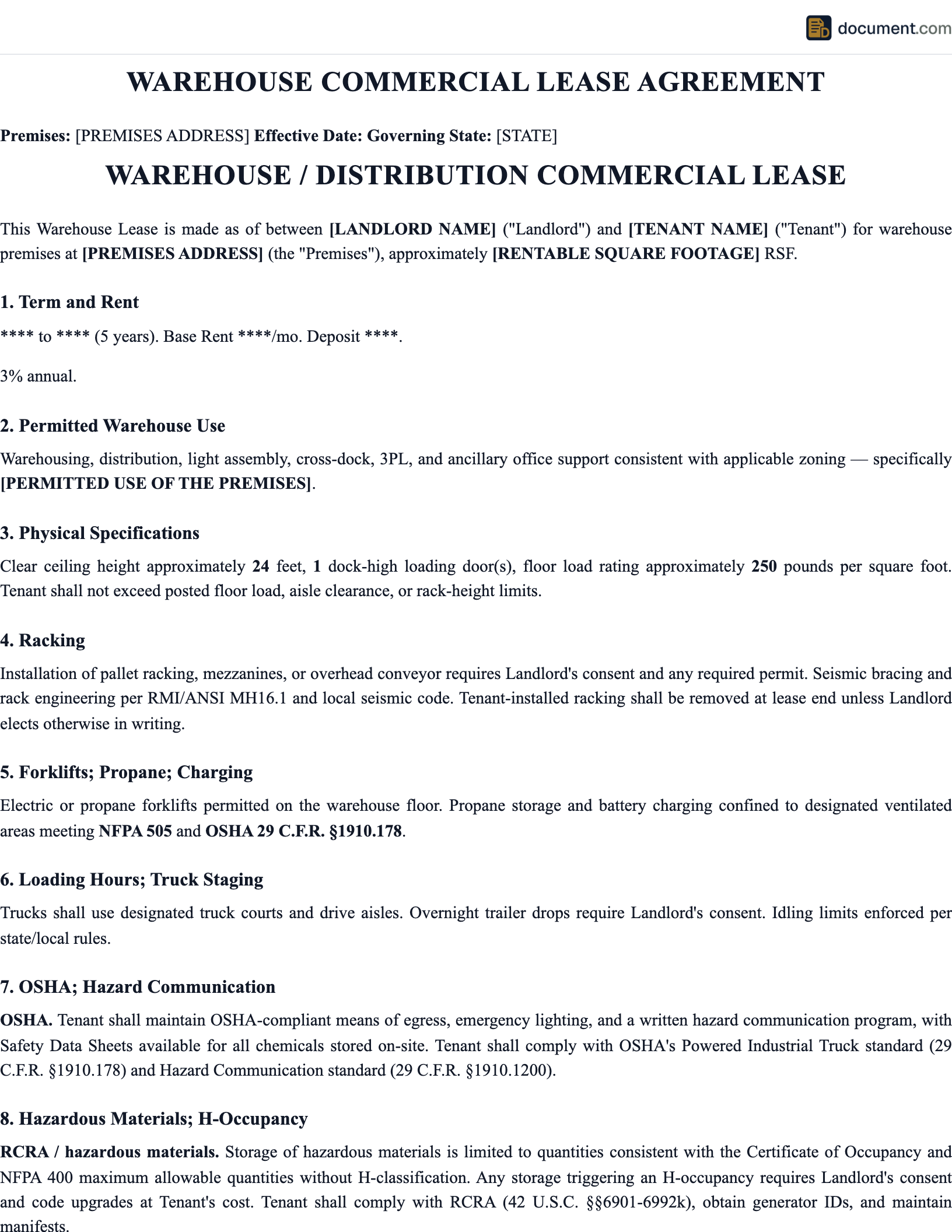



Minnesota Warehouse Lease Overview
Minnesota's industrial real estate market is centered on the Twin Cities, the upper Midwest's most important distribution hub. The I-35 and I-94 intersection in the metro, combined with Minneapolis-Saint Paul International Airport and BNSF intermodal operations, makes Minnesota the logistics gateway for the Dakotas, Montana, and northern Wisconsin. The state's food processing industry, anchored by General Mills, Cargill, and Land O'Lakes, creates specialized warehouse demand.
Minnesota warehouse leasing is shaped by severe winter weather that creates significant operational and cost considerations, a complex property tax system with above-average commercial rates, and a strong labor market anchored by Target, Best Buy, and a large healthcare sector. Minnesota's progressive regulatory environment adds compliance complexity relative to less-regulated Midwestern states.
$46
Recording fee
$1.65 per $500
Transfer tax
Required
Notarization
0
Witnesses required
Minnesota Requirements
Minnesota warehouse leases are governed by general commercial contract law. The state's severe winters require specific snow removal, heating, and cold-weather operational provisions. Food industry operations require attention to Minnesota Department of Agriculture regulatory requirements.
Minnesota Specific Note
Minnesota winters are among the most severe in the continental US. January average temperatures below zero Fahrenheit combined with significant snowfall create real operational risk for warehouse operations. Snow removal from dock areas is not a convenience measure in Minnesota—it is an operational necessity. Specify detailed snow removal obligations in the lease, including response time after snowfall events, for any Minnesota warehouse.
Document Requirements
- Written Agreement: Minnesota requires leases for more than one year to be in writing under the Statute of Frauds.
- Snow Removal: Specify detailed snow removal responsibilities for truck courts, dock approaches, and parking areas. Minnesota snowfall is significant and frequent.
- Heating Requirements: Specify minimum heating requirements for dock areas and building systems to prevent pipe freezing during Minnesota winters.
- Property Tax Pass-Through: Define how property taxes are calculated and passed through. Minnesota's commercial classification rate creates above-average tax burdens.
- Food Industry Compliance: For food storage or processing, identify FDA, USDA, and Minnesota Department of Agriculture requirements.
- Energy Cost Allocation: Document utility allocation given Minnesota's significant heating costs.
How to File in Minnesota
Minnesota warehouse lease execution requires severe winter weather provisions, food industry regulatory compliance where applicable, and property tax analysis reflecting Minnesota's commercial classification rate.
Negotiate Comprehensive Winter Provisions
Specify snow removal response times, dock area heating minimums, and minimum building temperature requirements. Minnesota winters make these provisions operationally critical.
Identify Food Industry Regulatory Requirements
For food storage or processing operations, identify FDA, USDA, and Minnesota Department of Agriculture permit and compliance requirements.
Model Property Tax CAM
Minnesota commercial property tax rates are above average. Request prior year tax bills and model projected CAM contributions.
Evaluate Twin Cities Submarket
The I-494 west metro, I-35W south metro, and Saint Paul east metro each have distinct characteristics. Select a location consistent with your distribution geography and freight patterns.
Execute Lease and Establish Utilities
Sign the finalized lease and establish Xcel Energy service. Model heating costs as a significant Minnesota operating expense.
Minnesota Fees & Costs
Typical costs for filing in Minnesota. Actual fees may vary by county.
| Fee / Tax | Amount |
|---|---|
| Recording Fee | $46 |
| Transfer Tax | $1.65 per $500 |
| Notarization | $5 - $25 per signature |
| Certified Copy | $1 - $10 per page |
| Attorney Review (optional) | $150 - $500 |
Minnesota Tax Implications
Minnesota imposes a corporate income tax and personal income tax with rates among the higher ones in the Midwest. Minnesota's corporate tax has a top rate above 9%. Lease payments are deductible business expenses.
Minnesota's commercial and industrial property tax rates are above average nationally due to the commercial classification rate structure. These costs pass through in triple-net leases and are a significant CAM component in Minnesota.
Minnesota's 6.875% state sales and use tax plus local add-ons applies to equipment and goods purchases. Minnesota offers manufacturing exemptions for qualifying production equipment. Confirm applicable exemptions for significant capital purchases.
Sample Minnesota Warehouse Lease
Preview of our Minnesota-specific template. Your document will include all fields required for recording in any Minnesota county.
WAREHOUSE LEASE AGREEMENT
STATE OF MINNESOTA
Legal Document
PARTY INFORMATION
Name: [Full Legal Name]
Address: [Minnesota Address]
County: [County]
PROPERTY DESCRIPTION
County: [County] State: Minnesota
Legal Description: [Per Recorded Plat]
Parcel No.: [APN]
Minnesota Warehouse Lease FAQ
Common questions about filing in Minnesota, including requirements, fees, and tax implications.
Official Minnesota Resources
Official state resources for verifying requirements and finding your local recording office.
Important Considerations for Minnesota Warehouse Tenants
Minnesota's winters create consistent operational challenges for warehouse operations. Multi-day snowstorms, below-zero temperatures, and icy road conditions affect delivery schedules regularly. Budget for winter weather disruption as part of Minnesota operational planning.
Minnesota's corporate income tax rates are among the higher ones in the Midwest, making total operating costs higher than neighboring South Dakota and Wisconsin for comparable operations.
Minnesota's progressive regulatory environment includes strong environmental regulations and employee protection requirements that create compliance costs above some competing Midwestern states.
Minnesota Warehouse Tip
Minnesota's severe winters reward investment in quality dock door seals, heated truck courts, and snow-clearing equipment arrangements made well before the winter season begins. Warehouse operators who try to manage Minnesota winter conditions reactively, addressing problems as they arise rather than preparing comprehensively before the first snow, face predictable and avoidable operational disruptions. The cost of adequate winter preparation is modest compared to the cost of a single day's production delay caused by inaccessible dock areas after a blizzard.
Related Documents
Depending on your situation, you may need additional documents alongside this one. Below are commonly related documents that are frequently used together in real estate transactions.
Create your Minnesota Commercial Warehouse Lease Agreement in under 5 minutes.
Answer a few questions and download a Minnesota-compliant document, ready for the state agency.