
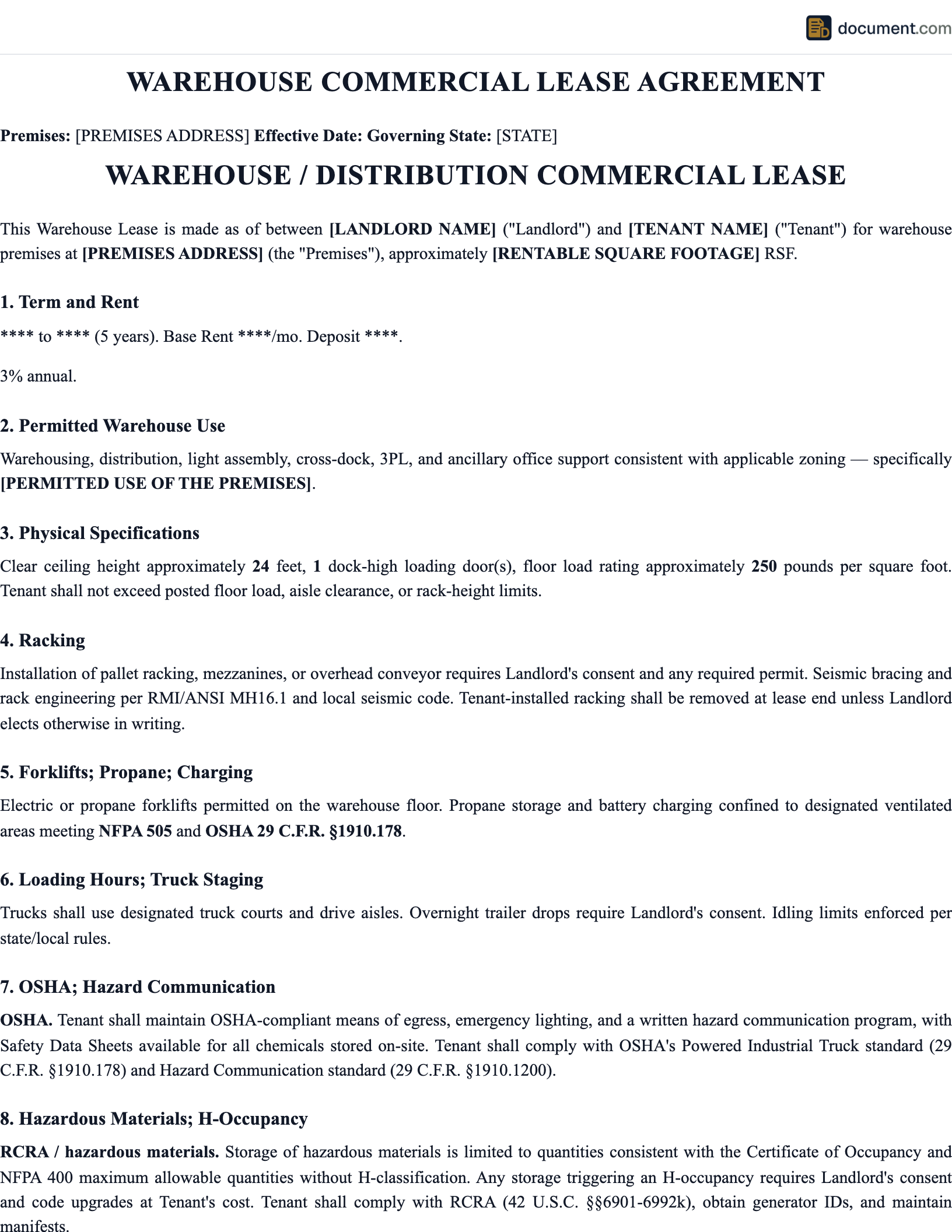



Massachusetts Warehouse Lease Overview
Massachusetts industrial real estate is concentrated along the Route 128 and I-495 corridors west of Boston, one of the world's most significant life sciences and technology industry clusters. Boston's dense consumer base drives strong last-mile delivery demand, the Port of Boston creates containerized import logistics demand, and the pharmaceutical and biotech industry along Route 128 creates specialized temperature-controlled and GMP-compliant warehouse requirements.
Massachusetts warehouse leasing is shaped by above-average property taxes that create high CAM charges, among the nation's highest electricity rates, limited available industrial land creating scarcity-driven pricing, and a regulatory environment that is more complex than most other states. These cost factors make Massachusetts one of the more expensive industrial real estate markets in the country, but the state's dense consumer population and life sciences industry concentration create compelling reasons for specific tenants to operate here.
$75
Recording fee
$2.28 per $500
Transfer tax
Required
Notarization
0
Witnesses required
Massachusetts Requirements
Massachusetts warehouse leases are governed by general commercial contract law. The state's high property taxes, above-average electricity costs, and complex regulatory environment require more careful due diligence than most other states.
Massachusetts Specific Note
Massachusetts property taxes on commercial real estate are among the highest in the country, and these costs pass directly through to tenants in triple-net warehouse leases as the dominant CAM line item. Combined with Massachusetts electricity rates, which are also among the country's highest, total occupancy costs in Massachusetts warehouse space are substantially above national averages. Always model full all-in occupancy costs rather than comparing lease rates alone.
Document Requirements
- Written Agreement: Massachusetts requires leases for more than one year to be in writing under the Statute of Frauds.
- Signatures: Both landlord and tenant must sign. Massachusetts does not require witnesses or notarization for commercial leases.
- Property Description: Describe leased premises with precision including square footage, dock count, clear height, floor load rating, and truck court depth.
- Property Tax Pass-Through: Define precisely how commercial property taxes are calculated and passed through. Request prior year tax bills. Massachusetts commercial rates are significantly above residential rates.
- Energy Cost Allocation: Document electricity allocation. Massachusetts electricity rates are among the country's highest and deserve explicit attention.
- Snow Removal: Specify snow removal responsibilities for dock areas, truck courts, and parking areas given Massachusetts winter conditions.
How to File in Massachusetts
Massachusetts warehouse lease execution requires careful property tax analysis, energy cost modeling, snow removal provision negotiation, and realistic total occupancy cost comparison against New Hampshire or Rhode Island alternatives.
Model Property Tax CAM Carefully
Obtain prior year property tax bills and current assessed values. Massachusetts commercial property tax rates are among the highest in the country and are the dominant CAM variable.
Model Energy Costs Explicitly
Obtain current Eversource or National Grid commercial rate schedules and model projected electricity costs. Massachusetts electricity rates are among the country's highest.
Address Snow Removal Provisions
Negotiate comprehensive snow removal responsibilities for dock areas, truck courts, and parking. Massachusetts winters are significant and snow removal costs are material.
Compare with New Hampshire Alternatives
If operations can function from southern New Hampshire, model the total occupancy cost difference. New Hampshire's lack of income and sales taxes plus lower property taxes create a meaningful cost advantage.
Execute Lease and Establish Utilities
Sign the finalized lease and establish Eversource or National Grid service. Budget for Massachusetts electricity costs as a major ongoing operating expense.
Massachusetts Fees & Costs
Typical costs for filing in Massachusetts. Actual fees may vary by county.
| Fee / Tax | Amount |
|---|---|
| Recording Fee | $75 |
| Transfer Tax | $2.28 per $500 |
| Notarization | $5 - $25 per signature |
| Certified Copy | $1 - $10 per page |
| Attorney Review (optional) | $150 - $500 |
Massachusetts Tax Implications
Massachusetts imposes a flat corporate income tax at 8% (subject to recent changes under the Fair Share Amendment which added a 4% surtax for income over $1M, potentially increasing effective rates). Massachusetts also has a flat personal income tax at 5%. Lease payments are deductible business expenses.
Massachusetts commercial property taxes are among the highest in the country. The state's dual-rate system allows municipalities to tax commercial property at higher rates than residential property. Combined with high assessed values, commercial property tax burdens in Boston-area industrial facilities are substantially above national averages.
Massachusetts's 6.25% sales and use tax applies to equipment and goods purchases. Massachusetts offers manufacturing exemptions for qualifying production equipment. Life sciences and pharmaceutical equipment may qualify for specific exemptions. Engage a Massachusetts CPA to identify applicable exemptions.
Sample Massachusetts Warehouse Lease
Preview of our Massachusetts-specific template. Your document will include all fields required for recording in any Massachusetts county.
WAREHOUSE LEASE AGREEMENT
STATE OF MASSACHUSETTS
Legal Document
PARTY INFORMATION
Name: [Full Legal Name]
Address: [Massachusetts Address]
County: [County]
PROPERTY DESCRIPTION
County: [County] State: Massachusetts
Legal Description: [Per Recorded Plat]
Parcel No.: [APN]
Massachusetts Warehouse Lease FAQ
Common questions about filing in Massachusetts, including requirements, fees, and tax implications.
Official Massachusetts Resources
Official state resources for verifying requirements and finding your local recording office.
Important Considerations for Massachusetts Warehouse Tenants
Massachusetts industrial occupancy costs are among the highest in New England. High property taxes, above-average electricity rates, high construction costs, and scarce industrial land all contribute to total occupancy costs that are substantially higher than regional and national alternatives. Only tenants with compelling reasons to be specifically in the Massachusetts market can justify these premiums.
Massachusetts Route 128 and I-93 traffic congestion is severe and among the worst in the country by some measures. Delivery operations, driver hours-of-service compliance, and employee commuting are all affected by chronic highway congestion that has limited improvement despite decades of infrastructure investment.
Massachusetts's regulatory environment is complex and compliance costs are above the national average for industrial operations. Environmental compliance, permitting, and the state's rigorous wetlands protection laws create pre-occupancy regulatory timelines that can extend project schedules significantly.
Massachusetts Warehouse Tip
Massachusetts industrial tenants whose distribution geography is primarily the New England region should model New Hampshire and southern Connecticut as potential alternatives for large-format warehouse needs. Southern New Hampshire offers meaningful total occupancy cost savings versus Massachusetts, proximity to the same Boston market via I-93 and I-95, and no state income or sales tax. For the right operation, the cost savings from a New Hampshire location justify the modest geographic separation from downtown Boston.
Related Documents
Depending on your situation, you may need additional documents alongside this one. Below are commonly related documents that are frequently used together in real estate transactions.
Create your Massachusetts Commercial Warehouse Lease Agreement in under 5 minutes.
Answer a few questions and download a Massachusetts-compliant document, ready for the state agency.