
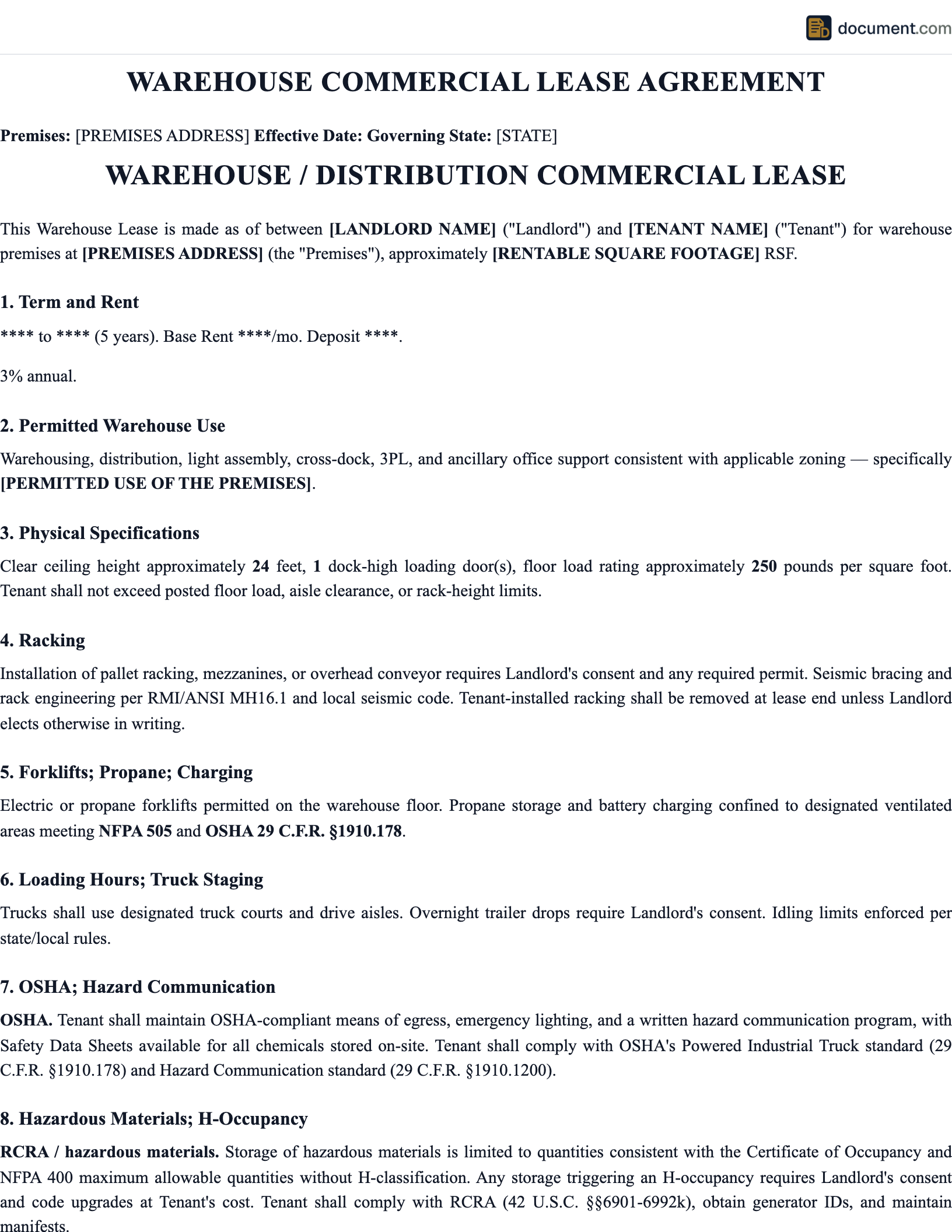



Maine Warehouse Lease Overview
Maine's industrial real estate market is small relative to other New England states but serves a distinctive economy built around seafood and fishing, forest products, tourism industry supply chain, and the dispersed service needs of one of the most rural large states in the country. Portland serves as the state's primary commercial and logistics hub, with the International Marine Terminal providing deep-water port access.
Maine warehouse leasing is governed by general commercial contract law without specialized state industrial leasing statutes. The state's harsh winters create operational requirements specific to Maine that softer-climate markets do not require. Energy costs are above average for New England. The seafood and forest products industries create specialized warehouse facility requirements distinct from general merchandise distribution.
$13
Recording fee
$2.20 per $500
Transfer tax
Required
Notarization
0
Witnesses required
Maine Requirements
Maine warehouse leases are governed by general commercial contract law. The state's harsh winters require specific provisions for snow removal, heating, and dock area maintenance. Seafood operations require attention to FDA and HACCP compliance requirements.
Maine Specific Note
Maine's winter heating costs are substantial and should be modeled carefully as part of total warehouse occupancy cost. Long heating seasons, extreme cold, and above-average electricity rates combine to make energy costs in Maine significantly higher than national averages. For any Maine warehouse with conditioned areas, refrigeration, or heating requirements, model energy costs explicitly using CMP or Versant Power rates before committing.
Document Requirements
- Written Agreement: Maine requires leases for more than one year to be in writing under the Statute of Frauds.
- Snow Removal: Specify detailed snow removal responsibilities for truck courts, dock approaches, and parking areas. Maine's snowfall is substantial.
- Heating Requirements: Specify minimum heating requirements for dock areas and pipe protection. Maine winters can cause significant pipe damage in unheated spaces.
- Seafood Facility Compliance: For seafood processing or cold storage, address FDA registration, HACCP plan requirements, and Maine DMR permit obligations.
- Property Description: Describe leased premises including dock count, clear height, floor load rating, and refrigeration capacity if applicable.
- Energy Cost Allocation: Document electricity and heating fuel allocation clearly given Maine's above-average energy costs.
How to File in Maine
Maine warehouse lease execution requires harsh winter provisions, seafood industry regulatory compliance for relevant operations, and energy cost modeling reflecting Maine's above-average rates.
Model Energy Costs Carefully
Maine electricity and heating costs are above national averages. For any conditioned or refrigerated warehouse space, model energy costs using CMP current rates before committing.
Negotiate Comprehensive Snow Removal Provisions
Specify who is responsible for snow removal from dock areas, truck courts, and parking areas, with a defined response time after snowfall events. Maine snowfall is frequent and heavy.
Assess Seafood Regulatory Requirements
For seafood storage or processing operations, identify FDA registration requirements, HACCP plan obligations, and Maine DMR permit requirements before signing.
Review Property Tax History
Request the prior year's property tax bill and the current assessed value. Maine property taxes vary significantly by municipality.
Execute Lease and Establish Utilities
Sign the finalized lease and establish CMP or Versant Power service. Budget for Maine's above-average energy costs as a significant ongoing expense.
Maine Fees & Costs
Typical costs for filing in Maine. Actual fees may vary by county.
| Fee / Tax | Amount |
|---|---|
| Recording Fee | $13 |
| Transfer Tax | $2.20 per $500 |
| Notarization | $5 - $25 per signature |
| Certified Copy | $1 - $10 per page |
| Attorney Review (optional) | $150 - $500 |
Maine Tax Implications
Maine imposes a corporate income tax and personal income tax. Maine's tax rates are moderate for New England but above national averages. Lease payments are deductible business expenses.
Maine property taxes are assessed at the municipal level and vary considerably. Portland's rates are moderate relative to the state average. Smaller Maine municipalities can have higher effective rates. Property taxes pass through in triple-net leases.
Maine's 5.5% sales and use tax applies to equipment and goods purchases. Maine offers a manufacturing exemption for qualifying production equipment. Seafood processing equipment may qualify for specific exemptions.
Sample Maine Warehouse Lease
Preview of our Maine-specific template. Your document will include all fields required for recording in any Maine county.
WAREHOUSE LEASE AGREEMENT
STATE OF MAINE
Legal Document
PARTY INFORMATION
Name: [Full Legal Name]
Address: [Maine Address]
County: [County]
PROPERTY DESCRIPTION
County: [County] State: Maine
Legal Description: [Per Recorded Plat]
Parcel No.: [APN]
Maine Warehouse Lease FAQ
Common questions about filing in Maine, including requirements, fees, and tax implications.
Official Maine Resources
Official state resources for verifying requirements and finding your local recording office.
Important Considerations for Maine Warehouse Tenants
Maine's geographic isolation creates real freight cost and transit time disadvantages for businesses serving national markets from a Maine warehouse. The state's northeastern corner position adds distance and cost to deliveries to any market outside New England.
Maine's harsh winters create genuine operational disruptions. Multi-day snowstorms, ice accumulations, and road closures affect delivery operations. Maine warehouse operators experience more weather-related operational disruptions per year than facilities in any state south of Massachusetts.
Maine's industrial real estate inventory is small and concentrated in the Portland and Bangor areas. Tenants with specific building specifications for clear height, dock count, or refrigeration capacity may find very limited options and may need to commission new construction.
Maine Warehouse Tip
Maine's seafood industry is the state's most distinctive industrial sector and creates specialized warehouse demand that general distribution operators cannot serve. If your business is in seafood cold chain logistics, Maine offers access to the most productive lobster and groundfish fisheries in the country and a growing aquaculture industry. The specialized cold chain infrastructure near Portland and Down East Maine is worth evaluating for seafood-specific warehouse requirements, even given Maine's high energy costs.
Related Documents
Depending on your situation, you may need additional documents alongside this one. Below are commonly related documents that are frequently used together in real estate transactions.
Create your Maine Commercial Warehouse Lease Agreement in under 5 minutes.
Answer a few questions and download a Maine-compliant document, ready for the state agency.