
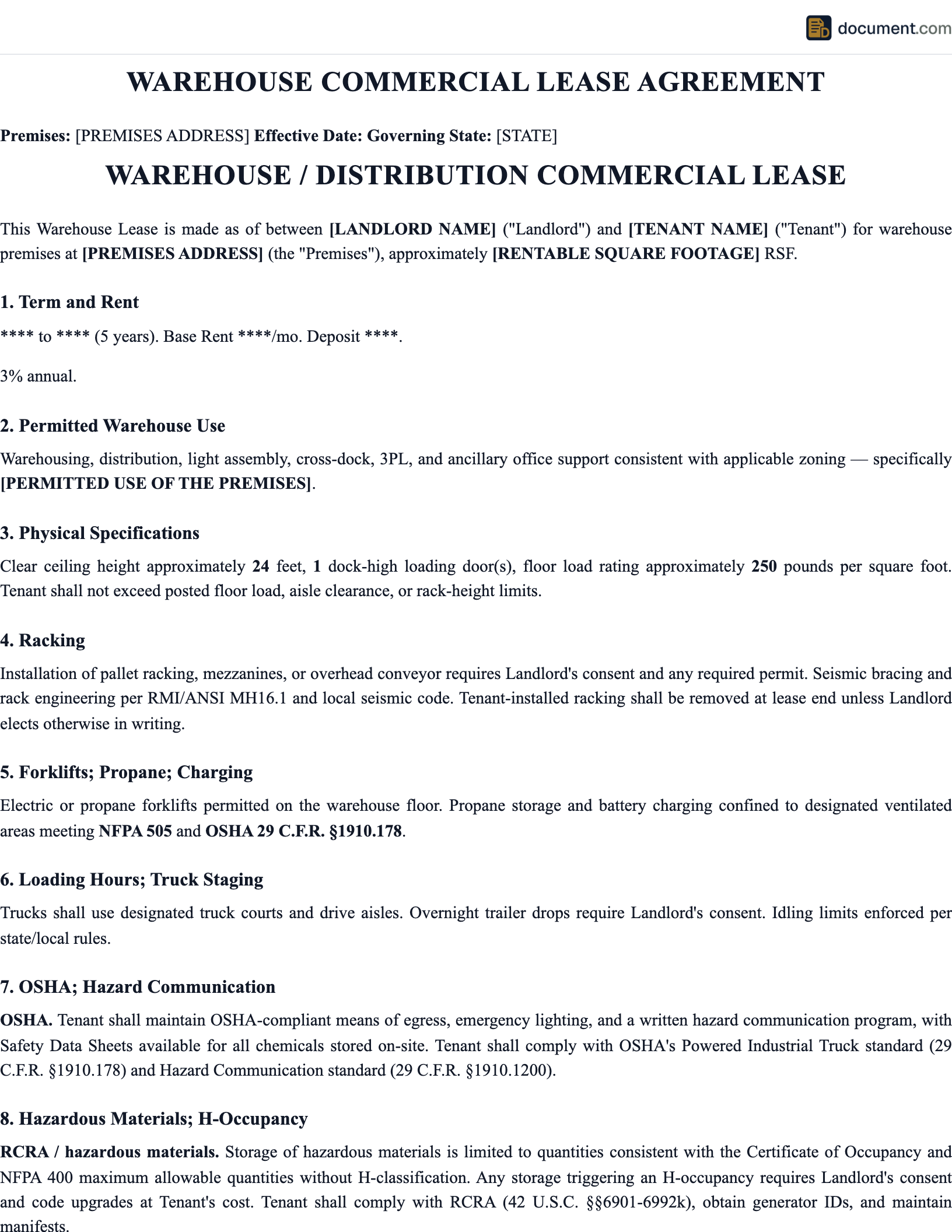



Louisiana Warehouse Lease Overview
Louisiana's industrial real estate market is shaped by its position at the mouth of the Mississippi River, one of the world's most important commercial waterways, and by the massive petrochemical industrial complex along the Mississippi River corridor between Baton Rouge and New Orleans. The Port of New Orleans and the Port of Greater Baton Rouge collectively handle enormous volumes of cargo, and the petrochemical industry creates industrial real estate demand unlike any other state.
Louisiana warehouse leasing requires attention to several factors specific to the state: flood risk that affects FEMA zone designation and insurance requirements, hurricane provisions similar to Florida's coastal market, the Industrial Tax Exemption Program that can provide substantial property tax relief, and the complex regulatory environment of Louisiana's civil law-influenced legal system, which differs from the common law framework used by all other US states.
$50
Recording fee
None
Transfer tax
Required
Notarization
2
Witnesses required
Louisiana Requirements
Louisiana warehouse leases must address flood risk provisions, hurricane casualty provisions similar to Florida, Industrial Tax Exemption Program eligibility, and compliance with Louisiana's civil law-influenced commercial contract framework.
Louisiana Specific Note
Louisiana's flood risk is a material consideration for any warehouse tenant. Flood zone designation, building elevation relative to base flood elevation, flood insurance requirements, and lease provisions for flood damage and rent abatement should all be addressed before signing any Louisiana industrial lease. The cost of inadequate flood coverage for stored goods in a Louisiana warehouse can be catastrophic.
Document Requirements
- Written Agreement: Louisiana requires leases for more than one year to be in writing under the Louisiana Civil Code.
- Flood Provisions: Address FEMA flood zone designation, required flood insurance, damage repair timelines, and rent abatement for flood events.
- Hurricane Provisions: Address storm preparation obligations, casualty damage repair timelines, rent abatement, and termination rights for hurricane damage.
- ITEP Eligibility: Assess whether operations qualify for Louisiana's Industrial Tax Exemption Program and structure the lease accordingly.
- Environmental Compliance: For petrochemical or chemical storage, confirm Louisiana DEQ regulatory requirements.
- Parish Zoning: Confirm that the specific use is permitted under applicable parish zoning regulations.
How to File in Louisiana
Louisiana warehouse lease execution requires flood zone assessment, hurricane provisions, ITEP eligibility analysis, and parish-specific zoning confirmation.
Assess Flood Zone and Elevation
Obtain FEMA flood zone maps for the specific property and confirm the building's elevation certificate. Consider flood risk as a material factor in Louisiana site selection.
Negotiate Hurricane and Flood Provisions
Address storm preparation obligations, damage repair timelines with specific landlord deadlines, rent abatement periods, and termination rights for extended closures.
Assess ITEP Eligibility
Engage a Louisiana economic development attorney to determine whether planned operations qualify for Industrial Tax Exemption Program benefits. ITEP can provide significant property tax savings.
Confirm Parish Zoning
Verify that the intended use, including outdoor storage, trailer parking, and commodity type, is permitted under the applicable parish zoning ordinance.
Execute Lease and Establish Utilities
Sign the finalized lease and establish Entergy Louisiana or Cleco service. Budget for Louisiana's hot climate cooling costs.
Louisiana Fees & Costs
Typical costs for filing in Louisiana. Actual fees may vary by county.
| Fee / Tax | Amount |
|---|---|
| Recording Fee | $50 |
| Transfer Tax | None |
| Notarization | $5 - $25 per signature |
| Certified Copy | $1 - $10 per page |
| Attorney Review (optional) | $150 - $500 |
Louisiana Tax Implications
Louisiana imposes a corporate income tax and personal income tax. Louisiana's corporate tax rates are below national averages. The state's Industrial Tax Exemption Program can provide property tax relief for qualifying manufacturing and industrial operations. Lease payments are deductible business expenses.
Louisiana's ITEP program is one of the most generous industrial tax incentive programs in the country, offering up to 80% property tax exemption for qualifying operations for up to 10 years. This benefit can dramatically reduce the effective property tax burden in triple-net leases for qualifying tenants.
Louisiana's 4.45% state sales and use tax plus parish-level sales taxes, which can add another 4-5%, creates one of the highest combined sales tax rates in the country for goods and equipment purchases. Louisiana offers manufacturing exemptions for qualifying production equipment. Engage a Louisiana CPA to identify applicable exemptions.
Sample Louisiana Warehouse Lease
Preview of our Louisiana-specific template. Your document will include all fields required for recording in any Louisiana county.
WAREHOUSE LEASE AGREEMENT
STATE OF LOUISIANA
Legal Document
PARTY INFORMATION
Name: [Full Legal Name]
Address: [Louisiana Address]
County: [County]
PROPERTY DESCRIPTION
County: [County] State: Louisiana
Legal Description: [Per Recorded Plat]
Parcel No.: [APN]
Louisiana Warehouse Lease FAQ
Common questions about filing in Louisiana, including requirements, fees, and tax implications.
Official Louisiana Resources
Official state resources for verifying requirements and finding your local recording office.
Important Considerations for Louisiana Warehouse Tenants
Louisiana's flood and hurricane risk creates real operational and financial risk for warehouse tenants. Business interruption insurance calibrated to Louisiana's risk profile, adequate flood insurance on stored goods, and well-negotiated casualty provisions are essential risk management tools in Louisiana.
Louisiana's civil law legal system, derived from the Napoleonic Code rather than the English common law framework used by all other US states, creates some distinctly different commercial lease concepts and remedies. Engage a Louisiana attorney familiar with commercial lease law before signing any Louisiana industrial lease.
Louisiana's petrochemical industrial corridor creates environmental legacy concerns in some areas. Sites with prior chemical manufacturing or storage use may have contamination regulated by Louisiana DEQ. Environmental due diligence is essential for any older Louisiana industrial site.
Louisiana Warehouse Tip
Louisiana's Industrial Tax Exemption Program is one of the most valuable and least-understood industrial incentive programs in the country. For warehouse and distribution tenants whose operations qualify as manufacturing or processing under the program's definitions, ITEP can eliminate or greatly reduce property tax pass-throughs in triple-net leases. Always have an ITEP eligibility assessment done before signing a Louisiana industrial lease. The potential savings over a 10-year lease term can be substantial.
Related Documents
Depending on your situation, you may need additional documents alongside this one. Below are commonly related documents that are frequently used together in real estate transactions.
Create your Louisiana Commercial Warehouse Lease Agreement in under 5 minutes.
Answer a few questions and download a Louisiana-compliant document, ready for the state agency.