
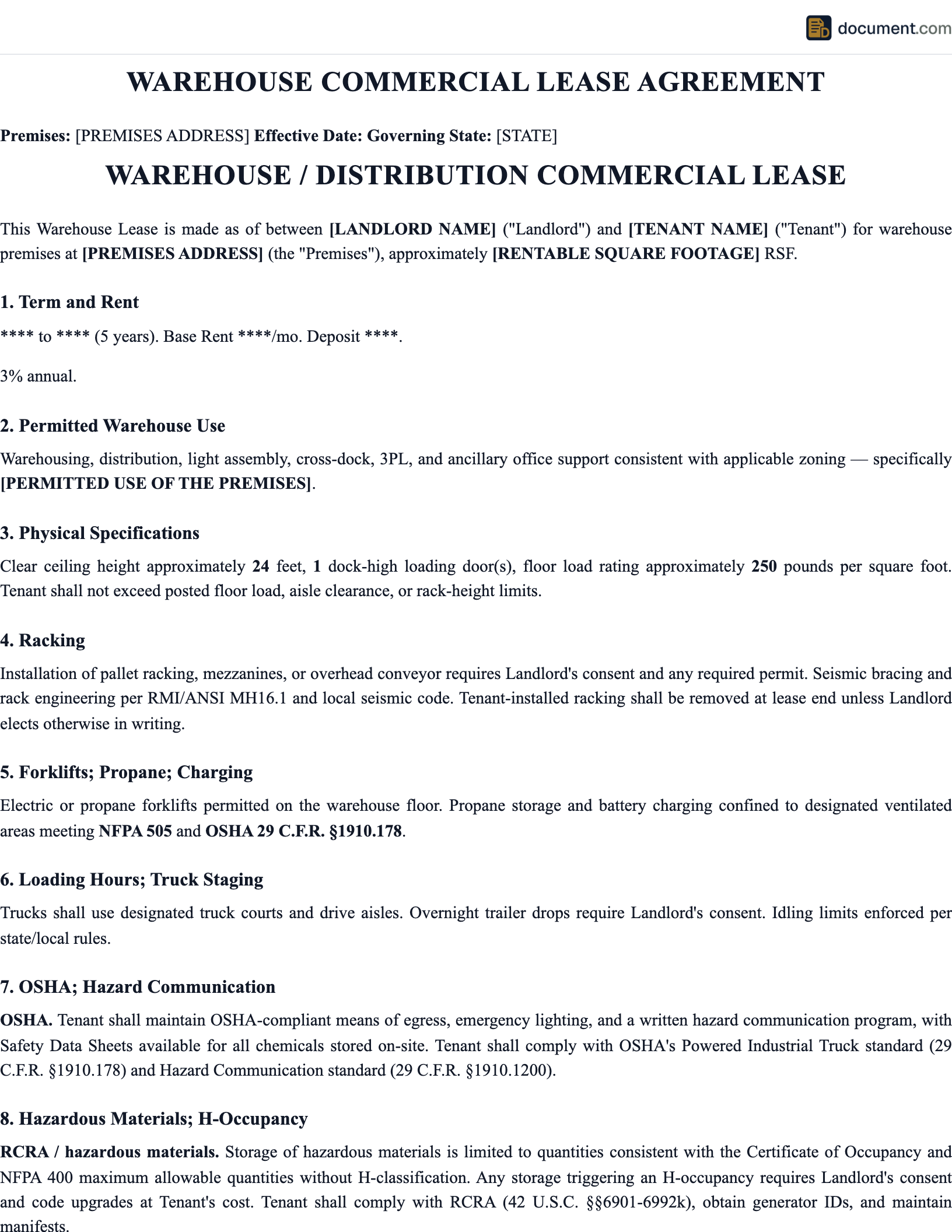



Illinois Warehouse Lease Overview
Illinois's industrial real estate market, centered on the Chicago metropolitan area, is one of the largest and most strategically important in North America. Chicago sits at the convergence of seven Class 1 railroads, the busiest rail freight hub on the continent, with three major interstate highways and a major air cargo airport. This logistics infrastructure concentration makes Illinois the distribution center of the Midwest and a critical node in national supply chains.
Illinois warehouse leasing is shaped by high property taxes that pass through to tenants as the dominant CAM expense, strong labor unions in the logistics sector, complex regulatory requirements relative to many Midwestern states, and a large, diverse industrial inventory ranging from older urban warehouses to modern Class A buildings exceeding one million square feet. Chicago's industrial market is competitive and sophisticated, with experienced landlords and active brokerage markets.
$50
Recording fee
$0.50 per $500
Transfer tax
Required
Notarization
0
Witnesses required
Illinois Requirements
Illinois warehouse leases are governed by general commercial contract law. The state's high property tax burden, complex regulatory environment, and sophisticated industrial market require careful attention to CAM structure, tax reconciliation provisions, and tenant improvement obligations.
Illinois Specific Note
Illinois property taxes, particularly in Cook County, are among the highest in the country and represent the single most important financial variable in any Illinois warehouse triple-net lease. Property tax CAM charges can represent a more significant cost than in most other states. Always request two prior years of property tax bills and the current assessed value before committing to any Illinois triple-net industrial lease. The property tax burden alone can make a nominally cheaper-looking facility more expensive than alternatives with lower tax burdens.
Document Requirements
- Written Agreement: Illinois requires leases for more than one year to be in writing under the Statute of Frauds.
- Signatures: Both landlord and tenant must sign. Illinois does not require witnesses or notarization for a commercial lease to be enforceable between parties.
- Property Description: Describe the leased premises in detail including square footage, dock count and configuration, clear height, floor load rating, truck court depth, and trailer parking allocation.
- Property Tax Pass-Through: This is the most critical provision in any Illinois triple-net lease. Define exactly how property taxes are calculated, billed, and reconciled. Negotiate a cap on annual tax increases if possible.
- Sprinkler System Rating: Confirm NFPA 13 compliance and the specific sprinkler system rating against the intended commodity class and storage configuration.
- Environmental Compliance: Address Illinois EPA requirements for any operations involving regulated substances.
How to File in Illinois
Illinois warehouse lease execution requires careful property tax analysis, fire code compliance verification, and labor market assessment for warehouse staffing in Chicago's union-active environment.
Analyze Property Tax Burden
Obtain the prior two years of property tax bills and the current assessment for the specific parcel. Illinois property taxes, particularly in Cook County, are the most important variable in total occupancy cost. Compare effective tax rates across submarket locations.
Verify Sprinkler System and Fire Code Compliance
Have a fire protection engineer confirm the sprinkler system is rated for your intended commodity class and storage height. Confirm the applicable local fire marshal's requirements.
Assess Labor Market
Evaluate the warehouse labor market in the specific submarket. The Chicago area has strong union activity in distribution and logistics. Model labor costs including any collective bargaining obligations.
Compare Submarket Options
Illinois's major industrial submarkets have different tax burdens, building specifications, and access characteristics. Compare the I-55 corridor, I-80 corridor, and O'Hare submarket systematically against your operational needs.
Execute Lease and Establish Utilities
Sign the finalized lease and establish utility accounts with ComEd or applicable utility. Illinois electricity rates are moderate within the Midwest region.
Illinois Fees & Costs
Typical costs for filing in Illinois. Actual fees may vary by county.
| Fee / Tax | Amount |
|---|---|
| Recording Fee | $50 |
| Transfer Tax | $0.50 per $500 |
| Notarization | $5 - $25 per signature |
| Certified Copy | $1 - $10 per page |
| Attorney Review (optional) | $150 - $500 |
Illinois Tax Implications
Illinois imposes a corporate income tax at 9.5% (including the personal property replacement tax surcharge), one of the higher corporate tax rates among Midwestern states. Illinois also has a flat personal income tax rate of 4.95%. Lease payments are deductible business expenses.
Illinois property taxes are a dominant cost driver in warehouse occupancy. The state's property tax system is entirely locally administered, with significant variation between counties and municipalities. Cook County's commercial property tax rates are among the highest in the country. These costs pass through directly in triple-net leases.
Illinois's 6.25% state sales and use tax, plus applicable local surcharges that can bring the Chicago combined rate to 10.25% or higher, applies to equipment and goods purchases. Illinois has manufacturing exemptions for qualifying production equipment. Confirm applicable rates and exemptions with an Illinois tax professional.
Sample Illinois Warehouse Lease
Preview of our Illinois-specific template. Your document will include all fields required for recording in any Illinois county.
WAREHOUSE LEASE AGREEMENT
STATE OF ILLINOIS
Legal Document
PARTY INFORMATION
Name: [Full Legal Name]
Address: [Illinois Address]
County: [County]
PROPERTY DESCRIPTION
County: [County] State: Illinois
Legal Description: [Per Recorded Plat]
Parcel No.: [APN]
Illinois Warehouse Lease FAQ
Common questions about filing in Illinois, including requirements, fees, and tax implications.
Official Illinois Resources
Official state resources for verifying requirements and finding your local recording office.
Important Considerations for Illinois Warehouse Tenants
Illinois's property tax burden and high corporate income tax rate make it one of the more expensive states for industrial operations in the Midwest. Tenants with flexibility in choosing between Illinois and neighboring Indiana, Ohio, or Wisconsin should model the tax cost differential explicitly before committing.
Chicago's traffic congestion, while less severe than coastal cities, creates real transportation efficiency challenges for warehouse operations. The Dan Ryan, Eisenhower, and I-294 corridors experience significant congestion that affects delivery windows and driver hours-of-service management.
Illinois's political and fiscal environment has created business uncertainty in recent years, with concerns about long-term tax policy trajectory. While the industrial market remains strong due to Chicago's irreplaceable logistics infrastructure, tenants signing long-term leases in Illinois should account for the state's fiscal trajectory in their long-term business planning.
Illinois Warehouse Tip
The difference in property tax burden between a Cook County industrial property and a comparable facility in Will County or DuPage County can be substantial enough to affect the effective total occupancy cost significantly despite nominally similar asking rents. When comparing Illinois industrial options, model the all-in total occupancy cost including estimated property tax pass-through rather than comparing asking rents alone. The tax burden in Cook County is frequently the deciding factor in location selection.
Related Documents
Depending on your situation, you may need additional documents alongside this one. Below are commonly related documents that are frequently used together in real estate transactions.
Create your Illinois Commercial Warehouse Lease Agreement in under 5 minutes.
Answer a few questions and download a Illinois-compliant document, ready for the state agency.