
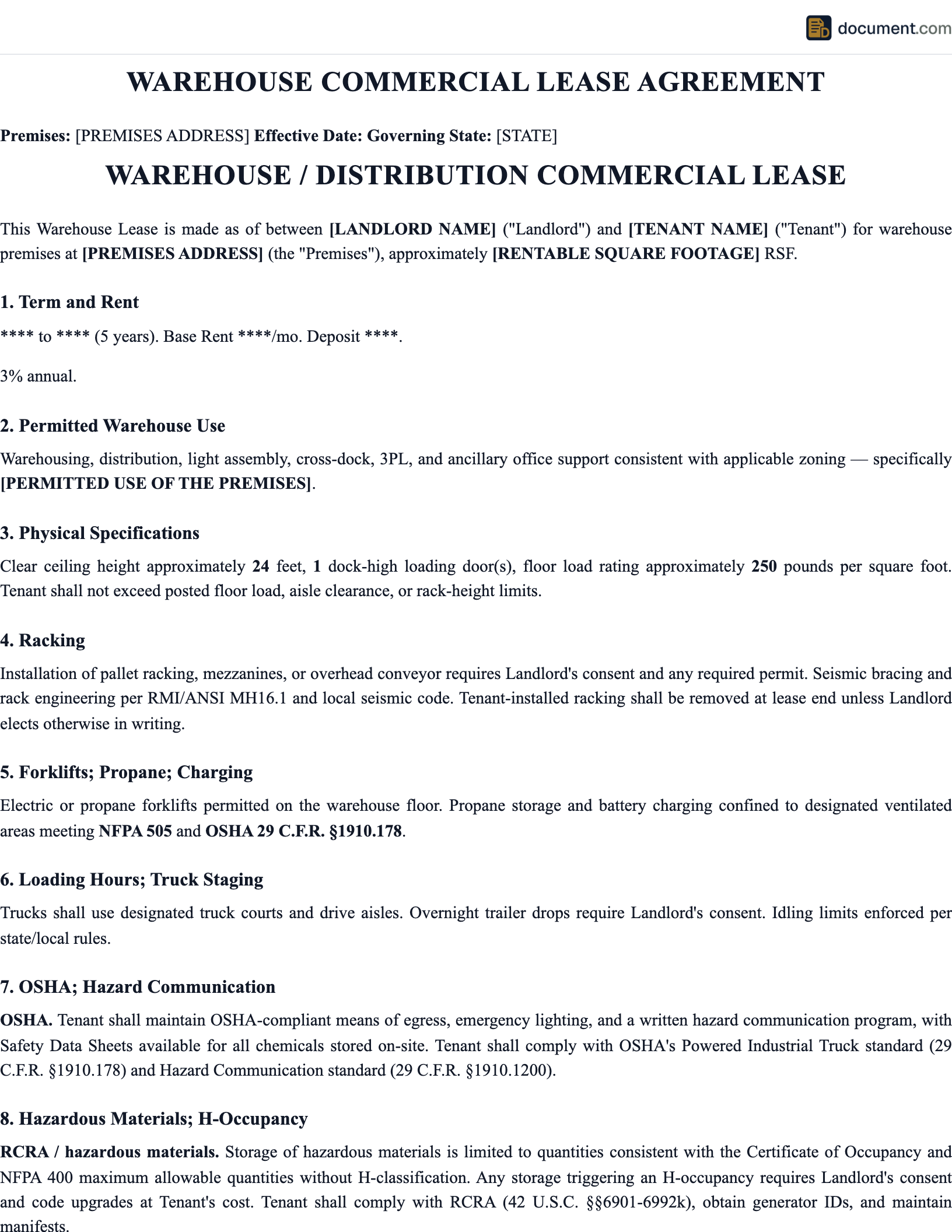



Hawaii Warehouse Lease Overview
Hawaii's industrial real estate market is unique in the United States. The state's island geography creates inherently constrained industrial land supply across all islands, with Oahu holding the dominant share of Hawaii's industrial inventory concentrated near Honolulu Harbor and the Sand Island industrial district. All building materials and tenant improvement components must be shipped to Hawaii, making development costs substantially higher than any mainland market.
Hawaii warehouse leasing is shaped by factors that have no parallel in mainland industrial markets: leasehold versus fee simple land tenure complexity, complete maritime shipping dependency, the nation's highest electricity rates, and labor costs amplified by the Hawaii Prepaid Health Care Act's mandatory employer health insurance requirement. Tenants evaluating Hawaii warehouse space should model all of these cost components carefully and realistically before committing.
$36
Recording fee
$0.10-$1.25 per $100
Transfer tax
Required
Notarization
0
Witnesses required
Hawaii Requirements
Hawaii warehouse leases must address the island-specific cost factors of maritime shipping dependency, leasehold land tenure, high electricity costs, and the Hawaii Prepaid Health Care Act's impact on labor costs.
Hawaii Specific Note
Hawaii's electricity rates are the highest in the nation. Warehouse operations that depend on refrigeration, climate control, conveyor systems, or significant lighting loads will face electricity costs substantially above any mainland alternative. Model electricity costs using actual Hawaiian Electric rates before committing to any Hawaii warehouse space. This is not a minor expense line item in Hawaii.
Document Requirements
- Written Agreement: Hawaii requires leases for more than one year to be in writing under the Statute of Frauds.
- Land Tenure Confirmation: Confirm whether the building sits on fee simple or leasehold land. Leasehold arrangements require additional due diligence regarding lease term, renewal rights, and subletting permissions.
- Electricity Cost Analysis: Document who is responsible for electricity costs and model the projected cost using Hawaiian Electric rates. Electricity is the highest-risk cost variable in Hawaii industrial leases.
- Property Description: Describe leased premises including square footage, dock access, clear height, and any outdoor staging areas.
- Sprinkler Compliance: Confirm the sprinkler system rating against intended commodity class and storage height.
- Permit Obligations: Identify all state and county permits required for the specific operations planned in the space.
How to File in Hawaii
Hawaii warehouse lease execution requires land tenure due diligence, electricity cost modeling, permit identification, and supply chain analysis for maritime shipping dependency.
Confirm Land Tenure
Determine whether the building is on fee simple or leasehold land. If leasehold, review the underlying ground lease terms including remaining term, renewal rights, and restrictions.
Model Electricity Costs
Obtain Hawaiian Electric or county utility rate schedules and model projected electricity costs based on the warehouse's expected operational loads. Hawaii electricity costs can be 3x mainland averages.
Identify Required Permits
Work with a Hawaii attorney and the county permitting office to identify all permits required for the intended operations before lease commencement.
Plan Supply Chain Buffer Stock
Hawaii's maritime shipping dependency requires maintaining higher safety stock levels than mainland operations. Budget for the additional space required to hold buffer inventory.
Execute Lease and Establish Utilities
Sign the finalized lease and establish utility accounts. Budget for Hawaii's electricity rates as a major ongoing operating cost.
Hawaii Fees & Costs
Typical costs for filing in Hawaii. Actual fees may vary by county.
| Fee / Tax | Amount |
|---|---|
| Recording Fee | $36 |
| Transfer Tax | $0.10-$1.25 per $100 |
| Notarization | $5 - $25 per signature |
| Certified Copy | $1 - $10 per page |
| Attorney Review (optional) | $150 - $500 |
Hawaii Tax Implications
Hawaii imposes a General Excise Tax (GET) at a rate of 4% on business gross revenues, which is structurally different from a sales tax and applies broadly to business transactions. The GET applies to warehouse tenants' gross revenues from Hawaii operations. Some GET exemptions apply to certain manufacturing and business activities.
Property taxes in Hawaii are assessed by county. Honolulu's commercial and industrial property tax rates are moderate compared to mainland high-tax states, though high property values in Hawaii partially offset the lower nominal rates.
Hawaii has no state use tax separate from the GET. The GET's broad application to business gross revenues makes Hawaii's effective tax burden on business operations higher than the GET rate alone suggests. Engage a Hawaii CPA to model the full GET impact on your specific business operations in Hawaii.
Sample Hawaii Warehouse Lease
Preview of our Hawaii-specific template. Your document will include all fields required for recording in any Hawaii county.
WAREHOUSE LEASE AGREEMENT
STATE OF HAWAII
Legal Document
PARTY INFORMATION
Name: [Full Legal Name]
Address: [Hawaii Address]
County: [County]
PROPERTY DESCRIPTION
County: [County] State: Hawaii
Legal Description: [Per Recorded Plat]
Parcel No.: [APN]
Hawaii Warehouse Lease FAQ
Common questions about filing in Hawaii, including requirements, fees, and tax implications.
Official Hawaii Resources
Official state resources for verifying requirements and finding your local recording office.
Important Considerations for Hawaii Warehouse Tenants
Hawaii's high cost environment, including the nation's highest electricity rates, mandatory employer health insurance under the Prepaid Health Care Act, high labor costs, and expensive construction for improvements, makes total occupancy cost substantially higher than any mainland alternative. Tenants must have a compelling geographic reason for Hawaii operations to justify the cost premium.
Hawaii's complete maritime shipping dependency creates supply chain risk with no mainland equivalent. Port strikes, vessel delays, weather disruptions, and surge capacity constraints can all affect the reliability of goods arriving in Hawaii on schedule. Model supply chain risk and buffer stock requirements as a business planning matter, not just as a lease consideration.
Hawaii's leasehold land tenure complexity affects long-term planning for industrial tenants. Buildings on leasehold land may have limited lease terms that affect a tenant's ability to make capital investments in improvements with adequate payback periods. Understand the ground lease structure before committing to any Hawaii industrial building.
Hawaii Warehouse Tip
Hawaii warehouse tenants who can tolerate the state's high cost environment often find that the competition for well-located industrial space near Honolulu Harbor is intense. Move quickly when suitable space is identified, because Hawaii's limited industrial inventory means that quality spaces rarely stay vacant long. Having financing and legal counsel ready to move quickly is a competitive advantage in Hawaii's constrained industrial market.
Related Documents
Depending on your situation, you may need additional documents alongside this one. Below are commonly related documents that are frequently used together in real estate transactions.
Create your Hawaii Commercial Warehouse Lease Agreement in under 5 minutes.
Answer a few questions and download a Hawaii-compliant document, ready for the state agency.