



Georgia Warehouse Lease Overview
Georgia's industrial real estate market is anchored by two distinct logistics clusters: the Atlanta metro, which sits at the crossroads of three major interstates and hosts one of the largest freight airports in the Southeast, and the Savannah market, which has grown dramatically around the Port of Georgia's expansion into one of the most active container ports on the East Coast.
Atlanta's industrial submarket is mature and diversified, with options ranging from older single-story buildings along established freight corridors to modern Class A distribution centers exceeding one million square feet. The Savannah market offers newer, purpose-built industrial space closer to port infrastructure. Georgia warehouse leases are governed by general commercial contract principles without specialized industrial leasing statutes.
$25
Recording fee
$1.00 per $1,000
Transfer tax
Required
Notarization
0
Witnesses required
Georgia Requirements
Georgia warehouse leases are governed by general commercial contract law with no specialized state industrial leasing statutes. Both the Atlanta and Savannah markets require attention to CAM structure, sprinkler compliance, and the specific submarket dynamics that affect pricing.
Georgia Specific Note
Georgia's two major industrial corridors serve different logistics functions. The Atlanta metro serves regional Southeast distribution and e-commerce fulfillment for the Southeast's largest consumer market. The Savannah area serves import-heavy port-adjacent operations. Tenants should identify which corridor best serves their supply chain needs before beginning site selection, as the rental rate, building specifications, and lease economics differ significantly between the two markets.
Document Requirements
- Written Agreement: Georgia requires leases for more than one year to be in writing. Commercial warehouse leases always meet this threshold.
- Signatures: Both landlord and tenant must sign. Georgia does not require witnesses or notarization for a commercial lease to be enforceable between parties.
- Property Description: Describe leased premises including square footage, dock doors, clear height, floor load rating, and any exclusive parking or truck court areas.
- CAM Structure: Define what is included in operating expense pass-throughs. Request two prior years of actual CAM reconciliations for any Georgia industrial property.
- Sprinkler Compliance: Confirm the sprinkler system rating against intended commodity class and storage height under NFPA 13 requirements.
- Port Provisions: For Savannah-area leases, address container staging rights, port access routes, and any port authority restrictions on access hours.
How to File in Georgia
Georgia warehouse lease execution requires market selection between Atlanta and Savannah corridors, CAM analysis, and sprinkler compliance confirmation.
Select the Right Submarket
Determine whether Atlanta metro access or Savannah port proximity better serves your supply chain. Each market has distinct building specifications, pricing, and available inventory.
Review CAM Reconciliation History
Request two prior years of CAM reconciliations including property tax bills. Property tax rates vary by county in Georgia and are the most significant CAM variable.
Confirm Sprinkler System Rating
Have a fire protection engineer verify that the existing sprinkler system is rated for your specific commodity class and intended storage height before committing.
Negotiate Tenant Improvement Allowance
Specify in writing all landlord improvement obligations including dock levelers, lighting, and office build-out, with completion deadlines tied to rent commencement.
Execute Lease and Establish Utilities
Sign the finalized lease and establish utility accounts with Georgia Power or applicable municipal utility. Georgia Power's commercial rates are competitive relative to national averages.
Georgia Fees & Costs
Typical costs for filing in Georgia. Actual fees may vary by county.
| Fee / Tax | Amount |
|---|---|
| Recording Fee | $25 |
| Transfer Tax | $1.00 per $1,000 |
| Notarization | $5 - $25 per signature |
| Certified Copy | $1 - $10 per page |
| Attorney Review (optional) | $150 - $500 |
Georgia Tax Implications
Georgia imposes a corporate income tax and a personal income tax, both at rates below many competing industrial states. The state has been on a trajectory to reduce its income tax rates. Lease payments are deductible business expenses under both federal and Georgia tax rules.
Property taxes in Georgia are assessed at the county level and vary significantly across the state. Fulton County rates are higher than many suburban Atlanta counties. Savannah-area industrial property taxes have grown with property values. These costs pass directly through to tenants in triple-net leases.
Georgia's 4% state sales and use tax applies to equipment and goods purchases. Georgia offers a manufacturing exemption for qualifying production equipment that may benefit warehouse tenants who also perform light manufacturing or assembly operations.
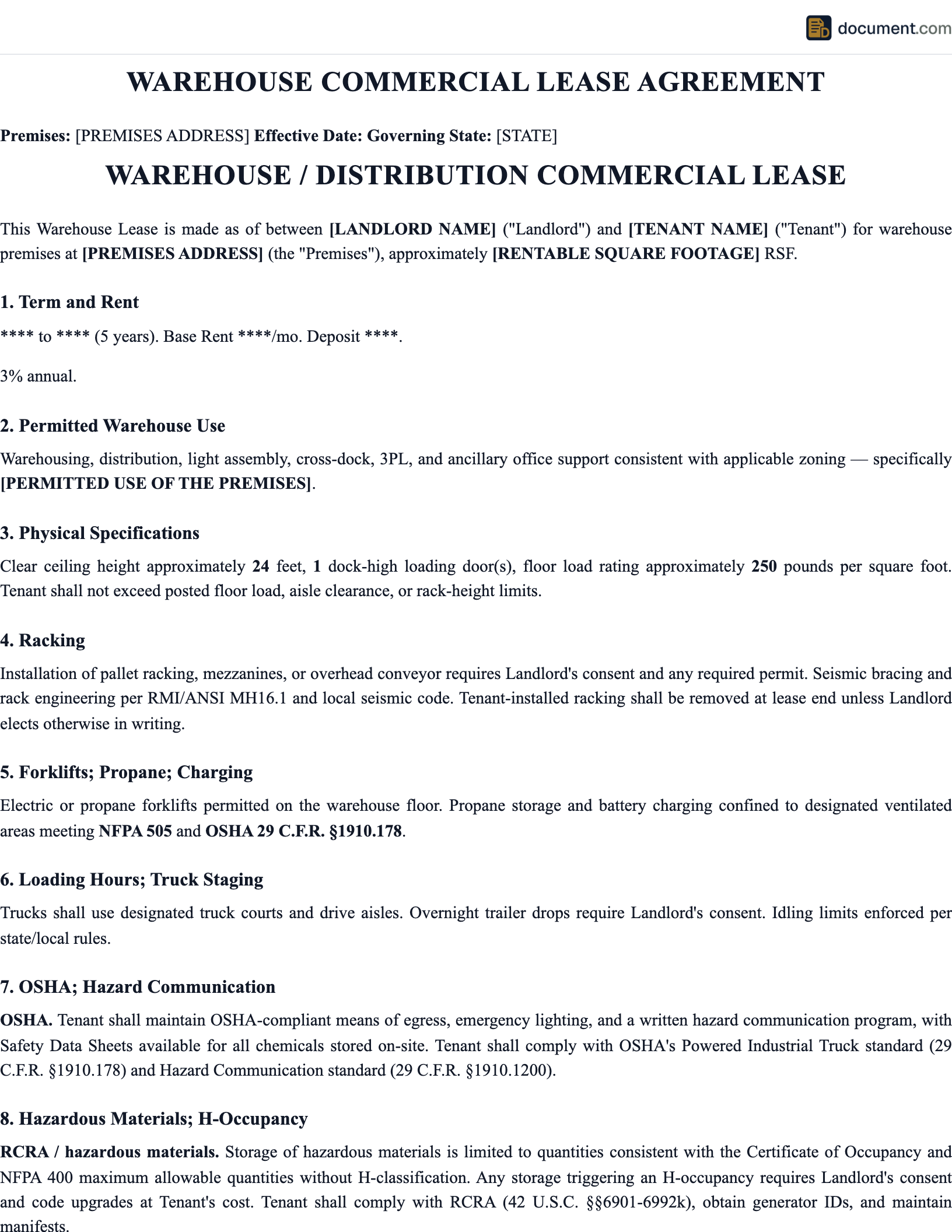
Sample Georgia Warehouse Lease
Preview of our Georgia-specific template. Your document will include all fields required for recording in any Georgia county.
WAREHOUSE LEASE AGREEMENT
STATE OF GEORGIA
Legal Document
PARTY INFORMATION
Name: [Full Legal Name]
Address: [Georgia Address]
County: [County]
PROPERTY DESCRIPTION
County: [County] State: Georgia
Legal Description: [Per Recorded Plat]
Parcel No.: [APN]
Georgia Warehouse Lease FAQ
Common questions about filing in Georgia, including requirements, fees, and tax implications.
Official Georgia Resources
Official state resources for verifying requirements and finding your local recording office.
Important Considerations for Georgia Warehouse Tenants
Atlanta's traffic congestion is among the worst in the Southeast, affecting delivery timing and driver hours-of-service compliance for warehouse operations with time-sensitive windows. Tenants with large truck fleets should evaluate site access during peak commuting hours before committing to an Atlanta industrial location.
Georgia summer heat and humidity affect warehouse operations. Facilities without climate control experience high interior temperatures that can affect employee productivity, commodity conditions, and equipment reliability. Model cooling costs for any conditioned areas as part of total occupancy cost.
The Savannah industrial market's rapid growth has driven significant rent increases and competitive conditions for quality industrial space. Tenants targeting port-adjacent Savannah space may face competitive situations, particularly for large-format modern buildings near the port.
Georgia Warehouse Tip
Georgia's two industrial markets reward different strategies. In Atlanta, patience and local broker relationships can uncover older functional buildings at below-market rents that offer excellent value for operations that do not require modern clear heights. In Savannah, speed matters because demand from port-oriented logistics users is strong. Know which market you are targeting and calibrate your search approach accordingly.
Related Documents
Depending on your situation, you may need additional documents alongside this one. Below are commonly related documents that are frequently used together in real estate transactions.
Create your Georgia Commercial Warehouse Lease Agreement in under 5 minutes.
Answer a few questions and download a Georgia-compliant document, ready for the state agency.