
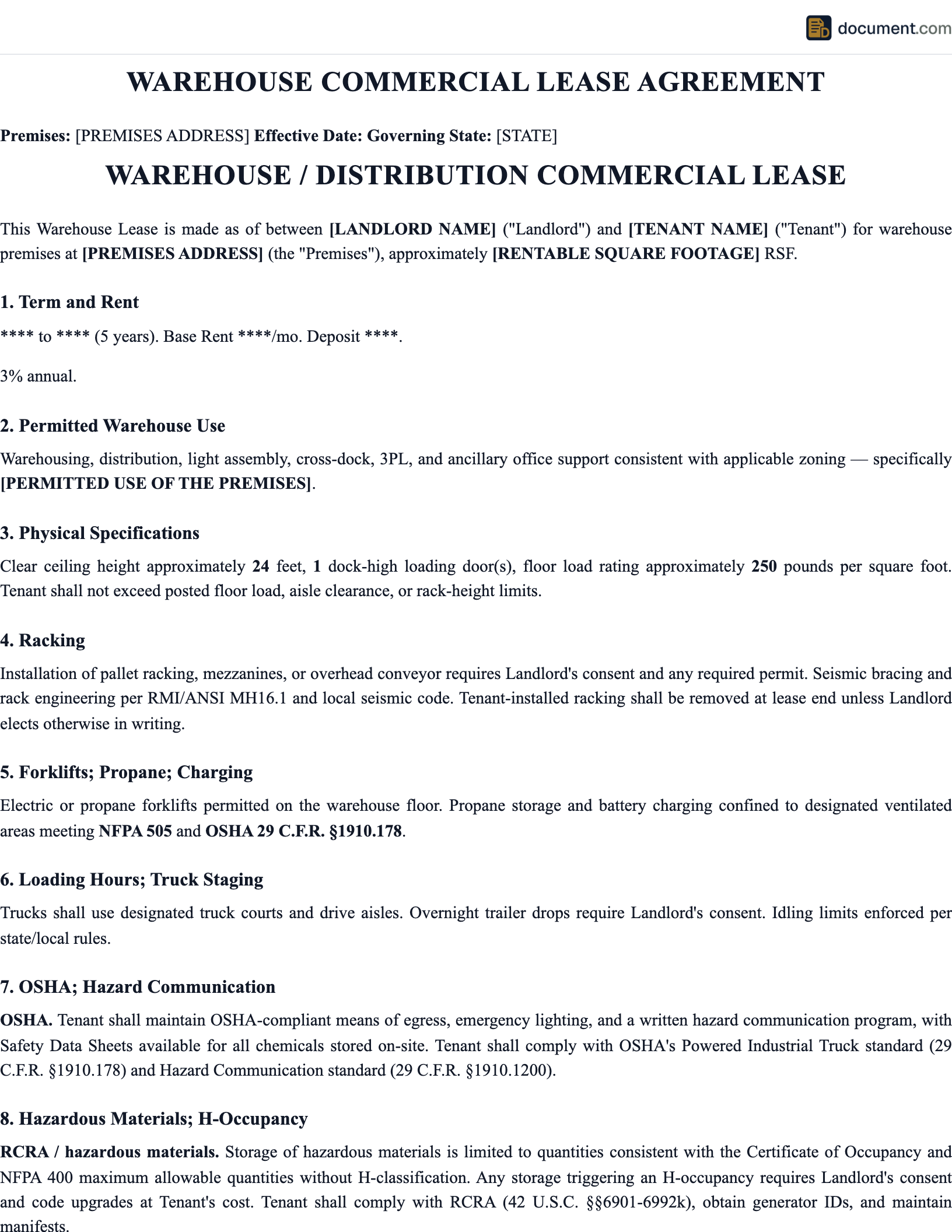



Florida Warehouse Lease Overview
Florida's industrial real estate market is driven by three major port complexes, a rapidly growing population, and the state's no-income-tax environment that attracts businesses relocating from higher-tax states. Miami, Jacksonville, and Tampa each anchor distinct industrial submarkets, with Miami-Dade County serving international trade, Jacksonville serving automotive imports and general cargo, and Tampa serving bulk commodities and regional distribution.
Florida warehouse leasing has a practical dimension that sets it apart from most other states: hurricane risk. Florida warehouse leases must address storm preparedness obligations, casualty damage timelines, and business interruption provisions in ways that inland markets do not require. This is not optional language in Florida commercial leases and landlords experienced in the Florida market expect to negotiate these provisions with every industrial tenant.
$10
Recording fee
$0.70 per $100
Transfer tax
Required
Notarization
2
Witnesses required
Florida Requirements
Florida warehouse leases operate under general Florida commercial contract law but require hurricane-specific provisions, port access considerations if applicable, and attention to Florida's property tax system as a driver of CAM charges.
Florida Specific Note
Hurricane provisions are essential in Florida warehouse leases and should not be treated as boilerplate. The lease should specify which party is responsible for pre-storm preparation including boarding, securing outdoor equipment, and evacuating sensitive inventory. Post-storm casualty damage repair timelines must be clearly defined. Tenants in South Florida, particularly Miami-Dade, Broward, and Palm Beach counties, operate in the most hurricane-exposed real estate in the country.
Document Requirements
- Written Agreement: Florida requires leases for more than one year to be in writing. All commercial warehouse leases meet this threshold.
- Hurricane Provisions: The lease must address pre-storm preparation responsibilities, damage repair timelines, and rent abatement during extended closure periods following a hurricane.
- Property Description: Describe leased premises including square footage, dock doors, clear height, floor load rating, and any exclusive parking or truck court areas.
- Property Tax Pass-Through: Define how property taxes are calculated as a CAM pass-through. Florida's property tax rates vary significantly by county.
- Sprinkler Compliance: Florida Fire Prevention Code requirements for high-piled storage apply. Confirm the sprinkler system rating against intended commodity and storage height.
- Environmental Status: For older industrial sites, request FDEP cleanup status and Phase I environmental assessment information.
How to File in Florida
Florida warehouse lease execution requires specific attention to hurricane preparedness provisions, total occupancy cost modeling including Florida's no-income-tax advantage, and environmental due diligence for older industrial sites.
Negotiate Hurricane Provisions
Address pre-storm preparation obligations, post-storm repair timelines, rent abatement periods during extended closures, and tenant termination rights if the landlord fails to repair within a defined timeframe.
Inspect the Building's Wind Resistance
Confirm the building's wind load rating and Miami-Dade NOA certification for any hurricane-vulnerable components. Ask for the building permit history and any post-hurricane repair records.
Review CAM Expense History
Request two years of prior CAM reconciliations including property tax bills. Florida property taxes are significant in triple-net leases and vary considerably by county.
Execute the Lease
Both parties sign after all modifications are finalized. Ensure hurricane provisions and environmental status are addressed before signing.
Establish Utilities
Set up electricity with FPL, Duke Energy, or Tampa Electric depending on the service territory. Florida cooling costs for any conditioned warehouse areas should be part of total utility cost modeling.
Florida Fees & Costs
Typical costs for filing in Florida. Actual fees may vary by county.
| Fee / Tax | Amount |
|---|---|
| Recording Fee | $10 |
| Transfer Tax | $0.70 per $100 |
| Notarization | $5 - $25 per signature |
| Certified Copy | $1 - $10 per page |
| Attorney Review (optional) | $150 - $500 |
Florida Tax Implications
Florida has no state personal income tax and no state corporate income tax on most income, making it one of the most tax-favorable states for business operations in the country. This advantage is real and significant for businesses that can choose their operational state. Lease payments are deductible business expenses under federal tax rules.
Property taxes are a significant component of CAM charges in Florida triple-net warehouse leases. Florida's property tax rates vary by county with Miami-Dade and Broward counties generally higher than interior counties. The prior year's tax bill is an essential document to obtain before committing to any Florida triple-net industrial lease.
Florida's 6% state sales and use tax, combined with applicable county surcharges typically bringing the rate to 7% or higher in most areas, applies to the purchase of goods and equipment used in warehouse operations. Certain manufacturing exemptions may apply. Confirm applicable rates with a Florida tax professional for significant equipment purchases.
Sample Florida Warehouse Lease
Preview of our Florida-specific template. Your document will include all fields required for recording in any Florida county.
WAREHOUSE LEASE AGREEMENT
STATE OF FLORIDA
Legal Document
PARTY INFORMATION
Name: [Full Legal Name]
Address: [Florida Address]
County: [County]
PROPERTY DESCRIPTION
County: [County] State: Florida
Legal Description: [Per Recorded Plat]
Parcel No.: [APN]
Florida Warehouse Lease FAQ
Common questions about filing in Florida, including requirements, fees, and tax implications.
Official Florida Resources
Official state resources for verifying requirements and finding your local recording office.
Important Considerations for Florida Warehouse Tenants
Hurricane season runs from June through November in Florida, creating annual operational risk for warehouse operations. Tenants should carry adequate business interruption insurance calibrated to Florida hurricane risk, and should have documented business continuity plans that address the possibility of extended facility closure following a major storm.
Florida's real estate market has experienced significant appreciation, driving property tax increases that pass through to tenants in triple-net leases. Tenants who signed long-term Florida leases before recent appreciation cycles are sitting on significant advantages in terms of property tax CAM contributions. New tenants should model the risk of tax increases at the next assessment cycle.
Labor market dynamics in Florida's major industrial markets have tightened. Miami-Dade, Broward, and Palm Beach county warehouse operators compete for workers with the hospitality and retail sectors, which affects warehouse staffing costs. The combination of low state taxes and high labor competition creates a mixed cost environment that tenants should model carefully.
Florida Warehouse Lease Tip
Florida warehouse tenants should insist on a lease provision that defines a specific number of days within which the landlord must complete structural repairs following hurricane damage, coupled with a tenant right to terminate if repairs are not completed within that period. Without this protection, a tenant can be tied to a damaged facility for an extended period while the landlord works through insurance claims. This is the most important Florida-specific negotiating point for any warehouse tenant.
Related Documents
Depending on your situation, you may need additional documents alongside this one. Below are commonly related documents that are frequently used together in real estate transactions.
Create your Florida Commercial Warehouse Lease Agreement in under 5 minutes.
Answer a few questions and download a Florida-compliant document, ready for the state agency.