



Connecticut Warehouse Lease Overview
Connecticut sits at the heart of the Northeast corridor logistics network, positioned between the massive distribution hubs of New York-New Jersey to the south and the Boston market to the north. Hartford and the Route 91 corridor serve as critical pass-through points for freight moving between these two mega-markets, and the state's industrial base supports warehousing for consumer goods, pharmaceutical products, and aerospace components.
Connecticut's industrial real estate market is characterized by older building stock, high property taxes that create substantial CAM charges in triple-net leases, and a relatively limited supply of modern speculative industrial development. Tenants requiring 36-foot clear heights and ESFR sprinkler systems will find fewer options in Connecticut than in Sun Belt markets, but the state's proximity to New York and Boston consumer bases makes Connecticut warehousing strategically attractive for last-mile and regional distribution.
$60
Recording fee
0.75% - 2.25%
Transfer tax
Required
Notarization
2
Witnesses required
Connecticut Requirements
Connecticut warehouse leases follow general commercial contract law. The state's high property tax burden and older industrial building stock create practical requirements specific to Connecticut that must be addressed in any warehouse lease.
Connecticut Specific Note
Connecticut's property taxes are among the highest in the nation, and these costs pass directly through to tenants in triple-net warehouse leases. Industrial property in Hartford County and New Haven County can carry effective tax rates significantly above the national average. Request the prior two years of property tax bills and the current assessed value before signing any Connecticut warehouse lease to understand this major cost component.
Document Requirements
- Written Agreement: Connecticut requires leases for more than one year to be in writing. Commercial warehouse leases universally exceed this threshold.
- Signatures: Both landlord and tenant must sign. Connecticut does not require witnesses for a commercial lease to be enforceable between parties.
- Property Description: Describe leased premises including square footage, dock count, clear height, floor load rating, and any exclusive parking or truck court areas.
- Property Tax Pass-Through: Define precisely how property taxes are calculated as a CAM pass-through. Consider negotiating a cap on annual property tax increases given Connecticut's high rates.
- Sprinkler Compliance: Connecticut State Fire Prevention Code requirements for high-piled storage apply. Confirm the existing sprinkler system rating against intended commodity storage class.
- Environmental Disclosure: Request environmental due diligence information for any older Connecticut industrial property with historical manufacturing or chemical use.
How to File in Connecticut
Connecticut warehouse lease execution requires careful attention to property tax pass-through structures, building condition assessment for older stock, and total occupancy cost modeling that includes Connecticut's above-average energy costs.
Request Prior Property Tax Bills
Obtain the prior two years of property tax bills and the current mill rate for the specific municipality. Property tax rates vary enormously by Connecticut town, and this is the single most important financial data point for any Connecticut triple-net lease.
Assess Building Age and Mechanical Systems
Much of Connecticut's industrial inventory is older construction with aging dock equipment and mechanical systems. Budget for potential upgrades and factor landlord improvement obligations into negotiations.
Evaluate Truck Access and Highway Proximity
Confirm access to I-91, I-84, and I-95 depending on freight patterns. Verify that local road weight restrictions do not affect your delivery fleet.
Negotiate a Property Tax Cap
Because Connecticut property taxes can escalate significantly, negotiate a cap on the tenant's annual property tax exposure or a base-year structure that limits pass-through increases.
Execute Lease and Establish Utilities
Sign the finalized lease and establish utility accounts with Eversource or United Illuminating depending on the service territory. Connecticut energy costs are among the highest in the country and should be modeled as part of total occupancy cost.
Connecticut Fees & Costs
Typical costs for filing in Connecticut. Actual fees may vary by county.
| Fee / Tax | Amount |
|---|---|
| Recording Fee | $60 |
| Transfer Tax | 0.75% - 2.25% |
| Notarization | $5 - $25 per signature |
| Certified Copy | $1 - $10 per page |
| Attorney Review (optional) | $150 - $500 |
Connecticut Tax Implications
Connecticut imposes a corporate business tax at a flat rate of 7.5% on Connecticut-sourced income. Individual and pass-through entity owners pay Connecticut's progressive personal income tax with rates ranging up to 6.99%. Lease payments are deductible business expenses under both federal and Connecticut rules.
Property tax pass-throughs are the most significant state-specific tax impact on Connecticut warehouse tenants. Mill rates vary dramatically by municipality, making property tax comparison between locations an essential part of warehouse site selection in Connecticut.
Connecticut has a 6.35% sales and use tax. Purchases of goods and equipment used in manufacturing operations may qualify for manufacturing exemptions, but warehouse tenants who are not engaged in manufacturing typically do not benefit from these exemptions.
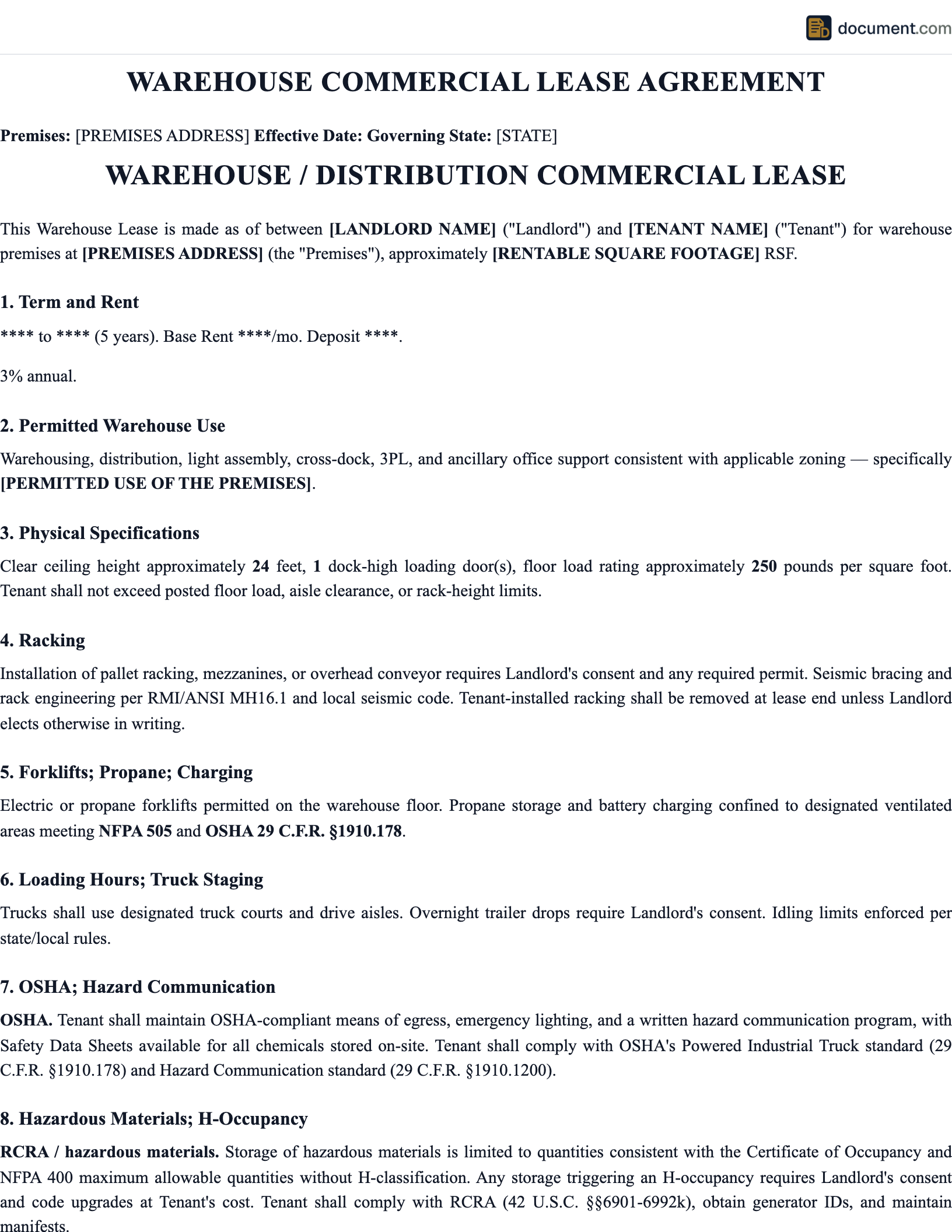
Sample Connecticut Warehouse Lease
Preview of our Connecticut-specific template. Your document will include all fields required for recording in any Connecticut county.
WAREHOUSE LEASE AGREEMENT
STATE OF CONNECTICUT
Legal Document
PARTY INFORMATION
Name: [Full Legal Name]
Address: [Connecticut Address]
County: [County]
PROPERTY DESCRIPTION
County: [County] State: Connecticut
Legal Description: [Per Recorded Plat]
Parcel No.: [APN]
Connecticut Warehouse Lease FAQ
Common questions about filing in Connecticut, including requirements, fees, and tax implications.
Official Connecticut Resources
Official state resources for verifying requirements and finding your local recording office.
Important Considerations for Connecticut Warehouse Tenants
Connecticut's high property tax burden, combined with high energy costs and an expensive labor market, makes total occupancy cost per square foot substantially higher than Sun Belt alternatives. Tenants choosing Connecticut for its Northeast market access should model all-in costs carefully before committing.
Traffic congestion on Connecticut's major highway corridors, particularly I-95 and I-84, creates operational challenges for time-sensitive distribution. Delivery windows and driver hours-of-service compliance are both affected by Connecticut's congestion patterns during peak commuting hours.
Connecticut's older industrial building stock means tenants with modern automation requirements, including narrow-aisle racking, automated conveyors, or robotics systems, may need to budget for significant structural and electrical upgrades. Confirm floor flatness specifications and electrical capacity before committing to automation investment.
Connecticut Warehouse Tip
Connecticut's industrial market rewards patience and local broker relationships. Older buildings that appear unattractive on paper can often be negotiated into excellent deals because landlords of legacy Connecticut industrial property have limited alternative tenants and may fund significant improvements in exchange for a longer lease commitment.
Related Documents
Depending on your situation, you may need additional documents alongside this one. Below are commonly related documents that are frequently used together in real estate transactions.
Create your Connecticut Commercial Warehouse Lease Agreement in under 5 minutes.
Answer a few questions and download a Connecticut-compliant document, ready for the state agency.