



California Warehouse Lease Overview
California's Los Angeles and Inland Empire industrial market is the most expensive and competitive industrial real estate market in the United States. Rents in the Inland Empire, which covers Riverside and San Bernardino counties, have risen to levels unimaginable a decade ago, driven by e-commerce fulfillment demand for proximity to 25 million Southern California consumers. The ports of Los Angeles and Long Beach collectively handle more containerized cargo than any other port complex in the Western Hemisphere.
California industrial leasing is dramatically more complex than in most other states. CARB regulations directly affect warehouse operations including truck idling restrictions and cargo handling equipment standards. AB 5 affects how warehouse operators classify logistics workers. CEQA review applies to new industrial development and major expansions. Tenants and landlords carry legal and regulatory obligations unique to California that must be addressed explicitly in lease documentation.
$15
Recording fee
$1.10 per $1,000
Transfer tax
Required
Notarization
0
Witnesses required
California Requirements
California warehouse leases carry regulatory requirements and complexity that go well beyond those in other states. CARB compliance, environmental disclosure, and local operating restrictions all create provisions that must be addressed before signing.
California Specific Note
CARB's In-Use Off-Road Diesel Regulation and Truck and Bus Regulation impose significant compliance obligations on warehouse tenants who own or operate diesel-powered cargo handling equipment. These obligations are tenant obligations, not landlord obligations, but the lease should clearly allocate regulatory compliance costs and address what happens if regulatory changes impose unforeseen expenses on operations during the lease term.
Document Requirements
- Written Agreement: California requires leases for more than one year to be in writing under Civil Code Section 1624. All commercial warehouse leases meet this threshold.
- CARB Compliance Provisions: Address which party is responsible for compliance with CARB truck and cargo handling equipment regulations, including costs of fleet upgrades required by regulatory changes during the lease term.
- Environmental Disclosures: California landlords of industrial sites may have disclosure obligations under CEQA and the Polanco Act. The lease should address pre-existing contamination, indemnification provisions, and environmental testing rights.
- Clear Height and Floor Specifications: Document the certified clear height, floor flatness F-number specification, and floor load rating. These specifications are material to racking and automation system design.
- ESFR Sprinkler Rating: California Fire Code requirements for high-piled storage are stringent. Confirm the sprinkler system rating against your intended commodity and storage height before signing.
- Operating Hours Compliance: Some California municipalities restrict truck traffic hours. Confirm that your intended operating hours comply with local ordinances and address this explicitly in the lease.
How to File in California
Executing a California warehouse lease requires advance preparation on CARB compliance status, environmental due diligence, and total occupancy cost modeling that includes California-specific regulatory compliance costs.
Conduct CARB Compliance Assessment
Before signing, assess the CARB compliance status of any cargo handling equipment you plan to operate. Diesel forklifts, yard trucks, and refrigerated trailer units face specific California standards with phased-in compliance deadlines. Budget for compliance costs as part of total occupancy analysis.
Review Environmental Status
Request Phase I environmental assessment reports. Inland Empire industrial sites often have legacy contamination from historical agricultural or industrial uses. Confirm the landlord's indemnification scope for pre-existing conditions in the lease.
Evaluate Truck Traffic and Local Restrictions
Confirm that local ordinances permit truck traffic during your planned operating hours. Some Southern California municipalities have adopted overnight truck restrictions that affect 24-hour distribution operations.
Model Total Occupancy Cost Including Regulatory Compliance
California industrial rents are one component of total occupancy cost. CARB compliance, property tax pass-throughs, transaction privilege taxes, and utility costs in California create a materially higher all-in cost than the base rent suggests.
Execute Lease and Register with Regulatory Agencies
Sign the fully negotiated lease. Contact SCE, PG&E, SDG&E, or the applicable municipal utility for electrical service. Register with the applicable air district for any emissions reporting obligations relevant to your operations.
California Fees & Costs
Typical costs for filing in California. Actual fees may vary by county.
| Fee / Tax | Amount |
|---|---|
| Recording Fee | $15 |
| Transfer Tax | $1.10 per $1,000 |
| Notarization | $5 - $25 per signature |
| Certified Copy | $1 - $10 per page |
| Attorney Review (optional) | $150 - $500 |
California Tax Implications
California imposes the highest state income tax rates in the nation, with a top individual rate of 13.3% and a corporate rate of 8.84%. Pass-through entities and C corporations operating warehouse businesses in California pay California income tax on California-sourced income. Lease payments are deductible business expenses.
Property taxes are a major CAM component in California warehouse leases. While Proposition 13 caps annual assessment increases at 2% for existing owners, change-of-ownership events trigger reassessment to market value. If a property recently sold or transferred, the property tax pass-through in a triple-net lease may be significantly higher than prior periods. Always request current assessed value and prior year tax bill before signing.
California sales and use tax applies to the purchase of goods and certain equipment installed in warehouse facilities. The base rate is 7.25%, and local district taxes bring the effective rate to 10.25% or higher in many Inland Empire and Los Angeles County locations. Tenant improvement purchases may be subject to California sales tax depending on how improvements are classified.
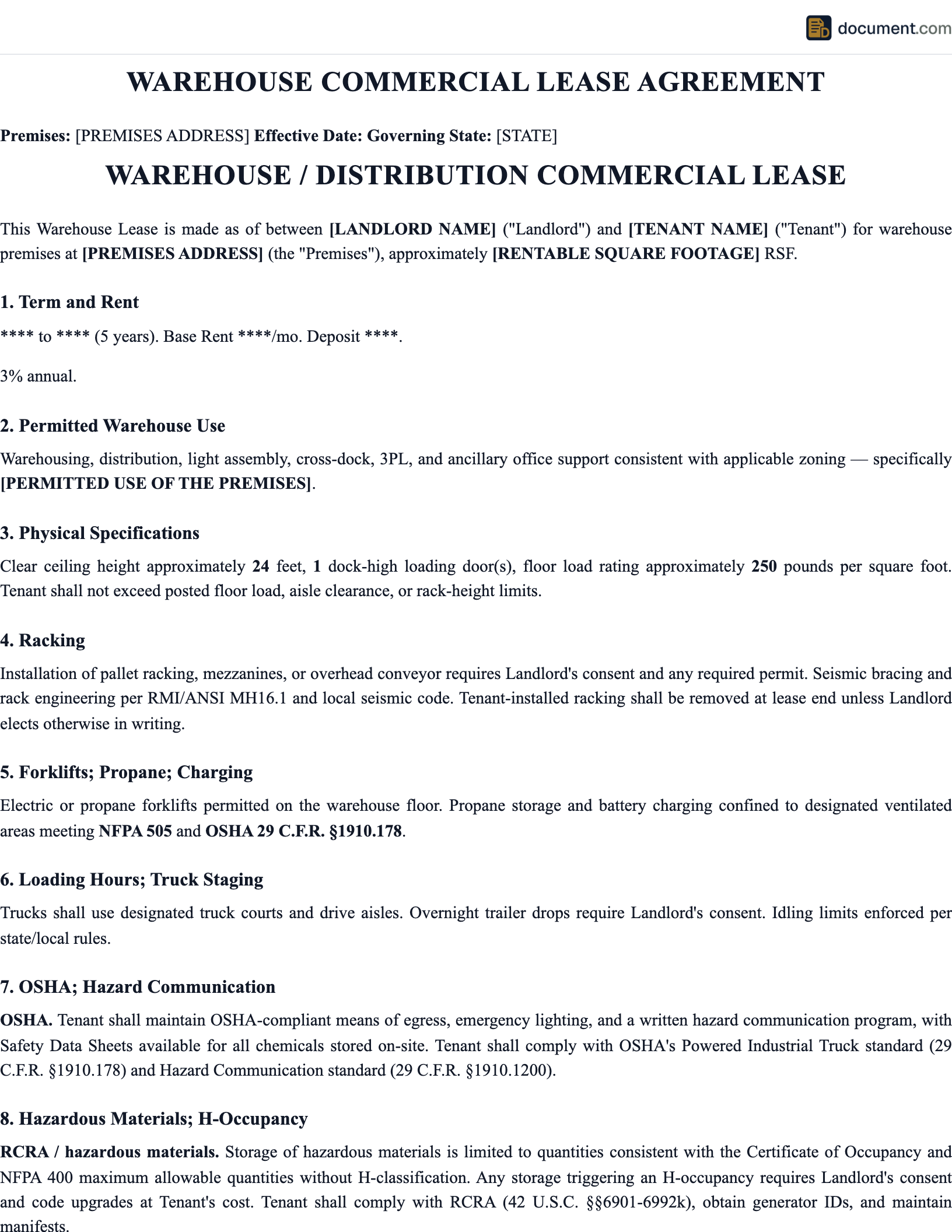
Sample California Warehouse Lease
Preview of our California-specific template. Your document will include all fields required for recording in any California county.
WAREHOUSE LEASE AGREEMENT
STATE OF CALIFORNIA
Legal Document
PARTY INFORMATION
Name: [Full Legal Name]
Address: [California Address]
County: [County]
PROPERTY DESCRIPTION
County: [County] State: California
Legal Description: [Per Recorded Plat]
Parcel No.: [APN]
California Warehouse Lease FAQ
Common questions about filing in California, including requirements, fees, and tax implications.
Official California Resources
Official state resources for verifying requirements and finding your local recording office.
Important Considerations
California's strict environmental and labor regulations create ongoing compliance obligations for warehouse tenants that have no equivalent in most other states. CARB's expanding regulations on cargo handling equipment are making diesel-powered operations increasingly expensive in California, and the transition to electric equipment requires significant electrical infrastructure upgrades at many older facilities.
The Inland Empire industrial market has expanded but community opposition to new warehouse development in residential-adjacent areas has intensified. Some municipalities have adopted warehouse development moratoriums or restrictive zoning. Tenants looking for new construction may need to look further from population centers and budget for longer permitting timelines.
Water availability and wildfire risk are increasingly important for California warehouse operators, particularly in the eastern Inland Empire and Central Valley. Confirm that the facility has adequate fire suppression water supply and verify the site's fire hazard severity zone designation which affects insurance costs and permit requirements.
California Warehouse Lease Warning
California is one of the most complex industrial lease environments from a regulatory burden perspective. CARB regulations, local truck restrictions, community benefit agreements, and labor law obligations can significantly increase the cost of operating a warehouse in California compared to other states. Work with a California commercial real estate attorney and a regulatory compliance consultant before signing any lease for a California industrial facility.
Related Documents
Depending on your situation, you may need additional documents alongside this one. Below are commonly related documents that are frequently used together in real estate transactions.
Create your California Commercial Warehouse Lease Agreement in under 5 minutes.
Answer a few questions and download a California-compliant document, ready for the state agency.