
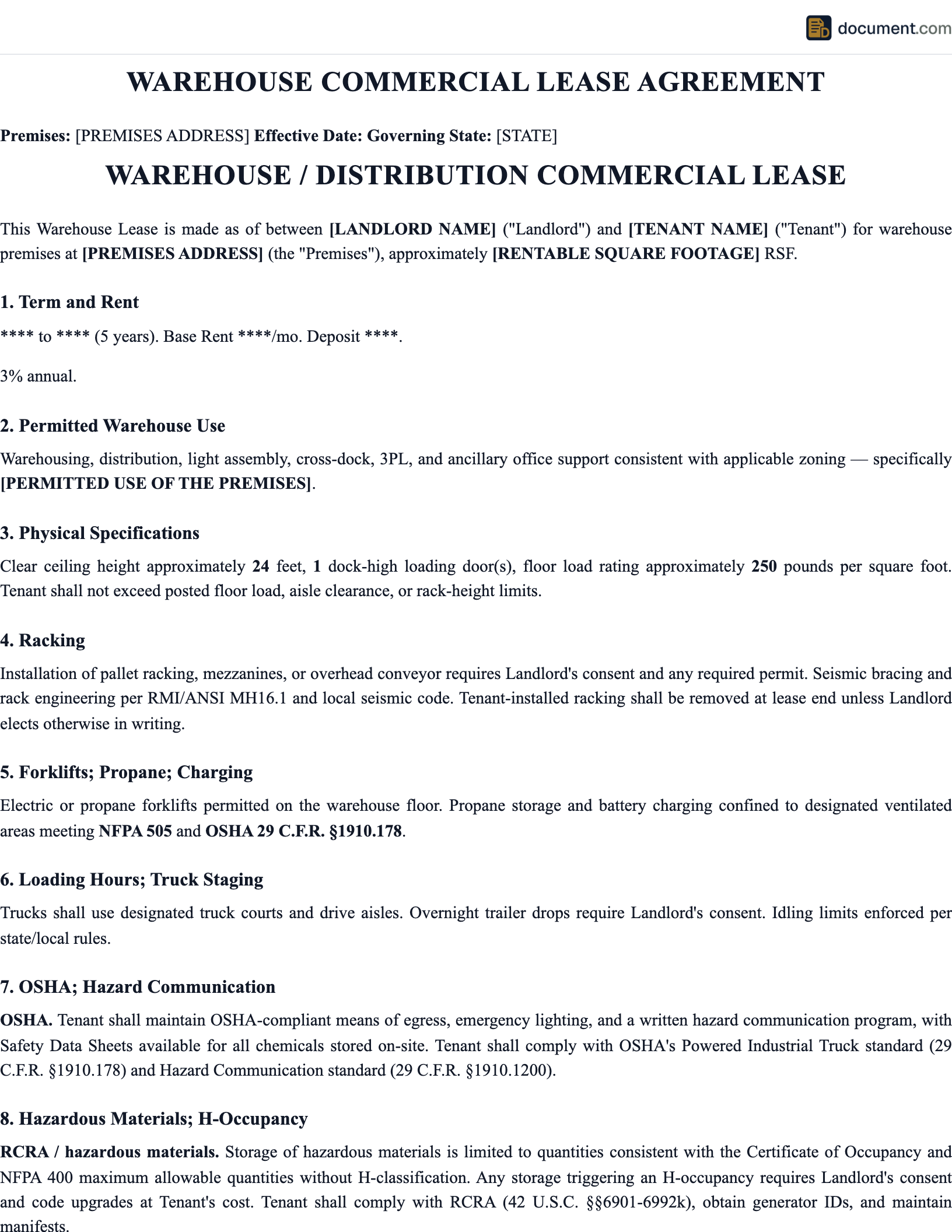



Arizona Warehouse Lease Overview
Arizona, and the Phoenix metro area in particular, has been one of the hottest industrial real estate markets in the country for the past decade. E-commerce growth, overflow demand from Southern California's Inland Empire, and Sunbelt population migration have driven speculative warehouse development at a pace few markets can match. The result is a well-supplied but competitive market where base rents have risen sharply even as vacancy has remained relatively tight.
Arizona's favorable business climate, absence of a personal income tax, and streamlined permitting processes have attracted major distribution center operators including Amazon, Walmart, and numerous third-party logistics providers. Tenants in the Phoenix market should understand that most available buildings are newer speculative construction delivering 32 to 36-foot clear heights, ESFR sprinkler systems, and deep truck courts designed for 53-foot trailer maneuvering.
$30
Recording fee
None
Transfer tax
Required
Notarization
0
Witnesses required
Arizona Requirements
Arizona warehouse leases follow general commercial contract principles with no specialized industrial leasing statute. The written requirement under ARS 44-101 applies to all leases over one year. The desert climate and high-volume Phoenix industrial market create practical provisions that should be negotiated before any Arizona warehouse lease is signed.
Arizona Specific Note
Arizona's extreme summer heat creates warehouse conditions unique in the industrial market. Building temperatures in non-conditioned warehouse bays can exceed 115 to 120 degrees Fahrenheit in July and August. Tenants storing temperature-sensitive goods including pharmaceuticals, food products, or electronics must specifically negotiate for climate control or accept that standard speculative warehouse buildings in Arizona are not conditioned.
Lease Requirements
- Written Agreement: Arizona requires leases for more than one year to be in writing under ARS Section 44-101. All commercial warehouse leases meet this threshold.
- Signatures: Both parties must sign. Arizona does not require witnesses or notarization for a commercial lease to be binding between parties, though notarization is required for recording.
- Property Description: Describe the leased premises including square footage, dock doors, grade-level doors, truck court dimensions, and exclusive parking or trailer staging areas.
- HVAC Provisions: Specify which portions are climate-controlled and who maintains HVAC serving conditioned areas. Mechanical failure in Arizona summer is a serious operational risk.
- Sprinkler Classification: Confirm the sprinkler system rating matches the tenant's intended commodity storage classification. ESFR is standard in modern Phoenix-area construction.
- Zoning and Use Confirmation: Verify the facility zoning permits the tenant's specific use including outdoor storage, trailer parking, and intended operating hours.
How to Execute a Arizona Warehouse Lease
Executing a commercial warehouse lease in Arizona requires attention to heat management provisions, sprinkler specifications, and total occupancy cost modeling beyond base rent.
Verify ESFR Sprinkler Rating
Confirm the building's sprinkler system rating against the commodity class of goods you plan to store. High-piled storage or Class III-IV commodities may require system upgrades that should be addressed in the lease with clear cost allocation.
Inspect the Building During Warm Weather
Visit the facility during summer if possible to assess heat buildup in the warehouse bay, evaluate any existing ventilation or evaporative cooling, and confirm conditions in the dock area.
Review Prior CAM Reconciliations
Request two years of operating expense reconciliations to understand actual property tax pass-throughs, insurance costs, and maintenance charges before committing.
Execute the Lease
Both parties sign after all modifications are finalized. The lease should explicitly address heat management provisions, sprinkler obligations, and outdoor storage rights.
Establish Utility Accounts
Set up electricity with Arizona Public Service or Salt River Project. Confirm water and sewer details with the applicable municipality or private utility provider.
Arizona Fees & Costs
Typical costs for filing in Arizona. Actual fees may vary by county.
| Fee / Tax | Amount |
|---|---|
| Recording Fee | $30 |
| Transfer Tax | None |
| Notarization | $5 - $25 per signature |
| Certified Copy | $1 - $10 per page |
| Attorney Review (optional) | $150 - $500 |
Arizona Tax Implications for Warehouse Leases
Arizona imposes no personal income tax, benefiting sole proprietors and pass-through entities operating warehouse businesses. Corporate entities pay Arizona's flat 4.9% corporate income tax on Arizona-sourced income. Rent payments are deductible business expenses under both federal and Arizona tax rules.
Property taxes are a significant pass-through item in Arizona triple-net leases. Arizona industrial property is assessed at a higher rate than residential property. Maricopa County tax rates apply to most Phoenix-area facilities. Request the current assessed value and prior year tax bill to understand the expected annual CAM contribution.
Arizona's transaction privilege tax effectively adds to the tenant's total occupancy cost. Rates vary by municipality and the landlord collects and remits this tax. It should be included in all financial modeling alongside base rent and CAM charges to get an accurate picture of total cost.
Sample Arizona Warehouse Lease
Preview of our Arizona-specific template. Your document will include all fields required for recording in any Arizona county.
WAREHOUSE LEASE AGREEMENT
STATE OF ARIZONA
Legal Document
PARTY INFORMATION
Name: [Full Legal Name]
Address: [Arizona Address]
County: [County]
PROPERTY DESCRIPTION
County: [County] State: Arizona
Legal Description: [Per Recorded Plat]
Parcel No.: [APN]
Arizona Warehouse Lease FAQ
Common questions about filing in Arizona, including requirements, fees, and tax implications.
Official Arizona Resources
Official state resources for verifying requirements and finding your local recording office.
Important Considerations for Arizona Warehouse Tenants
Phoenix-area industrial rents have increased substantially since 2020. New tenants should model total occupancy cost including base rent, CAM, transaction privilege tax, and utility costs rather than focusing only on the quoted base rent per square foot.
Outdoor storage is a common need for Arizona distribution tenants. Zoning rules vary significantly by municipality, and some communities require screening of outdoor storage from adjacent streets. Confirm outdoor storage rights explicitly in the lease.
Water availability is an increasingly important consideration for Arizona warehouse operators with significant cooling tower use, truck washing, or food processing. The state's long-term water supply management affects development approvals and large water users.
Arizona Warehouse Lease Tip
In the Phoenix market, landlord property management quality matters as much as the rent rate. HVAC failures in summer, sprinkler issues, and dock door malfunctions need fast response. Ask for references from other tenants in the same building before signing and negotiate specific maintenance response time commitments into the lease.
Related Documents
Depending on your situation, you may need additional documents alongside this one. Below are commonly related documents that are frequently used together in real estate transactions.
Arizona Warehouse Lease Checklist
Before signing any Arizona warehouse lease, verify these key points. A landlord who resists discussing these provisions openly warrants additional scrutiny before you commit.
Review CAM reconciliation methodology carefully. Some landlords use gross-up provisions that inflate the expense pool even during periods of partial vacancy. Ask for the prior two years of actual CAM reconciliation statements.
Negotiate a rent abatement period for any tenant improvement work rather than simply a delayed commencement date that still accrues rent. Free rent during construction or fit-out is a standard ask in most industrial markets.
Confirm in writing who owns improvements you install, including racking anchor points, dock seals, and electrical upgrades. Absent a written provision, installed improvements generally become landlord property at lease termination.
Professional Recommendation
Industrial leases are not standardized. Each landlord uses their own form, and tenant-favorable provisions that are standard in other markets may need to be specifically negotiated. A commercial real estate attorney familiar with Arizona industrial leasing can identify provisions that create undue risk before you are committed to the space.
Related Documents
Depending on your situation, you may need additional documents alongside this one. Below are commonly related documents that are frequently used together in real estate transactions.
Create your Arizona Commercial Warehouse Lease Agreement in under 5 minutes.
Answer a few questions and download a Arizona-compliant document, ready for the state agency.