



Wisconsin NNN Lease Overview
A triple-net lease in Wisconsin shifts the major operating expenses of a commercial property from the landlord to the tenant. In addition to base rent, the tenant reimburses property taxes, building insurance, and common area maintenance. The result is a lower gross rent number, but the tenant's total occupancy cost depends heavily on how the expense pass-throughs are defined and capped in the lease.
Wisconsin commercial leases are governed by contract law, and there is no state statute dictating what expenses may or may not pass through to a tenant. That means negotiation matters. Milwaukee, Madison, and the Fox Valley corridor all have active NNN markets for retail, industrial, and medical office uses, with lease rates and expense structures varying considerably by submarket and property type.
Pass-through
Expense structure
None
Commercial rent tax
Contract
Governs expense scope
Municipal
Property tax assessment
Wisconsin NNN Lease Requirements
Because Wisconsin commercial leases are purely contract-driven, the provisions you negotiate before signing define the tenant's financial exposure for the entire lease term. Getting the expense language right at the outset is far easier than disputing it later.
Wisconsin Property Tax Note
Wisconsin property taxes are assessed at the municipal level, and rates vary considerably across counties. Milwaukee County properties often carry higher assessed values than comparable suburban parcels. Tenants should review the most recent tax bill before executing a NNN lease and ask for a history of annual increases to model future pass-through exposure.
Key NNN Lease Provisions
- Expense Definitions: The lease should define precisely what costs are included in each category of tax, insurance, and CAM, along with any exclusions such as capital replacements or management fees
- CAM Cap: Negotiate a cap on year-over-year increases in controllable CAM expenses, typically 3 to 5 percent annually, to prevent unchecked cost escalation
- Audit Rights: Include a tenant right to audit the landlord's expense records within a stated period after receiving the annual reconciliation statement
- Roof and Structure: Clarify whether roof replacement and structural repairs are included in the NNN pass-throughs or retained by the landlord, and set a cost threshold for items classified as capital versus maintenance
- Tax Contest Rights: Include a provision allowing the tenant to initiate or participate in a property tax appeal, since any reduction in the assessed value directly lowers the tenant's pass-through obligation
- Casualty and Abatement: Address what happens to rent and expense obligations if the property is damaged and the tenant cannot operate from the space
How to Negotiate and Execute a Wisconsin NNN Lease
Executing a Wisconsin NNN lease starts well before anyone signs. The steps below walk through how to protect yourself through the negotiation and execution process.
Review Historical Expense Data
Before making an offer, request two to three years of actual NNN expense statements from the landlord. Review property tax bills, insurance premiums, and CAM reconciliations to understand what the real occupancy cost will look like beyond base rent.
Negotiate Expense Definitions and Caps
Push back on broad expense definitions. Get exclusions for management fees above market, capital replacements, and costs relating to other tenants. Negotiate a cap on controllable CAM increases and confirm whether roof and structural items are included or excluded.
Clarify Roof and Structural Responsibility
If the landlord expects the tenant to contribute to roof replacement or structural repairs, establish a cost threshold distinguishing routine maintenance from capital items. In Wisconsin industrial and big-box retail properties, roof replacement costs can be substantial.
Engage a Wisconsin Commercial Real Estate Attorney
Have a Wisconsin attorney review the final draft before you execute. NNN leases involve long-term financial commitments and the expense language can significantly affect total cost. An attorney familiar with the Milwaukee or Madison market will know what is standard and what is unusual.
Execute and Set Up NNN Accounting
Once signed, set up a budget that separates base rent from NNN estimates. Track monthly estimates against the budget and set aside reserves for the annual reconciliation true-up. Request reconciliation statements promptly at year end and review them against the expense records you have audit rights to inspect.
Wisconsin NNN Lease Fees & Costs
Total occupancy cost under a Wisconsin NNN lease includes base rent plus all expense pass-throughs. The table below reflects typical ranges by category.
| Cost Item | Typical Range |
|---|---|
| Base Rent | $8 to $30 per sq ft annually (varies by market and property type) |
| Property Tax Pass-Through | $2 to $8 per sq ft annually (higher in Milwaukee County) |
| Building Insurance | $0.50 to $1.50 per sq ft annually |
| CAM / Operating Expenses | $1 to $5 per sq ft annually |
| Attorney Review | $1,500 to $5,000 depending on complexity |
Wisconsin Tax Considerations for NNN Tenants
Wisconsin does not impose a commercial rent tax, so tenants are not paying a lease excise on top of their rent. The primary tax exposure for NNN tenants is the property tax pass-through, which is assessed at the municipal level and can vary considerably across Wisconsin counties. Milwaukee County properties tend to carry the highest assessed values, while smaller counties in central and northern Wisconsin are often more modest.
Tenants with operations in Wisconsin are generally subject to the state corporate income or franchise tax and may be required to register with the Wisconsin Department of Revenue. Business income earned in Wisconsin is taxable at the state level, and business personal property such as furniture, fixtures, and equipment may be subject to local personal property taxes depending on the municipality.
Because property tax pass-throughs flow through the lease rather than being paid directly to the taxing authority, tenants have an interest in the accuracy of the landlord's tax billing. Leases that include tenant audit rights and tax contest participation rights give tenants the tools to verify and potentially reduce their allocated tax share. A Wisconsin tax professional can advise on the full picture of state and local tax obligations connected to a commercial tenancy.
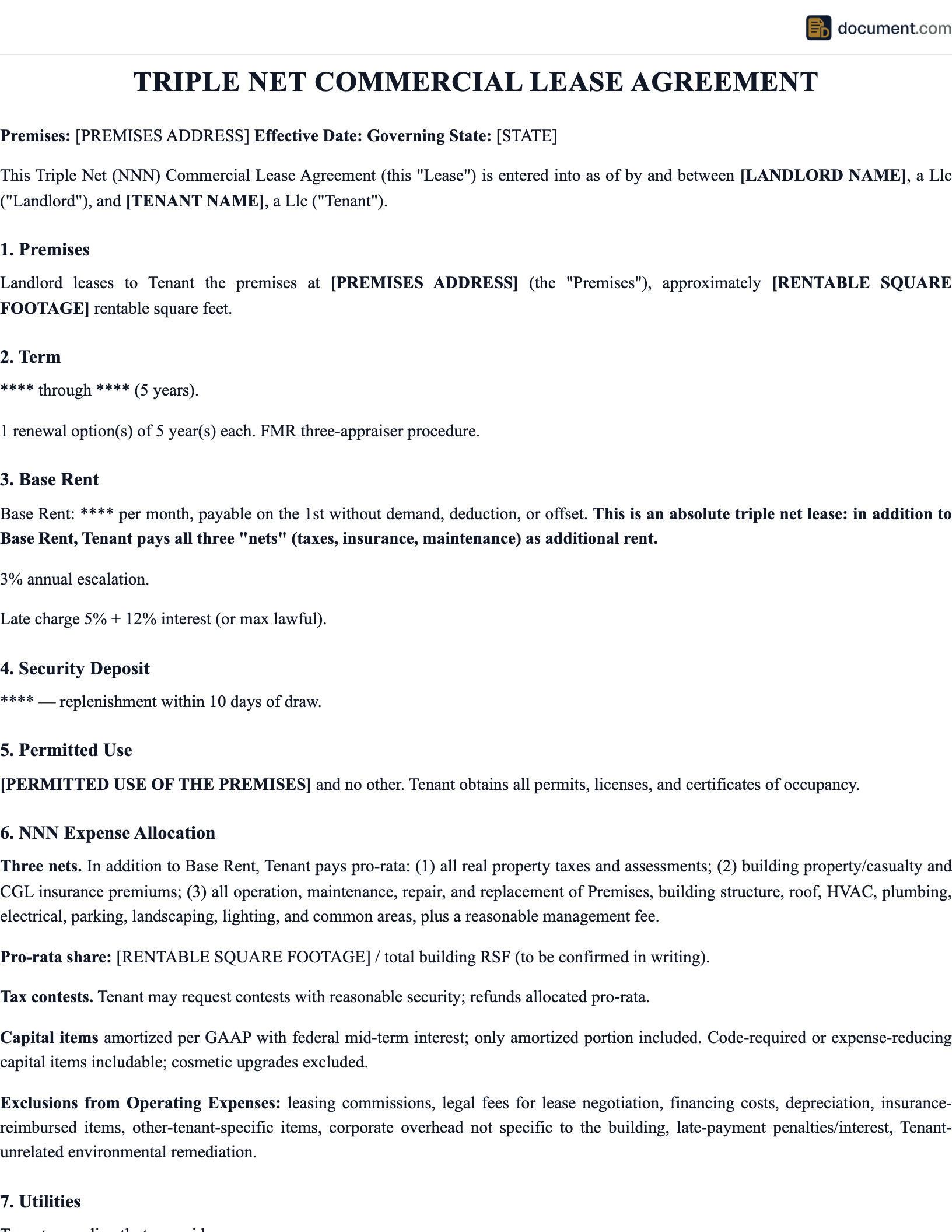
Sample Wisconsin NNN Lease
Preview of our Wisconsin-specific template. Your document will include all fields required for recording in any Wisconsin county.
TRIPLE NET (NNN) COMMERCIAL LEASE
STATE OF WISCONSIN
Legal Document
PARTY INFORMATION
Name: [Full Legal Name]
Address: [Wisconsin Address]
County: [County]
PROPERTY DESCRIPTION
County: [County] State: Wisconsin
Legal Description: [Per Recorded Plat]
Parcel No.: [APN]
Wisconsin NNN Lease FAQ
Common questions about filing in Wisconsin, including requirements, fees, and tax implications.
Official Wisconsin Resources
Official state resources for verifying requirements and finding your local recording office.
Important Considerations
Before proceeding with your document, there are several important factors to consider. Each real estate transaction is unique, and understanding the specific requirements and implications of your situation will help ensure a smooth process.
Real estate laws and regulations are subject to change, and local requirements may differ from state-level rules. It is always advisable to verify current requirements with your local recording office before submitting any documents for recording.
If your transaction involves complex circumstances such as multiple parties, commercial properties, trusts, estates, or interstate elements, consulting with a licensed real estate attorney in your state is strongly recommended. An attorney can provide guidance specific to your situation and help you avoid potential legal issues.
Keep copies of all documents related to your real estate transaction in a safe place. Recorded documents become part of the public record, but having your own copies ensures you can reference the terms and conditions at any time. Digital copies stored securely are also recommended as a backup.
Professional Recommendation
While our templates are designed to be comprehensive and legally compliant, we recommend having your completed document reviewed by a licensed attorney before recording, especially for high-value transactions or complex situations. Many attorneys offer flat-fee document review services that provide peace of mind at a reasonable cost.
Related Documents
Depending on your situation, you may need additional documents alongside this one. Below are commonly related documents that are frequently used together in real estate transactions.
Important Considerations
Before proceeding with your document, there are several important factors to consider. Each real estate transaction is unique, and understanding the specific requirements and implications of your situation will help ensure a smooth and legally compliant process.
Real estate laws and regulations are subject to change, and local requirements may differ from state-level rules. It is always advisable to verify current requirements with your local recording office before submitting any documents for recording.
If your transaction involves complex circumstances such as multiple parties, commercial properties, trusts, estates, or interstate elements, consulting with a licensed real estate attorney is strongly recommended. An attorney can provide guidance specific to your situation and help you avoid potential legal issues.
Keep copies of all documents related to your real estate transaction in a safe place. Recorded documents become part of the public record, but having your own copies ensures you can reference the terms and conditions at any time. Digital copies stored securely are also recommended as a backup.
Professional Recommendation
While our templates are designed to be comprehensive and legally compliant, we recommend having your completed document reviewed by a licensed attorney before recording, especially for high-value transactions or complex situations. Many attorneys offer flat-fee document review services that provide peace of mind at a reasonable cost.
Related Documents
Depending on your situation, you may need additional documents alongside this one. Below are commonly related documents that are frequently used together in real estate transactions.
Create your Wisconsin Commercial Triple Net Lease Agreement in under 5 minutes.
Answer a few questions and download a Wisconsin-compliant document, ready for the state agency.