



West Virginia NNN Lease Overview
A triple-net lease in West Virginia shifts the major property operating costs to the tenant. In addition to base rent, the tenant pays their proportionate share of property taxes, building insurance, and common area maintenance. West Virginia commercial leases are governed by contract law, giving parties broad flexibility to define the exact scope of each expense category. That flexibility makes the lease language critical: an imprecise expense definition leads to disputes that West Virginia courts resolve by reading the contract literally.
West Virginia's commercial real estate market is generally more affordable than surrounding states. Charleston, Huntington, Morgantown, and Beckley are the primary commercial markets, and NNN leases in these cities tend to have lower base rents than comparable properties in Virginia, Ohio, or Pennsylvania. The state has no commercial rent tax, and property taxes are assessed at the county level with rates that vary by jurisdiction.
Affordable
WV market rents
None
Commercial rent tax
Contract
Governing law
County
Tax assessment
West Virginia NNN Lease Requirements
West Virginia commercial leases are contract documents with no specialized commercial tenant statute. The lease must clearly define each NNN component to be enforceable. Vague provisions that leave open questions about what is included in CAM or how property taxes are allocated will create disputes that could have been avoided with precise drafting.
West Virginia Property Tax Note
West Virginia property taxes are assessed at the county level. Rates vary across the state's 55 counties. NNN tenants should request the current tax bill and three years of tax history for the property before signing. If the landlord has recently purchased the property, the next assessment may reflect the purchase price, which could materially increase the tax pass-through.
Key West Virginia NNN Lease Provisions
- Expense Definitions: The lease must define each NNN component with sufficient specificity to identify what is included and excluded from property taxes, insurance, and CAM
- CAM Cap: Negotiate a cap on annual CAM increases (3 to 5 percent is common in West Virginia commercial leases) to protect against uncontrolled expense growth
- Audit Rights: Include the right to audit landlord expense calculations within 60 to 90 days of receiving the annual reconciliation statement
- Roof and Structure: Clearly define whether roof replacement and structural repairs are landlord responsibilities or tenant-borne; most West Virginia modified NNN leases keep these with the landlord
- Tax Contest Rights: The tenant should have the right to request that the landlord contest unreasonable property tax assessments, particularly where the tax pass-through represents a significant portion of total occupancy cost
- Casualty and Abatement: Define rent abatement rights when the space is damaged and becomes unusable, and set timelines for repair or lease termination
How to Negotiate and Execute a West Virginia NNN Lease
Negotiating a West Virginia NNN lease requires careful review of the property's expense history and precise drafting of the expense allocation provisions. These five steps guide the process.
Review the Property's Expense History
Request two to three years of actual property tax bills, insurance premiums, and CAM expense reports for the property. West Virginia commercial properties in smaller markets sometimes have limited competing options, so understanding total NNN cost from real numbers (not landlord estimates) is essential before negotiating base rent
Negotiate Expense Definitions and CAM Caps
Push for precise definitions of what is included in each NNN category, exclusions for capital expenditures and management fees, a cap on annual CAM increases, and the right to audit expense calculations. West Virginia landlords of smaller commercial properties may be less familiar with sophisticated NNN negotiation, making detailed term sheets particularly important
Clarify Roof and Structural Responsibility
Confirm in writing whether the lease is modified NNN (landlord handles roof and structure) or absolute NNN (tenant bears all costs). Many West Virginia commercial properties are older buildings where roof and structural conditions warrant careful inspection. The distinction between modified and absolute NNN can represent a very large dollar difference over a multi-year term
Have a West Virginia Attorney Review
A West Virginia commercial real estate attorney should review the final lease to confirm expense allocations are clearly defined, CAM caps and audit rights are properly documented, and the governing law clause designates West Virginia law for dispute resolution
Execute and Set Up NNN Accounting
Both parties sign the lease. From day one, track base rent, property tax billings, insurance invoices, and CAM charges separately so you can verify the landlord's annual reconciliation accurately
West Virginia NNN Lease Costs
Total occupancy cost under a West Virginia NNN lease includes base rent plus the three NNN components. The table below covers the main cost categories for West Virginia commercial tenants.
| Cost Item | Typical Range |
|---|---|
| Base Rent (West Virginia commercial) | $8 - $22 per sq ft per year (market-dependent) |
| Property Tax Pass-Through | $1 - $4 per sq ft per year (varies by county) |
| Building Insurance Pass-Through | $0.50 - $1.50 per sq ft per year |
| CAM Charges | $1 - $4 per sq ft per year |
| Attorney Review (West Virginia) | $750 - $2,500 |
West Virginia Tax Considerations for NNN Tenants
West Virginia imposes a Business and Occupation tax on certain categories of commercial business activity. This is a separate state-level obligation and should not appear in the NNN lease expense pass-through. Property taxes assessed by the county are the relevant NNN component, not any state-level business tax.
West Virginia property taxes are assessed annually by county assessors. NNN tenants who bear the property tax pass-through have a financial interest in accurate assessments and should ask the landlord to notify them of any significant assessment increases so they can evaluate whether to request a protest.
West Virginia has a corporate net income tax that applies to business income earned in the state, but this is the tenant's own tax obligation and is unrelated to the NNN lease structure. Tenants should consult a West Virginia CPA to understand their full tax picture alongside lease obligations.
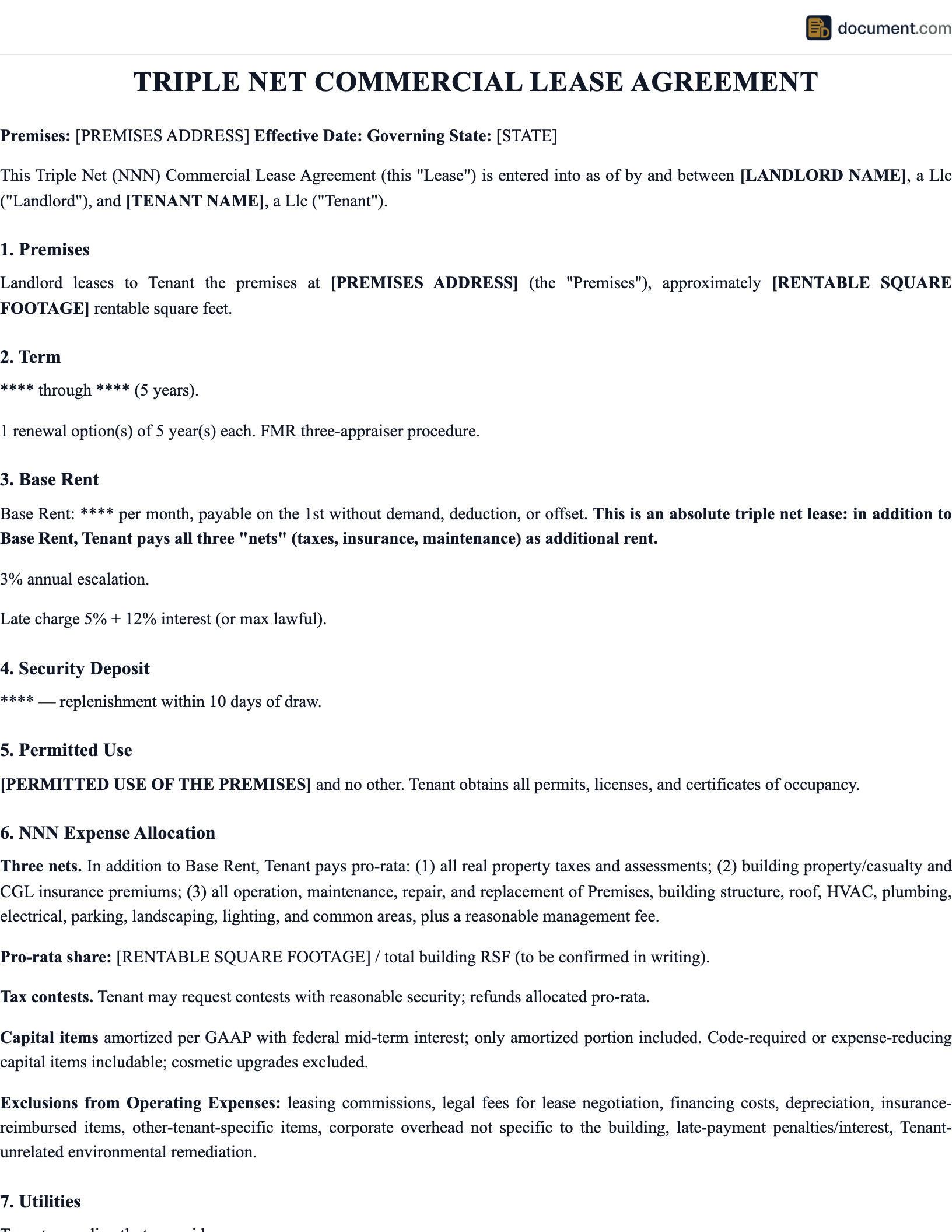
Sample West Virginia NNN Lease
Preview of our West Virginia-specific template. Your document will include all fields required for recording in any West Virginia county.
TRIPLE NET (NNN) COMMERCIAL LEASE
STATE OF WEST VIRGINIA
Legal Document
PARTY INFORMATION
Name: [Full Legal Name]
Address: [West Virginia Address]
County: [County]
PROPERTY DESCRIPTION
County: [County] State: West Virginia
Legal Description: [Per Recorded Plat]
Parcel No.: [APN]
West Virginia NNN Lease FAQ
Common questions about filing in West Virginia, including requirements, fees, and tax implications.
Official West Virginia Resources
Official state resources for verifying requirements and finding your local recording office.
Important Considerations
Before proceeding with your document, there are several important factors to consider. Each real estate transaction is unique, and understanding the specific requirements and implications of your situation will help ensure a smooth process.
Real estate laws and regulations are subject to change, and local requirements may differ from state-level rules. It is always advisable to verify current requirements with your local recording office before submitting any documents for recording.
If your transaction involves complex circumstances such as multiple parties, commercial properties, trusts, estates, or interstate elements, consulting with a licensed real estate attorney in your state is strongly recommended. An attorney can provide guidance specific to your situation and help you avoid potential legal issues.
Keep copies of all documents related to your real estate transaction in a safe place. Recorded documents become part of the public record, but having your own copies ensures you can reference the terms and conditions at any time. Digital copies stored securely are also recommended as a backup.
Professional Recommendation
While our templates are designed to be comprehensive and legally compliant, we recommend having your completed document reviewed by a licensed attorney before recording, especially for high-value transactions or complex situations. Many attorneys offer flat-fee document review services that provide peace of mind at a reasonable cost.
Related Documents
Depending on your situation, you may need additional documents alongside this one. Below are commonly related documents that are frequently used together in real estate transactions.
Important Considerations
Before proceeding with your document, there are several important factors to consider. Each real estate transaction is unique, and understanding the specific requirements and implications of your situation will help ensure a smooth and legally compliant process.
Real estate laws and regulations are subject to change, and local requirements may differ from state-level rules. It is always advisable to verify current requirements with your local recording office before submitting any documents for recording.
If your transaction involves complex circumstances such as multiple parties, commercial properties, trusts, estates, or interstate elements, consulting with a licensed real estate attorney is strongly recommended. An attorney can provide guidance specific to your situation and help you avoid potential legal issues.
Keep copies of all documents related to your real estate transaction in a safe place. Recorded documents become part of the public record, but having your own copies ensures you can reference the terms and conditions at any time. Digital copies stored securely are also recommended as a backup.
Professional Recommendation
While our templates are designed to be comprehensive and legally compliant, we recommend having your completed document reviewed by a licensed attorney before recording, especially for high-value transactions or complex situations. Many attorneys offer flat-fee document review services that provide peace of mind at a reasonable cost.
Related Documents
Depending on your situation, you may need additional documents alongside this one. Below are commonly related documents that are frequently used together in real estate transactions.
Create your West Virginia Commercial Triple Net Lease Agreement in under 5 minutes.
Answer a few questions and download a West Virginia-compliant document, ready for the state agency.