
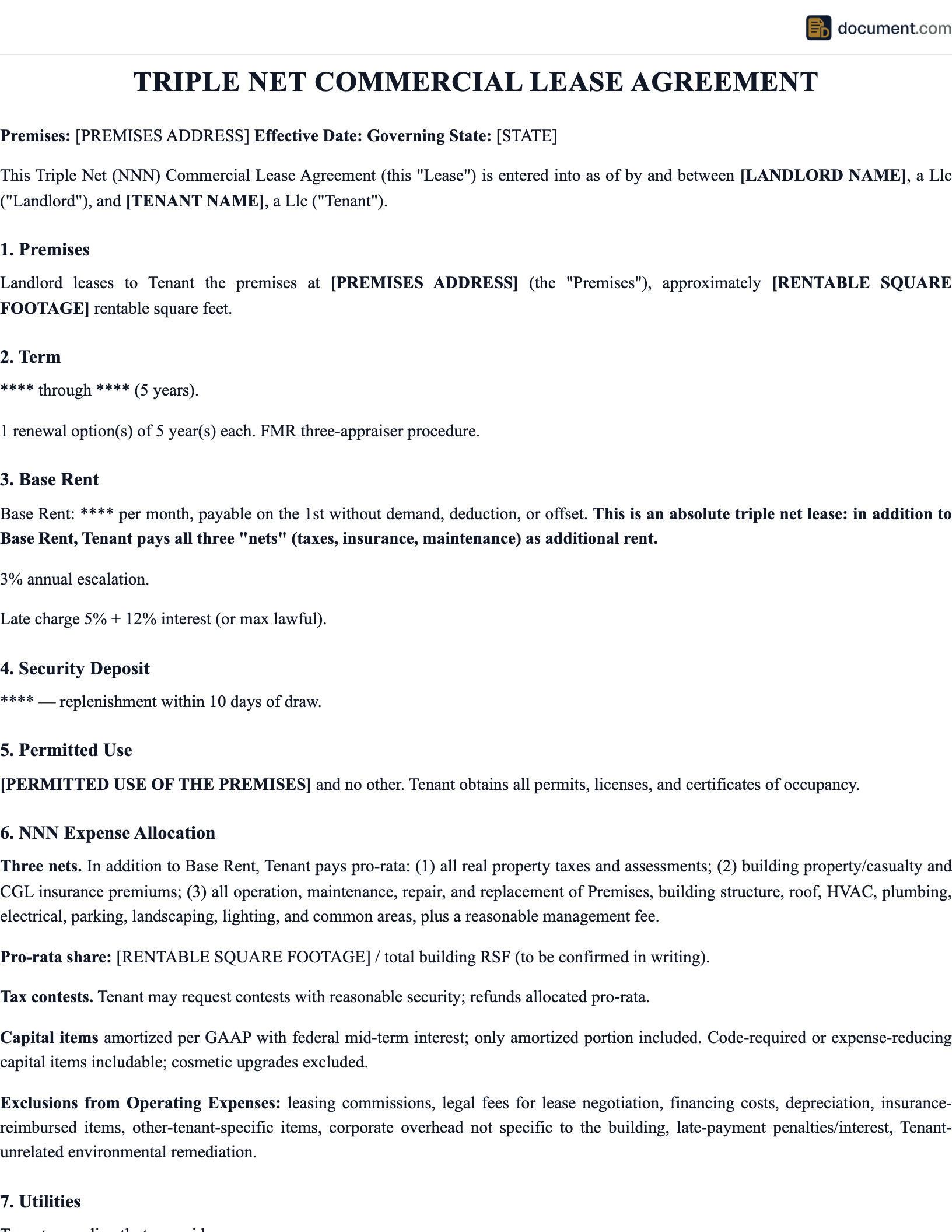



Texas NNN Lease Overview
A triple net lease in Texas requires the tenant to pay base rent plus property taxes, building insurance, and common area maintenance costs. Texas is one of the most active NNN markets in the country, driven by the scale of the Dallas-Fort Worth, Houston, Austin, and San Antonio commercial real estate markets. The state's no-income-tax environment attracts corporate tenants and investors, and NNN properties are a favored institutional investment vehicle across all four major metros.
The most important financial variable in any Texas NNN lease is the property tax pass-through. Texas counties assess commercial property at market value annually, and rates are set by multiple taxing authorities including cities, counties, school districts, and special districts. Dallas County, Harris County, Travis County, and Bexar County all carry effective commercial tax rates that can produce pass-through costs of $3 to $6 per square foot per year or more on stabilized assets. Tenants must model the full occupancy cost, not just the face rent, before committing to a Texas NNN lease.
None
State income tax
High
Property tax burden
Contract
Law governs
4 Major
Commercial markets
Texas Requirements
Texas NNN leases are governed by contract law. There is no Texas statute prescribing specific provisions, so the lease agreement must address all expense categories, reconciliation procedures, audit rights, and maintenance responsibilities in clear language. Vague or incomplete drafting creates disputes that are difficult and expensive to resolve.
Texas Property Tax Pass-Through
Texas property taxes are assessed by county appraisal districts and paid to multiple taxing entities. The tenant's NNN obligation should specify which taxing jurisdictions are included, whether the tenant can protest the appraisal district's assessment, and how tax protest costs and savings are allocated. In Dallas County, Harris County, Travis County, and Bexar County, commercial assessments have increased significantly in recent years, making these provisions financially material.
Key Lease Provisions
- Property Tax Pass-Through: Define what taxes are included (property taxes from all Texas taxing authorities covering the premises), whether the tenant can protest appraisals, and how savings are split if a protest succeeds
- CAM Definitions and Caps: Specify what is included in CAM, exclude management fees above a stated percentage, exclude capital expenditures or amortize them, and include a year-over-year cap on controllable CAM increases
- Insurance Requirements: Require commercial property insurance, general liability, and business interruption; for Houston and Gulf Coast properties, confirm whether windstorm and flood coverage is included or separately required
- Maintenance Responsibility: Absolute NNN requires the tenant to handle structural and roof repairs; modified NNN retains roof and structure with the landlord; make the boundary explicit for Dallas-Fort Worth or Houston industrial properties where HVAC replacement costs are significant
- Annual Reconciliation and Audit Rights: Require the landlord to provide an annual expense statement within 120 days after year end; give the tenant the right to audit once per year; require the landlord to reimburse overcharges with interest if an audit reveals a material discrepancy
- Casualty and Condemnation: Texas properties face hurricane risk on the Gulf Coast, tornado risk in North Texas, and hail damage statewide; specify rent abatement during reconstruction, a landlord rebuild obligation with a defined deadline, and tenant termination rights if the property is not restored in time
How to Draft and Finalize a Texas NNN Lease
Negotiating a Texas NNN lease requires more preparation than most tenants expect, particularly around the property tax provisions. Texas landlords, especially in the DFW and Houston markets, are experienced negotiators. Understanding what each provision means in dollar terms before entering negotiations is the most important thing a Texas tenant can do.
Request Actual Expense History
Before agreeing to any lease terms, request two to three years of actual property tax bills, insurance premium statements, and CAM reconciliation statements for the specific Texas property. Texas property taxes have increased substantially in many counties. Reviewing historical expenses rather than relying on landlord estimates is essential for accurate occupancy cost projections in Dallas, Houston, Austin, and San Antonio.
Negotiate CAM Definitions, Caps, and Exclusions
Texas landlords use varying CAM definitions. Push for express exclusions of management fees above a defined percentage of operating expenses, capital expenditures that benefit multiple tenants over long periods, and costs related to vacant space or pre-development work. Negotiate a year-over-year cap on controllable CAM expenses. Austin office and retail tenants should pay particular attention given the pace of cost increases in that market.
Clarify Structural Maintenance and Roof Allocation
For Texas industrial NNN leases in the Dallas-Fort Worth or Houston logistics corridors, confirm in writing who is responsible for major HVAC replacement, dock leveler repairs, and roof maintenance. Absolute NNN structures push all of these costs to the tenant. If the lease is absolute NNN, budget accordingly and consider negotiating a landlord contribution or replacement reserve for roof systems, particularly on older DFW or Houston warehouse properties.
Execute the Lease
Both parties sign the finalized lease. Texas commercial leases do not require notarization to be enforceable between the parties, though notarization is needed if the lease or a memorandum of lease is to be recorded with the county clerk. Distribute executed originals to landlord and tenant and provide copies to any lender if the property is financed.
Set Up Expense Tracking and Tax Protest Calendar
Establish a system for tracking the monthly NNN payment components and review the annual reconciliation statement against actual expenses. Mark the Texas property tax protest deadline, which is typically May 15 or 30 days after the county appraisal district mails the notice of appraised value, whichever is later. If the lease gives the tenant protest rights, engage a Texas property tax consultant to evaluate whether a protest is warranted each year.
Texas NNN Lease Fees & Costs
A Texas NNN lease involves the base rent plus three separate pass-through cost streams. The property tax component in Texas is particularly significant and should be modeled carefully before signing. The table below covers both ongoing lease costs and transaction costs at execution.
| Fee / Cost | Amount |
|---|---|
| Annual Property Tax Pass-Through | Varies by county appraisal district; Dallas, Harris, Travis, and Bexar County assessments frequently produce $3 to $6+ per square foot annually on stabilized commercial properties |
| Building Insurance Pass-Through | Varies; Gulf Coast Houston properties carry higher wind and flood premiums; typically $0.25 to $1.50 per square foot annually depending on location and structure |
| CAM Pass-Through | Varies by property type; multi-tenant properties include shared area maintenance, landscaping, parking lot, and utilities; watch for management fee and capital expense inclusions |
| State Income Tax | None; Texas has no state income tax on individuals |
| Attorney Review | $500 to $2,000 for review of a Texas NNN lease; strongly recommended given the TAR form's landlord-favorable defaults and the financial significance of the property tax provisions |
Texas Tax Considerations for NNN Tenants
Texas has no state income tax and no commercial rent tax. The Texas franchise tax applies to businesses operating in the state but is based on revenue or margin, not on lease payments specifically. For NNN tenants, the primary tax exposure is the property tax pass-through obligation.
Texas property taxes are levied by multiple overlapping authorities: the county, the city or municipality, the local school district, and various special purpose districts. For a commercial property in a city like Austin or San Antonio, the combined rate across all taxing entities can exceed 2.5% of the property's assessed value annually. The county appraisal district sets the assessed value independently of the tax rates. Tenants should track both the assessed value and the combined tax rate each year.
If the NNN lease gives the tenant the right to protest the county appraisal district's assessment, engaging a Texas property tax consultant is often worthwhile for large industrial or retail spaces. Successful protests in Dallas, Harris, Travis, and Bexar counties have reduced assessments meaningfully in years when comparable market data supports a lower value. The savings flow back to the tenant in the form of a lower property tax pass-through.
Sample Texas NNN Lease
Preview of our Texas-specific template. Your document will include all fields required for recording in any Texas county.
TRIPLE NET (NNN) COMMERCIAL LEASE
STATE OF TEXAS
Legal Document
PARTY INFORMATION
Name: [Full Legal Name]
Address: [Texas Address]
County: [County]
PROPERTY DESCRIPTION
County: [County] State: Texas
Legal Description: [Per Recorded Plat]
Parcel No.: [APN]
Texas NNN Lease FAQ
Common questions about filing in Texas, including requirements, fees, and tax implications.
Official Texas Resources
Official state resources for verifying requirements and finding your local recording office.
Related Texas Commercial Lease Documents
Depending on the specific transaction, you may need additional documents alongside the NNN lease. Texas commercial real estate transactions frequently involve property management agreements, lease amendments, and guaranty agreements.
Create your Texas Commercial Triple Net Lease Agreement in under 5 minutes.
Answer a few questions and download a Texas-compliant document, ready for the state agency.