
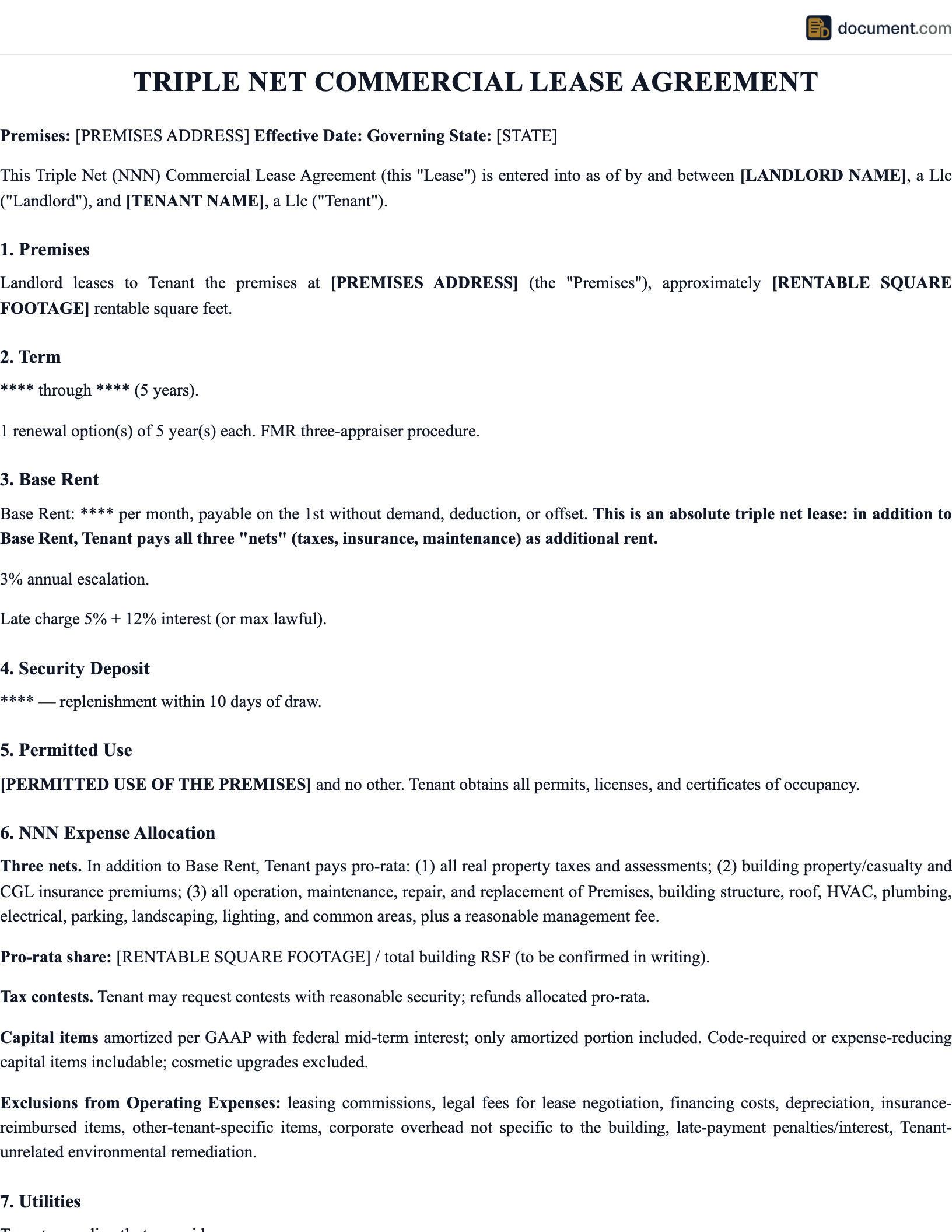



South Carolina Triple Net Lease Overview
A triple net lease in South Carolina transfers the majority of property operating expenses to the tenant, who pays base rent plus real property taxes, building insurance, and maintenance costs in addition to rent. South Carolina commercial leases are governed by contract law, and the state has no statute that limits how expenses can be allocated between landlord and tenant. This gives landlords broad flexibility to structure NNN obligations, which makes careful review of every expense definition in the lease critical for tenants.
South Carolina's two primary commercial markets sit at opposite ends of the state. Charleston has grown into a major port and distribution hub, with significant industrial NNN activity around the Port of Charleston and along I-26 and I-526. Columbia, the state capital, anchors the Midlands office and retail market. Greenville and Spartanburg in the Upstate have attracted major manufacturing and logistics tenants, driving strong NNN demand in industrial corridors along I-85. The coastal markets of Myrtle Beach and Hilton Head carry higher insurance pass-through costs because of hurricane exposure, which tenants must factor into any NNN budget analysis. South Carolina levies no commercial rent tax, so the cost components of an NNN lease are limited to rent, operating expenses, and county property taxes.
$10
Recording fee
$1.85 per $500
Transfer tax
Required
Notarization
0
Witnesses required
South Carolina NNN Lease Requirements
A well-structured South Carolina triple net lease needs to address several specific issues that arise from the state's property tax system, coastal insurance market, and commercial real estate practices. Tenants and landlords in Charleston, Columbia, and the Upstate markets should address each of these requirements before the lease is signed.
South Carolina County Property Tax Note
Commercial properties in South Carolina are assessed at 6% of fair market value, compared to 4% for owner-occupied residences. Each of South Carolina's 46 counties administers its own assessment and millage rate. Tenants paying property taxes as a NNN pass-through should review the county tax history for the specific parcel, particularly in Charleston County where rapid development has driven reassessments that significantly increased tax bills for NNN tenants in multi-year leases.
Key NNN Lease Provisions for South Carolina
- Expense Definitions: Define taxes, insurance, and maintenance with specificity. Taxes should be limited to the subject parcel; insurance should specify building replacement coverage with a named carrier; and maintenance should identify which systems the tenant is responsible for.
- County Tax Monitoring: The lease should address how property tax bills are delivered to the tenant and what happens if the landlord contests the assessment. Tenants in rapidly developing areas like the Charleston peninsula or Greenville County should request a right to participate in tax appeals.
- Insurance Pass-Through Cap: Coastal properties in Charleston, Myrtle Beach, and Hilton Head carry hurricane and wind exposure that can push premiums significantly higher after a storm season. Negotiating an annual cap on insurance cost increases protects tenants from unexpected spikes.
- CAM Audit Rights: The lease should provide tenants with the right to audit CAM expense records within 90 to 180 days after receiving the annual reconciliation, with any overpayment credited against the next month's charges.
- HVAC Responsibility: South Carolina's summer heat loads put HVAC systems under significant stress. The lease should clarify whether the tenant is responsible for HVAC repairs only up to a per-unit cap and what triggers a landlord replacement obligation.
- Casualty and Abatement: Include provisions addressing how rent and expense obligations are modified if the property is damaged by hurricane, fire, or flood, which are meaningful risks across South Carolina's coastal and inland regions alike.
How to Draft a South Carolina NNN Lease
Drafting a triple net lease for South Carolina commercial property requires attention to the state's property tax structure, coastal insurance considerations, and the specific operational characteristics of the market. Work through each step before presenting the lease to the other party.
Define the NNN Expense Scope
Specify exactly which expenses constitute taxes, insurance, and maintenance under the lease. Request 3 years of actual expense statements from the landlord for each category. For coastal South Carolina properties, confirm what insurance coverages are included and whether flood or windstorm coverage is a separate line item with its own premium history.
Verify South Carolina County Property Tax History
Pull the tax bill history for the specific parcel from the county assessor and treasurer. South Carolina commercial properties are assessed at 6% of fair market value and are subject to countywide reassessment cycles. Properties in rapidly growing counties like Charleston, Horry (Myrtle Beach), and Greenville may have seen significant assessment increases in recent years. Determine whether the property is due for reassessment during the proposed lease term.
Negotiate Maintenance Responsibilities and Expense Caps
Agree on responsibility for HVAC, roof, and structural components. For multi-tenant retail or industrial properties in Columbia or the Upstate, negotiate a controllable expense cap limiting annual increases in landlord-controlled operating costs. Address HVAC caps separately given South Carolina's climate demands. Include a CAM audit right exercisable within 180 days of receiving the annual reconciliation statement.
Execute the Lease Agreement
Both parties sign the fully negotiated NNN lease. South Carolina commercial leases for more than one year should be in writing to satisfy the Statute of Frauds under S.C. Code Ann. § 27-5-10. Retain executed originals for all parties. If the lease includes a purchase option or right of first refusal, confirm the option terms are clearly stated.
Record a Memorandum of Lease
For leases of five or more years, consider recording a memorandum of lease at the register of deeds in the county where the property is located. South Carolina has 46 counties, each with its own register of deeds office. Recording provides constructive notice to future purchasers and lenders and protects the tenant's leasehold interest if the property changes ownership during the term.
South Carolina NNN Lease Costs
Typical costs associated with a South Carolina triple net lease. Actual operating expense pass-throughs vary significantly by county, property type, and coastal versus inland location.
| Cost Item | Typical Amount |
|---|---|
| County Property Tax Pass-Through | Varies by county; commercial assessed at 6% of fair market value; Charleston and Greenville County rates among the higher in the state |
| Building Insurance Pass-Through | Substantially higher in coastal markets (Charleston, Myrtle Beach, Hilton Head) due to hurricane and wind exposure; inland Columbia and Upstate properties carry lower premiums |
| CAM Charges | Parking lot, exterior lighting, landscaping, and shared building systems; typically $2 to $6 per sq ft annually in South Carolina retail centers |
| County Register of Deeds Recording Fee (Memorandum) | Varies by county; typically $10 to $25 for a memorandum of lease |
| Attorney Review | $400 to $800 for a South Carolina commercial NNN lease review; higher for complex multi-tenant or long-term leases |
South Carolina Tax Implications
South Carolina's transfer tax rate is $1.85 per $500. Understanding the full tax picture is important for any real property transaction in South Carolina.
Gift transfers may require IRS Form 709 if the value exceeds the annual gift tax exclusion. Recipients may receive the transferor's cost basis, potentially resulting in capital gains tax upon future sale.
Property tax reassessment rules vary in South Carolina. Some transfers trigger reassessment while others are exempt. Contact the South Carolina tax assessor's office for guidance on your specific transaction.
Sample South Carolina NNN Lease
Preview of our South Carolina-specific template. Your document will include all fields required for recording in any South Carolina county.
TRIPLE NET (NNN) COMMERCIAL LEASE
STATE OF SOUTH CAROLINA
Legal Document
PARTY INFORMATION
Name: [Full Legal Name]
Address: [South Carolina Address]
County: [County]
PROPERTY DESCRIPTION
County: [County] State: South Carolina
Legal Description: [Per Recorded Plat]
Parcel No.: [APN]
South Carolina NNN Lease FAQ
Common questions about filing in South Carolina, including requirements, fees, and tax implications.
Official South Carolina Resources
Official state resources for verifying requirements and finding your local recording office.
Important Considerations
Before proceeding with your document, there are several important factors to consider. Each real estate transaction is unique, and understanding the specific requirements and implications of your situation will help ensure a smooth process.
Real estate laws and regulations are subject to change, and local requirements may differ from state-level rules. It is always advisable to verify current requirements with your local recording office before submitting any documents for recording.
If your transaction involves complex circumstances such as multiple parties, commercial properties, trusts, estates, or interstate elements, consulting with a licensed real estate attorney in your state is strongly recommended. An attorney can provide guidance specific to your situation and help you avoid potential legal issues.
Keep copies of all documents related to your real estate transaction in a safe place. Recorded documents become part of the public record, but having your own copies ensures you can reference the terms and conditions at any time. Digital copies stored securely are also recommended as a backup.
Professional Recommendation
While our templates are designed to be comprehensive and legally compliant, we recommend having your completed document reviewed by a licensed attorney before recording, especially for high-value transactions or complex situations. Many attorneys offer flat-fee document review services that provide peace of mind at a reasonable cost.
Related Documents
Depending on your situation, you may need additional documents alongside this one. Below are commonly related documents that are frequently used together in real estate transactions.
Important Considerations
Before proceeding with your document, there are several important factors to consider. Each real estate transaction is unique, and understanding the specific requirements and implications of your situation will help ensure a smooth and legally compliant process.
Real estate laws and regulations are subject to change, and local requirements may differ from state-level rules. It is always advisable to verify current requirements with your local recording office before submitting any documents for recording.
If your transaction involves complex circumstances such as multiple parties, commercial properties, trusts, estates, or interstate elements, consulting with a licensed real estate attorney is strongly recommended. An attorney can provide guidance specific to your situation and help you avoid potential legal issues.
Keep copies of all documents related to your real estate transaction in a safe place. Recorded documents become part of the public record, but having your own copies ensures you can reference the terms and conditions at any time. Digital copies stored securely are also recommended as a backup.
Professional Recommendation
While our templates are designed to be comprehensive and legally compliant, we recommend having your completed document reviewed by a licensed attorney before recording, especially for high-value transactions or complex situations. Many attorneys offer flat-fee document review services that provide peace of mind at a reasonable cost.
Related Documents
Depending on your situation, you may need additional documents alongside this one. Below are commonly related documents that are frequently used together in real estate transactions.
Create your South Carolina Commercial Triple Net Lease Agreement in under 5 minutes.
Answer a few questions and download a South Carolina-compliant document, ready for the state agency.