
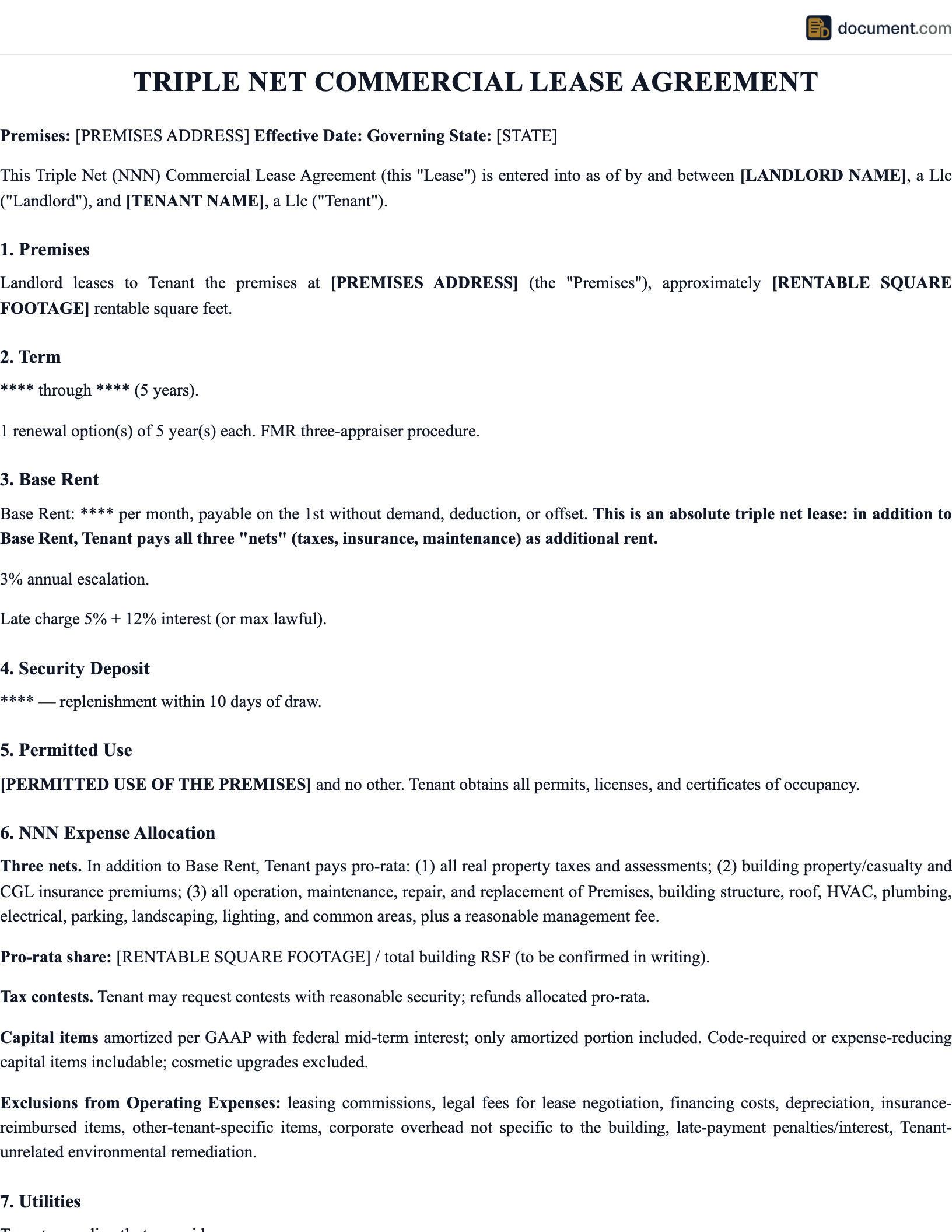



Oregon NNN Lease Overview
Oregon triple-net leases are governed by contract law, with no state statutes specifically regulating commercial tenant rights in NNN leases. The Portland metro area is Oregon's dominant commercial real estate market, with a mix of institutional and private landlords across office, industrial, and retail property types. Oregon's NNN market has distinct characteristics compared to other West Coast markets, including the influence of Measure 50 on property tax growth rates and the broader discussion around commercial rent regulation in Portland.
Oregon's lack of a statewide sales tax is relevant context for retail tenants, while the Corporate Activity Tax affects business tenants' overall occupancy cost. Property taxes are assessed county by county with a Measure 50 cap on annual assessment increases of 3%, which limits property tax escalation risk for NNN tenants compared to uncapped states. Tenants should request prior-year property tax bills and understand the Measure 50 cap before finalizing their NNN cost projections.
$56
Recording fee
Varies by county
Transfer tax
Required
Notarization
0
Witnesses required
Oregon Requirements
Oregon commercial leases are purely contractual. Both parties have significant freedom to negotiate the scope of NNN obligations, and Oregon courts enforce the terms the parties agreed to. Key provisions to focus on include expense definitions, CAM audit rights, the Measure 50 context for property tax pass-throughs, and structural maintenance allocations.
Oregon Specific Note
Oregon's Measure 50 caps property assessment increases at 3% per year, which limits NNN property tax growth for tenants in established buildings. However, major improvements or use changes can trigger reassessment outside the cap. Oregon has no commercial rent tax at the state level. Portland's active commercial rent control discussions make it worth monitoring local legislative developments if you are signing a long-term NNN lease in the Portland metro.
Key NNN Lease Provisions for Oregon
- Expense Definitions: Define each NNN layer, including which costs are operating expenses versus capital improvements, and which are excluded
- Property Tax Pass-Through: Confirm whether the Measure 50 assessed value or market value is the basis for the property tax bill and understand when reassessment events can disrupt the cap
- CAM Audit Rights: Negotiate a 90 to 180 day window after the annual CAM reconciliation to audit expense records
- Controllable Expense Caps: Annual cap on increases to management fees, administrative costs, and other controllable CAM items
- Roof and Structural Allocation: Clear written assignment of responsibility for the roof membrane, structural shell, and foundation
- Casualty Abatement: Provisions addressing NNN obligation abatement if the building is damaged and undergoing reconstruction
How to File in Oregon
An Oregon NNN lease is a private contract. The steps below describe the typical process from negotiation through execution and optional recording.
Draft and Negotiate NNN Expense Definitions
Define each of the three NNN cost layers with specificity; address capital versus operating expense distinctions and specify which costs are excluded from pass-throughs
Review Oregon Property Tax History Under Measure 50
Request prior-year property tax bills from the county assessor; understand that Oregon's Measure 50 caps assessment growth at 3% annually unless improvements or use changes trigger reassessment
Negotiate Audit Rights and Expense Caps
Oregon law does not require landlords to provide CAM audit rights; negotiate a specific audit window and cap controllable expense increases to limit long-term cost exposure
Execute the Lease
Both parties sign; Oregon's statute of frauds requires leases over one year to be in writing and signed by the party to be charged
Record with County Clerk if Required
For long-term leases, consider recording with the county clerk to give constructive notice; notarize signatures and confirm the county's current recording fee (typically around $56 base fee in Oregon)
Oregon Fees & Costs
Typical costs associated with an Oregon NNN lease, including any recording fees if the parties elect to record the lease with the county clerk.
| Fee / Cost | Amount |
|---|---|
| County Clerk Recording Fee (if recorded) | Approximately $56 base fee; confirm with county |
| Annual Property Tax Pass-Through | Varies by county assessor; Measure 50 caps growth at 3% annually in Oregon |
| Building Insurance Pass-Through | Actual premiums; verify scope and adequacy |
| CAM Charges | Monthly estimate with annual reconciliation; negotiate expense caps |
| Attorney Review (recommended) | $350 - $750 for NNN lease review by an Oregon commercial real estate attorney |
Oregon Tax Implications
Oregon's transfer tax rate is Varies by county. Understanding the full tax picture is important for any real property transaction in Oregon.
Gift transfers may require IRS Form 709 if the value exceeds the annual gift tax exclusion. Recipients may receive the transferor's cost basis, potentially resulting in capital gains tax upon future sale.
Property tax reassessment rules vary in Oregon. Some transfers trigger reassessment while others are exempt. Contact the Oregon tax assessor's office for guidance on your specific transaction.
Sample Oregon NNN Lease
Preview of our Oregon-specific template. Your document will include all fields required for recording in any Oregon county.
TRIPLE NET (NNN) COMMERCIAL LEASE
STATE OF OREGON
Legal Document
PARTY INFORMATION
Name: [Full Legal Name]
Address: [Oregon Address]
County: [County]
PROPERTY DESCRIPTION
County: [County] State: Oregon
Legal Description: [Per Recorded Plat]
Parcel No.: [APN]
Oregon NNN Lease FAQ
Common questions about filing in Oregon, including requirements, fees, and tax implications.
Official Oregon Resources
Official state resources for verifying requirements and finding your local recording office.
Important Considerations
Before proceeding with your document, there are several important factors to consider. Each real estate transaction is unique, and understanding the specific requirements and implications of your situation will help ensure a smooth process.
Real estate laws and regulations are subject to change, and local requirements may differ from state-level rules. It is always advisable to verify current requirements with your local recording office before submitting any documents for recording.
If your transaction involves complex circumstances such as multiple parties, commercial properties, trusts, estates, or interstate elements, consulting with a licensed real estate attorney in your state is strongly recommended. An attorney can provide guidance specific to your situation and help you avoid potential legal issues.
Keep copies of all documents related to your real estate transaction in a safe place. Recorded documents become part of the public record, but having your own copies ensures you can reference the terms and conditions at any time. Digital copies stored securely are also recommended as a backup.
Professional Recommendation
While our templates are designed to be comprehensive and legally compliant, we recommend having your completed document reviewed by a licensed attorney before recording, especially for high-value transactions or complex situations. Many attorneys offer flat-fee document review services that provide peace of mind at a reasonable cost.
Related Documents
Depending on your situation, you may need additional documents alongside this one. Below are commonly related documents that are frequently used together in real estate transactions.
Important Considerations
Before proceeding with your document, there are several important factors to consider. Each real estate transaction is unique, and understanding the specific requirements and implications of your situation will help ensure a smooth and legally compliant process.
Real estate laws and regulations are subject to change, and local requirements may differ from state-level rules. It is always advisable to verify current requirements with your local recording office before submitting any documents for recording.
If your transaction involves complex circumstances such as multiple parties, commercial properties, trusts, estates, or interstate elements, consulting with a licensed real estate attorney is strongly recommended. An attorney can provide guidance specific to your situation and help you avoid potential legal issues.
Keep copies of all documents related to your real estate transaction in a safe place. Recorded documents become part of the public record, but having your own copies ensures you can reference the terms and conditions at any time. Digital copies stored securely are also recommended as a backup.
Professional Recommendation
While our templates are designed to be comprehensive and legally compliant, we recommend having your completed document reviewed by a licensed attorney before recording, especially for high-value transactions or complex situations. Many attorneys offer flat-fee document review services that provide peace of mind at a reasonable cost.
Related Documents
Depending on your situation, you may need additional documents alongside this one. Below are commonly related documents that are frequently used together in real estate transactions.
Create your Oregon Commercial Triple Net Lease Agreement in under 5 minutes.
Answer a few questions and download a Oregon-compliant document, ready for the state agency.