
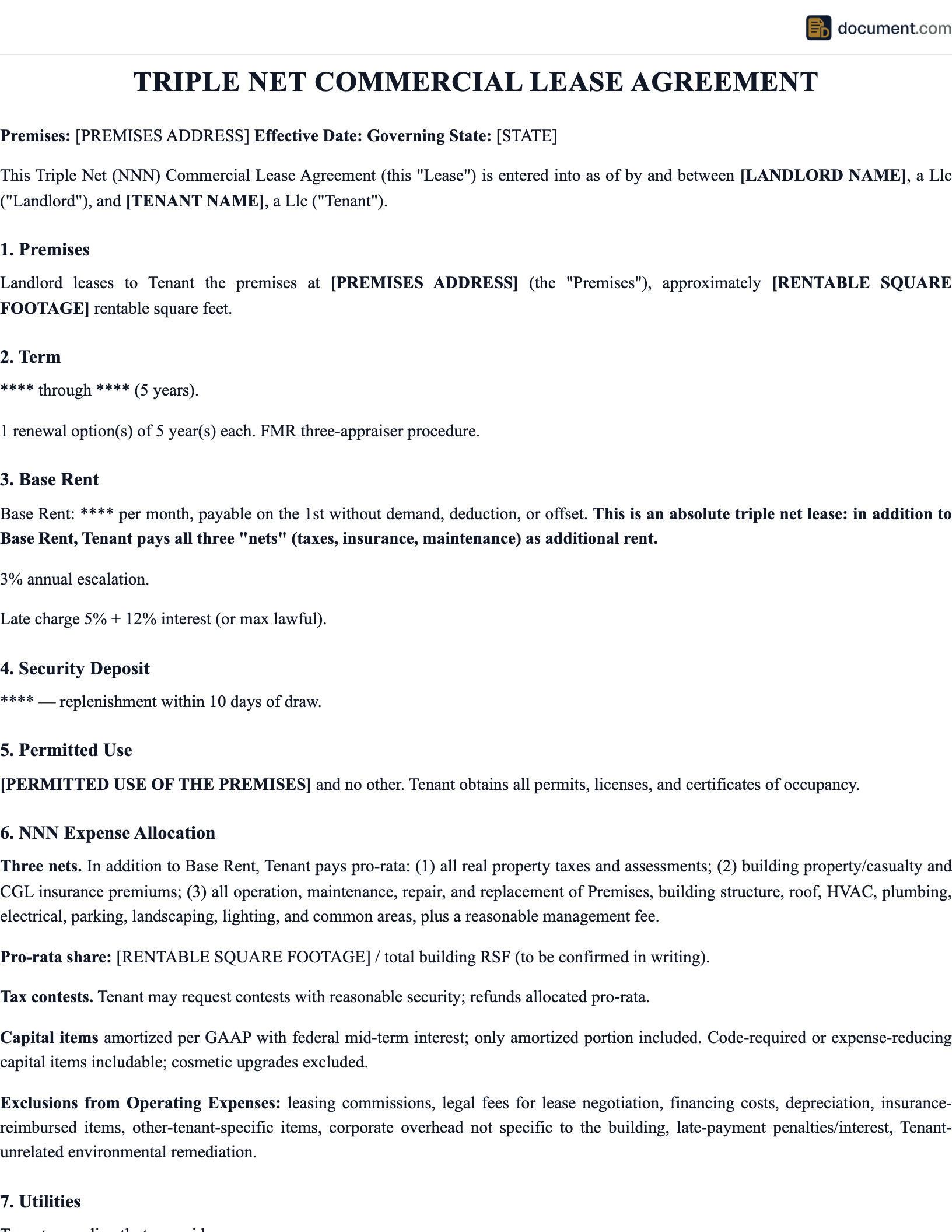



Ohio Triple Net (NNN) Lease Agreement Overview
A triple net lease requires the tenant to pay base rent plus property taxes, building insurance, and operating expenses including maintenance. Ohio is a significant commercial real estate state with three major metropolitan markets: Columbus, the largest and fastest-growing; Cleveland, with substantial industrial and medical corridor activity; and Cincinnati, with strong retail and suburban office demand. NNN structures are the standard lease format for freestanding retail, industrial facilities, and multi-tenant shopping centers across all three markets.
Ohio commercial leases are governed entirely by contract. No state statute caps CAM escalations, sets maintenance responsibility, or limits what expenses can be passed through to tenants. That means the lease document itself controls every significant cost question, and vague drafting routinely produces disputes over CAM reconciliation, capital expense allocation, and property tax reimbursement. Both landlords and tenants benefit from precise lease language reviewed by Ohio counsel before execution.
NNN
Standard industrial / retail
Contract
Governs all terms
Annual
CAM reconciliation
3 Cities
Columbus, Cleveland, Cincinnati
Ohio NNN Lease Requirements
Ohio commercial NNN leases are contract-driven. The lease should specify every expense category the tenant is responsible for, how costs are allocated in multi-tenant buildings, and what protections the tenant has against inflated or improperly included charges. Getting these provisions right at the drafting stage prevents costly disputes during the lease term.
Absolute NNN vs. Modified NNN in Ohio
Ohio freestanding retail properties often use absolute NNN structures where the tenant bears all costs including roof and structure. Multi-tenant shopping centers typically use modified NNN with the landlord retaining structural responsibility. Verify which type you are signing before executing any Ohio NNN lease, as the financial exposure is substantially different.
Key Lease Provisions to Address
- CAM Definitions and Caps: Define every included expense category with specificity and negotiate annual CAM escalation caps, typically 3% to 5% per year excluding certain uncontrollable costs
- Property Tax Pass-Through: Confirm whether the tenant pays its allocable share of real property taxes assessed on the parcel and address the timing of payments relative to when Ohio counties issue their tax bills
- Maintenance Matrix: Set out clearly which party maintains what, covering HVAC, roof, parking lot, plumbing, electrical, and structural components
- Audit Rights: Include the right to audit operating expense reconciliations annually, with a defined audit window, advance notice requirement, and cost-shifting provision for material overcharges
- Insurance Requirements: Specify minimum liability coverage amounts, property insurance obligations, any umbrella or excess liability requirements, and the additional insured designation
- Casualty and Abatement: Address what happens when the premises is damaged by fire or casualty, including the timeline for restoration and whether rent is abated during repairs
How to Negotiate an Ohio NNN Lease
A well-negotiated NNN lease protects both parties from years of cost disputes. Here is a practical process for Ohio landlords and tenants.
Request Historical Operating Expense Data
Ask the landlord for the past two to three years of actual CAM reconciliations, property tax bills, and insurance premiums. Ohio county tax assessor websites provide property tax history for most parcels. Use this data to model your actual occupancy cost at different expense growth scenarios before agreeing to any lease terms.
Identify Whether the Lease Is Absolute or Modified NNN
Confirm landlord versus tenant responsibility for roof, structure, HVAC, and parking lot capital repairs. Ohio freestanding properties often use absolute NNN while multi-tenant centers use modified NNN. The distinction can mean tens of thousands of dollars in unexpected costs if a major repair is needed during the lease term.
Negotiate CAM Caps, Exclusions, and Audit Rights
Push for annual CAM escalation caps to protect against sudden cost spikes. Negotiate exclusions for capital improvements, management fee percentages above market, and costs that benefit only other tenants. Confirm audit rights are in the lease with specific procedural language rather than a vague right to audit.
Have an Ohio Commercial Real Estate Attorney Review the Draft
An Ohio attorney familiar with Columbus, Cleveland, or Cincinnati commercial lease markets should review the complete draft, not just the economic terms. Pay particular attention to the default and cure provisions, the landlord's self-help rights, any personal guarantee clause, and the renewal option mechanics. Attorney review for an Ohio NNN lease typically costs $500 to $2,500 depending on complexity.
Execute the Lease and Set Up Expense Tracking
Both parties sign. The tenant should immediately set up tracking for monthly CAM estimates, the annual reconciliation deadline, property tax payment timing relative to Ohio county billing cycles, and all option exercise deadlines. Organized record-keeping makes audits straightforward and prevents missed rights.
Ohio NNN Lease Costs
Cost ranges below reflect typical Ohio commercial NNN transactions across Columbus, Cleveland, and Cincinnati. Actual figures depend on submarket, property class, and lease terms.
| Fee / Cost | Amount |
|---|---|
| NNN Base Rent (Columbus suburban retail) | $16 - $30 per sq ft annually |
| NNN Base Rent (Cleveland / Cincinnati retail) | $14 - $26 per sq ft annually |
| NNN Base Rent (Ohio industrial) | $4 - $9 per sq ft annually |
| Property Tax Pass-Through | $2 - $6 per sq ft (varies by county) |
| CAM and Insurance | $3 - $8 per sq ft annually |
| Attorney Review | $500 - $2,500 |
Ohio Tax Implications
Ohio's transfer tax rate is $1 per $1,000. Understanding the full tax picture is important for any real property transaction in Ohio.
Gift transfers may require IRS Form 709 if the value exceeds the annual gift tax exclusion. Recipients may receive the transferor's cost basis, potentially resulting in capital gains tax upon future sale.
Property tax reassessment rules vary in Ohio. Some transfers trigger reassessment while others are exempt. Contact the Ohio tax assessor's office for guidance on your specific transaction.
Sample Ohio NNN Lease
Preview of our Ohio-specific template. Your document will include all fields required for recording in any Ohio county.
TRIPLE NET (NNN) COMMERCIAL LEASE
STATE OF OHIO
Legal Document
PARTY INFORMATION
Name: [Full Legal Name]
Address: [Ohio Address]
County: [County]
PROPERTY DESCRIPTION
County: [County] State: Ohio
Legal Description: [Per Recorded Plat]
Parcel No.: [APN]
Ohio NNN Lease FAQ
Common questions about filing in Ohio, including requirements, fees, and tax implications.
Official Ohio Resources
Official state resources for verifying requirements and finding your local recording office.
Important Considerations
Before proceeding with your document, there are several important factors to consider. Each real estate transaction is unique, and understanding the specific requirements and implications of your situation will help ensure a smooth process.
Real estate laws and regulations are subject to change, and local requirements may differ from state-level rules. It is always advisable to verify current requirements with your local recording office before submitting any documents for recording.
If your transaction involves complex circumstances such as multiple parties, commercial properties, trusts, estates, or interstate elements, consulting with a licensed real estate attorney in your state is strongly recommended. An attorney can provide guidance specific to your situation and help you avoid potential legal issues.
Keep copies of all documents related to your real estate transaction in a safe place. Recorded documents become part of the public record, but having your own copies ensures you can reference the terms and conditions at any time. Digital copies stored securely are also recommended as a backup.
Professional Recommendation
While our templates are designed to be comprehensive and legally compliant, we recommend having your completed document reviewed by a licensed attorney before recording, especially for high-value transactions or complex situations. Many attorneys offer flat-fee document review services that provide peace of mind at a reasonable cost.
Related Documents
Depending on your situation, you may need additional documents alongside this one. Below are commonly related documents that are frequently used together in real estate transactions.
Important Considerations
Before proceeding with your document, there are several important factors to consider. Each real estate transaction is unique, and understanding the specific requirements and implications of your situation will help ensure a smooth and legally compliant process.
Real estate laws and regulations are subject to change, and local requirements may differ from state-level rules. It is always advisable to verify current requirements with your local recording office before submitting any documents for recording.
If your transaction involves complex circumstances such as multiple parties, commercial properties, trusts, estates, or interstate elements, consulting with a licensed real estate attorney is strongly recommended. An attorney can provide guidance specific to your situation and help you avoid potential legal issues.
Keep copies of all documents related to your real estate transaction in a safe place. Recorded documents become part of the public record, but having your own copies ensures you can reference the terms and conditions at any time. Digital copies stored securely are also recommended as a backup.
Professional Recommendation
While our templates are designed to be comprehensive and legally compliant, we recommend having your completed document reviewed by a licensed attorney before recording, especially for high-value transactions or complex situations. Many attorneys offer flat-fee document review services that provide peace of mind at a reasonable cost.
Related Documents
Depending on your situation, you may need additional documents alongside this one. Below are commonly related documents that are frequently used together in real estate transactions.
Create your Ohio Commercial Triple Net Lease Agreement in under 5 minutes.
Answer a few questions and download a Ohio-compliant document, ready for the state agency.