



Louisiana NNN Lease Overview
Louisiana is the only state in the country that follows a civil law tradition rooted in the Napoleonic Code rather than English common law. Commercial leases in Louisiana are governed by the Civil Code, specifically Articles 2668 through 2729, and parties need to understand how those provisions interact with NNN lease terms. An attorney unfamiliar with Louisiana's civil law framework can miss important issues that a common-law trained practitioner would not even think to check.
In a Louisiana NNN lease, the tenant pays base rent plus property taxes assessed by parish assessors, building insurance, and maintenance costs. One feature unique to Louisiana is the lessor's privilege, which gives the landlord an automatic statutory lien on tenant movables for unpaid obligations. This privilege arises under the Civil Code without any written agreement and is especially important to understand for tenants with high-value equipment on the premises. New Orleans and Baton Rouge are the primary commercial markets in the state.
$50
Recording fee
None
Transfer tax
Required
Notarization
2
Witnesses required
Louisiana NNN Lease Requirements
Louisiana NNN leases must comply with both the Civil Code provisions on leases and any additional terms the parties negotiate. The Civil Code establishes baseline obligations for lessor and lessee that can be modified by contract in many respects, but not in all. For leases to be recorded, they must be in authentic form (before a notary with two witnesses) or a private act acknowledged before a notary.
Louisiana Specific Note
Louisiana's lessor's privilege arises automatically on tenant movables under Civil Code Article 2707. You cannot waive this by simply not writing it into the lease. NNN tenants with valuable equipment on-site should understand this and consider negotiating a waiver or subordination of the privilege as part of lease negotiations. Parish assessors value commercial property independently, and rates vary by parish.
Key Lease Terms to Address
- Civil Code Compliance: Lease terms should be reviewed against LA Civil Code Articles 2668-2729
- Lessor's Privilege: Address whether the landlord will subordinate or waive the statutory privilege
- Parish Tax Pass-Through: Specify how parish-assessed property taxes are billed and reconciled
- Flood Insurance: Clarify whether flood insurance is included in the building insurance pass-through
- CAM Definitions: Define all maintenance categories to avoid disputes under Louisiana contract law
- Recordation: For leases of one year or more, record a memorandum with the parish clerk of court
How to Execute a Louisiana NNN Lease
Louisiana's civil law framework adds steps that landlords and tenants in other states would not encounter. Here is a practical sequence for executing a Louisiana NNN commercial lease.
Engage a Louisiana-Licensed Attorney
Given the Civil Code framework and the automatic lessor's privilege, a Louisiana-licensed commercial real estate attorney is essential for NNN leases. Common-law expertise from other states does not transfer directly to Louisiana practice.
Review Parish Property Tax History
Request the current parish assessment and recent tax bills. Parish assessors reassess commercial property periodically, so the current assessment may not reflect what you will pay in year two or three of the lease term.
Negotiate Privilege Subordination and CAM Terms
If you have valuable equipment or inventory, negotiate a waiver or subordination of the lessor's privilege. Define all NNN expense categories clearly and negotiate expense caps on controllable CAM items.
Execute Before a Notary With Two Witnesses
For authentic act execution (required for recording without acknowledgment), the lease must be signed before a Louisiana notary public and two witnesses. Both landlord and tenant should retain original copies.
Record a Memorandum With the Parish Clerk
File a memorandum of lease (not the full agreement) with the parish clerk of court to provide constructive notice without exposing confidential rent and financial terms in the public record.
Louisiana NNN Lease Costs
Typical costs for a Louisiana NNN commercial lease, covering both transaction expenses and ongoing pass-through obligations. Parish assessment rates and flood insurance costs can vary significantly depending on location.
| Cost Item | Typical Range |
|---|---|
| Base Rent (NNN retail, New Orleans area) | $12 - $28 per sq ft per year |
| Property Tax Pass-Through (parish-assessed) | $1.50 - $4.50 per sq ft per year |
| Building Insurance (including flood where applicable) | $0.50 - $2.00 per sq ft per year |
| CAM / Maintenance Pass-Through | $1.00 - $3.50 per sq ft per year |
| Louisiana-Licensed Attorney Review | $1,000 - $3,500 |
Louisiana Tax Implications
Louisiana's transfer tax rate is None. Understanding the full tax picture is important for any real property transaction in Louisiana.
Gift transfers may require IRS Form 709 if the value exceeds the annual gift tax exclusion. Recipients may receive the transferor's cost basis, potentially resulting in capital gains tax upon future sale.
Property tax reassessment rules vary in Louisiana. Some transfers trigger reassessment while others are exempt. Contact the Louisiana tax assessor's office for guidance on your specific transaction.
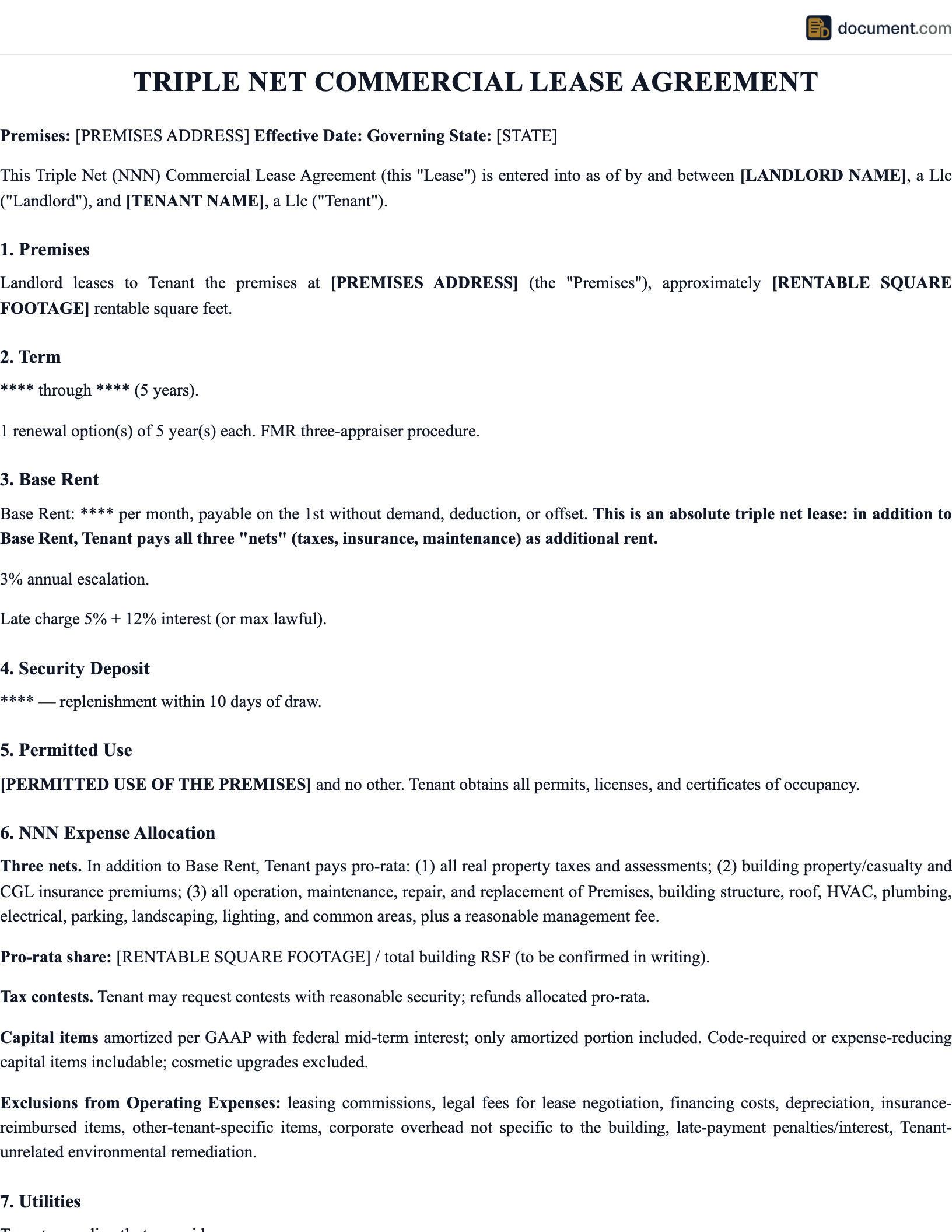
Sample Louisiana NNN Lease
Preview of our Louisiana-specific template. Your document will include all fields required for recording in any Louisiana county.
TRIPLE NET (NNN) COMMERCIAL LEASE
STATE OF LOUISIANA
Legal Document
PARTY INFORMATION
Name: [Full Legal Name]
Address: [Louisiana Address]
County: [County]
PROPERTY DESCRIPTION
County: [County] State: Louisiana
Legal Description: [Per Recorded Plat]
Parcel No.: [APN]
Louisiana NNN Lease FAQ
Common questions about filing in Louisiana, including requirements, fees, and tax implications.
Official Louisiana Resources
Official state resources for verifying requirements and finding your local recording office.
Important Considerations
Before proceeding with your document, there are several important factors to consider. Each real estate transaction is unique, and understanding the specific requirements and implications of your situation will help ensure a smooth process.
Real estate laws and regulations are subject to change, and local requirements may differ from state-level rules. It is always advisable to verify current requirements with your local recording office before submitting any documents for recording.
If your transaction involves complex circumstances such as multiple parties, commercial properties, trusts, estates, or interstate elements, consulting with a licensed real estate attorney in your state is strongly recommended. An attorney can provide guidance specific to your situation and help you avoid potential legal issues.
Keep copies of all documents related to your real estate transaction in a safe place. Recorded documents become part of the public record, but having your own copies ensures you can reference the terms and conditions at any time. Digital copies stored securely are also recommended as a backup.
Professional Recommendation
While our templates are designed to be comprehensive and legally compliant, we recommend having your completed document reviewed by a licensed attorney before recording, especially for high-value transactions or complex situations. Many attorneys offer flat-fee document review services that provide peace of mind at a reasonable cost.
Related Documents
Depending on your situation, you may need additional documents alongside this one. Below are commonly related documents that are frequently used together in real estate transactions.
Important Considerations
Before proceeding with your document, there are several important factors to consider. Each real estate transaction is unique, and understanding the specific requirements and implications of your situation will help ensure a smooth and legally compliant process.
Real estate laws and regulations are subject to change, and local requirements may differ from state-level rules. It is always advisable to verify current requirements with your local recording office before submitting any documents for recording.
If your transaction involves complex circumstances such as multiple parties, commercial properties, trusts, estates, or interstate elements, consulting with a licensed real estate attorney is strongly recommended. An attorney can provide guidance specific to your situation and help you avoid potential legal issues.
Keep copies of all documents related to your real estate transaction in a safe place. Recorded documents become part of the public record, but having your own copies ensures you can reference the terms and conditions at any time. Digital copies stored securely are also recommended as a backup.
Professional Recommendation
While our templates are designed to be comprehensive and legally compliant, we recommend having your completed document reviewed by a licensed attorney before recording, especially for high-value transactions or complex situations. Many attorneys offer flat-fee document review services that provide peace of mind at a reasonable cost.
Related Documents
Depending on your situation, you may need additional documents alongside this one. Below are commonly related documents that are frequently used together in real estate transactions.
Create your Louisiana Commercial Triple Net Lease Agreement in under 5 minutes.
Answer a few questions and download a Louisiana-compliant document, ready for the state agency.