



Kansas NNN Lease Overview
Kansas is a contract-law state for commercial real estate, which means the terms of a triple-net lease are largely what the parties negotiate. There is no statewide commercial landlord-tenant statute that overrides clearly written lease provisions. That puts a premium on getting the NNN expense structure precisely defined before execution. The Wichita and Kansas City metro areas are the two main commercial markets, and both have active retail corridors along I-70, I-135, and K-96 where freestanding NNN deals are common.
In a Kansas NNN lease, the tenant takes on base rent plus real property taxes (assessed by county appraisers), building insurance, and all maintenance costs including common area maintenance. Property taxes vary significantly by county, so tenants should request recent tax bills before committing to a NNN deal. Kansas has no commercial rent tax, and there is no statewide transfer tax on commercial leases, which keeps friction costs low compared to states like Maryland.
$21
Recording fee
None
Transfer tax
Required
Notarization
0
Witnesses required
Kansas NNN Lease Requirements
Kansas commercial leases are governed by contract law, and courts will generally enforce the written terms. For a NNN lease to be enforceable, it needs to clearly define all three expense categories and allocate responsibility without ambiguity. Kansas courts have ruled against landlords who tried to pass through expenses not specifically listed in the lease.
Kansas Specific Note
Kansas has no state commercial rent tax and no transfer tax on commercial leases. Property taxes are assessed at the county level by county appraisers, not a central state authority. HVAC maintenance obligations are especially important to define given Kansas weather extremes. Industrial NNN leases in the Wichita market often include specific provisions for exterior maintenance given tornado and hail exposure.
Key Lease Terms to Include
- Expense Definitions: Clearly list which costs are passed through as taxes, insurance, and maintenance
- CAM Reconciliation: Annual reconciliation process with deadlines and tenant audit rights
- HVAC Responsibility: Specify whether tenant or landlord handles HVAC repair and replacement
- Roof and Structure: Define who is responsible for roof repair and major structural items
- Expense Caps: Annual CAM increase caps on controllable expenses (typically 3 to 5 percent)
- Tax Contest Rights: Whether tenant can contest county property tax assessments directly
How to Execute a Kansas NNN Lease
Executing a Kansas NNN lease properly requires careful attention to the expense provisions and tenant protections before anyone picks up a pen. Here is a practical sequence to follow.
Request Prior Year Expense History
Ask the landlord for 2 to 3 years of actual property tax bills, insurance premiums, and CAM reconciliation statements so you can project your true occupancy cost
Draft and Negotiate the Lease
Work through expense definitions, CAM caps, HVAC obligations, roof responsibility, and audit rights before finalizing. Kansas courts enforce what is written, so precision matters here.
Review County Property Tax Assessment
Check the current assessed value with the county appraiser. Kansas property taxes can spike after a recent sale or improvement, which would flow directly through to your NNN obligation.
Execute and Retain Original Copies
Both landlord and tenant should sign and retain original executed copies. Long-term commercial leases are often recorded with the county register of deeds to provide constructive notice.
Set Up Escrow or Billing for Pass-Through Costs
Establish whether pass-through costs will be paid monthly as an estimate with annual true-up, or billed separately as they arise. Monthly escrow is the most common structure in Kansas retail NNN deals.
Kansas NNN Lease Costs
Below are typical transaction and occupancy costs associated with a Kansas NNN commercial lease. The pass-through costs vary by property and county, so treat the ranges as estimates only.
| Cost Item | Typical Range |
|---|---|
| Base Rent (NNN strip retail, Wichita area) | $10 - $22 per sq ft per year |
| Property Tax Pass-Through (county-assessed) | $1.50 - $4.00 per sq ft per year |
| Building Insurance Pass-Through | $0.25 - $0.75 per sq ft per year |
| CAM / Maintenance Pass-Through | $1.00 - $3.50 per sq ft per year |
| Commercial Real Estate Attorney Review | $500 - $2,500 |
Kansas Tax Implications
Kansas's transfer tax rate is None. Understanding the full tax picture is important for any real property transaction in Kansas.
Gift transfers may require IRS Form 709 if the value exceeds the annual gift tax exclusion. Recipients may receive the transferor's cost basis, potentially resulting in capital gains tax upon future sale.
Property tax reassessment rules vary in Kansas. Some transfers trigger reassessment while others are exempt. Contact the Kansas tax assessor's office for guidance on your specific transaction.
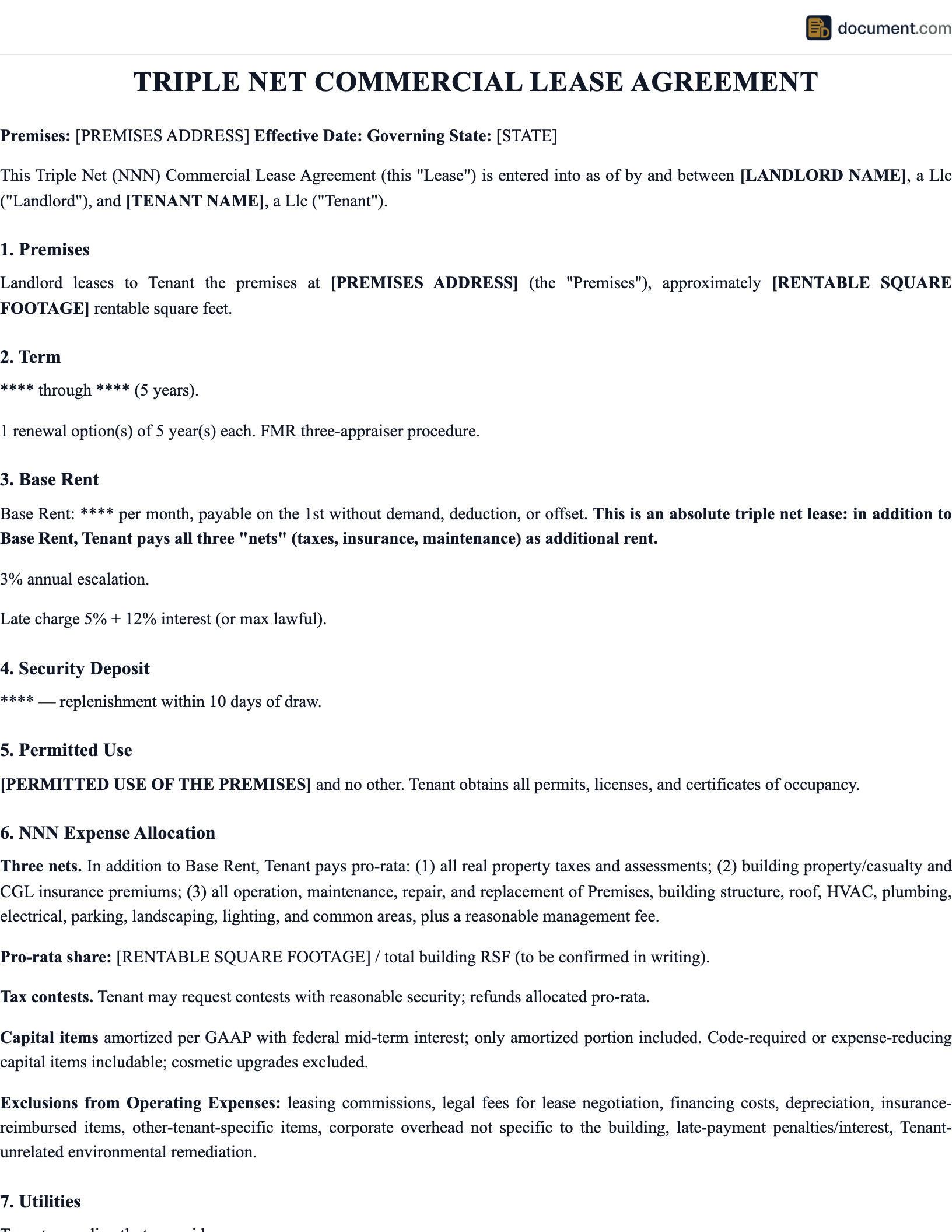
Sample Kansas NNN Lease
Preview of our Kansas-specific template. Your document will include all fields required for recording in any Kansas county.
TRIPLE NET (NNN) COMMERCIAL LEASE
STATE OF KANSAS
Legal Document
PARTY INFORMATION
Name: [Full Legal Name]
Address: [Kansas Address]
County: [County]
PROPERTY DESCRIPTION
County: [County] State: Kansas
Legal Description: [Per Recorded Plat]
Parcel No.: [APN]
Kansas NNN Lease FAQ
Common questions about filing in Kansas, including requirements, fees, and tax implications.
Official Kansas Resources
Official state resources for verifying requirements and finding your local recording office.
Important Considerations
Before proceeding with your document, there are several important factors to consider. Each real estate transaction is unique, and understanding the specific requirements and implications of your situation will help ensure a smooth process.
Real estate laws and regulations are subject to change, and local requirements may differ from state-level rules. It is always advisable to verify current requirements with your local recording office before submitting any documents for recording.
If your transaction involves complex circumstances such as multiple parties, commercial properties, trusts, estates, or interstate elements, consulting with a licensed real estate attorney in your state is strongly recommended. An attorney can provide guidance specific to your situation and help you avoid potential legal issues.
Keep copies of all documents related to your real estate transaction in a safe place. Recorded documents become part of the public record, but having your own copies ensures you can reference the terms and conditions at any time. Digital copies stored securely are also recommended as a backup.
Professional Recommendation
While our templates are designed to be comprehensive and legally compliant, we recommend having your completed document reviewed by a licensed attorney before recording, especially for high-value transactions or complex situations. Many attorneys offer flat-fee document review services that provide peace of mind at a reasonable cost.
Related Documents
Depending on your situation, you may need additional documents alongside this one. Below are commonly related documents that are frequently used together in real estate transactions.
Important Considerations
Before proceeding with your document, there are several important factors to consider. Each real estate transaction is unique, and understanding the specific requirements and implications of your situation will help ensure a smooth and legally compliant process.
Real estate laws and regulations are subject to change, and local requirements may differ from state-level rules. It is always advisable to verify current requirements with your local recording office before submitting any documents for recording.
If your transaction involves complex circumstances such as multiple parties, commercial properties, trusts, estates, or interstate elements, consulting with a licensed real estate attorney is strongly recommended. An attorney can provide guidance specific to your situation and help you avoid potential legal issues.
Keep copies of all documents related to your real estate transaction in a safe place. Recorded documents become part of the public record, but having your own copies ensures you can reference the terms and conditions at any time. Digital copies stored securely are also recommended as a backup.
Professional Recommendation
While our templates are designed to be comprehensive and legally compliant, we recommend having your completed document reviewed by a licensed attorney before recording, especially for high-value transactions or complex situations. Many attorneys offer flat-fee document review services that provide peace of mind at a reasonable cost.
Related Documents
Depending on your situation, you may need additional documents alongside this one. Below are commonly related documents that are frequently used together in real estate transactions.
Create your Kansas Commercial Triple Net Lease Agreement in under 5 minutes.
Answer a few questions and download a Kansas-compliant document, ready for the state agency.