



Iowa NNN Lease Overview
In an Iowa NNN lease, the tenant takes on financial responsibility for property taxes, property insurance, and common area maintenance on top of a base rent. Iowa does not impose a commercial rent tax, so the cost structure is straightforward from a tax standpoint. The complexity lies in Iowa's property tax rollback system, which affects how much taxable value the tenant is actually paying taxes on each year. Understanding how the rollback is applied in the county where the property sits is essential before agreeing to any tax pass-through language.
Iowa contract law governs commercial leases, and courts will enforce a well-drafted NNN agreement as written. The Des Moines metro, Cedar Rapids, Iowa City, and the Quad Cities are Iowa's most active commercial markets. Iowa winters make CAM cost management a real issue, particularly for outdoor common areas. Landlords and tenants should be specific about who controls snow removal contracts and whether those costs are subject to a CAM cap.
No state
Commercial rent tax
90% assessed
Commercial rollback
Common
CAM caps in market
Optional
Memorandum recording
Iowa Requirements
Iowa NNN leases are private commercial contracts and do not require recording. The provisions below are the substantive lease requirements, not filing formalities. Getting these terms right is what protects both parties through the full lease term.
Iowa Property Tax Rollback Warning
Iowa assesses commercial real property at 90% of actual value and then applies an annual rollback factor set by the state that can further reduce the taxable value. This means the actual property tax bill can shift year to year as the rollback changes. NNN leases should define the base-year assessment and rollback percentage so tenants can track changes and landlords can pass through the correct amounts.
Key NNN Lease Provisions
- Property Tax Pass-Through: Identify each tax installment due date under Iowa law and specify when the tenant's reimbursement is owed. Iowa property taxes are typically paid in September and March.
- CAM Definition and Exclusions: List what is included in CAM. Exclude capital expenditures, management fees above market, and costs covered by insurance proceeds or warranties. Address snow removal specifically given Iowa winters.
- CAM Cap: Tenants should negotiate an annual cap on controllable CAM increases of 3% to 5% per year, with uncontrollable costs such as utilities and snow removal excluded from the cap calculation.
- Structural Responsibility: State clearly whether the tenant or landlord is responsible for the roof, foundation, and exterior walls. True absolute NNN leases assign this to the tenant; modified NNN leases often keep structural items with the landlord.
- Audit Rights: Give the tenant the right to audit CAM and property tax reconciliation statements within 12 to 24 months after receiving the annual statement. Cost-shifting if overcharge exceeds a stated threshold.
How to File in Iowa
Preparing an Iowa NNN lease well requires working through the cost allocation terms before drafting begins. These steps cover the commercial substance of the agreement, not just the paperwork.
Obtain Iowa Operating Cost History
Request two to three years of property tax bills, insurance invoices, and CAM reconciliation statements. For properties in Des Moines, Cedar Rapids, or the Quad Cities, verify the county assessment and rollback percentage that will apply. This data supports negotiation on base rent and expense caps.
Define the Three NNN Cost Categories
Agree on what goes into each NNN bucket: property taxes with Iowa installment dates, insurance with coverage minimums, and CAM with explicit inclusions and exclusions. Iowa winters make snow removal a material CAM cost, so address it specifically rather than leaving it to a general CAM definition.
Negotiate Structural Responsibility and CAM Cap
Decide which party handles the roof, foundation, and exterior walls. Agree on an annual cap on controllable CAM increases and whether snow removal is inside or outside the cap. Document this in the lease, not just in negotiation emails.
Set Reconciliation and Audit Provisions
Require annual CAM and property tax reconciliation statements within 90 to 120 days after each lease year. Give the tenant audit rights covering the prior two years. Specify cost-shifting if the audit reveals an overcharge above a stated threshold, typically 3% to 5% of estimated annual charges.
Execute and Consider Recording a Memorandum
Both parties sign the lease. For long-term NNN leases, consider recording a memorandum of lease at the county recorder to establish the leasehold in the public record without disclosing financial terms. Recording fees in Iowa start at $15 for the first page.
Iowa Fees & Costs
These are the typical cost components for an Iowa NNN lease, including the tenant's pass-through obligations and transaction costs for both parties.
| Fee / Cost | Amount |
|---|---|
| Base Rent | Negotiated; Iowa market rates vary significantly by submarket and property type |
| Property Taxes | Tenant pays pro-rata share; Iowa commercial assessed at 90% AV with rollback; installments due September and March |
| Property Insurance | Tenant pays pro-rata share; landlord typically maintains policy and bills tenant |
| CAM (including snow removal) | Roughly $2 to $5 per SF per year; Iowa winters can push snow removal costs higher |
| Attorney Review | $750 to $2,500 for lease review and negotiation |
| Memorandum of Lease Recording (optional) | $15 for first page plus additional pages at county recorder; transfer tax does not apply to leasehold |
Iowa Tax Implications
Iowa imposes no commercial rent tax, which keeps the operating cost structure straightforward for NNN tenants. The primary tax consideration in an Iowa NNN lease is property tax administration. Iowa assesses commercial real property at 90% of actual value and then applies a rollback factor that the state sets each year. Because the rollback can shift annually, the actual tax bill passed through to a tenant can vary even when the assessed value stays flat.
Iowa property taxes are paid in two installments: typically September 1 and March 1 for the prior fiscal year. NNN leases should align the tenant's reimbursement obligations with these payment dates rather than requiring the tenant to prepay into an escrow that is then reconciled annually. Landlords should also confirm whether any tax exemptions apply to the property, such as urban revitalization exemptions, which could affect the tax pass-through amount.
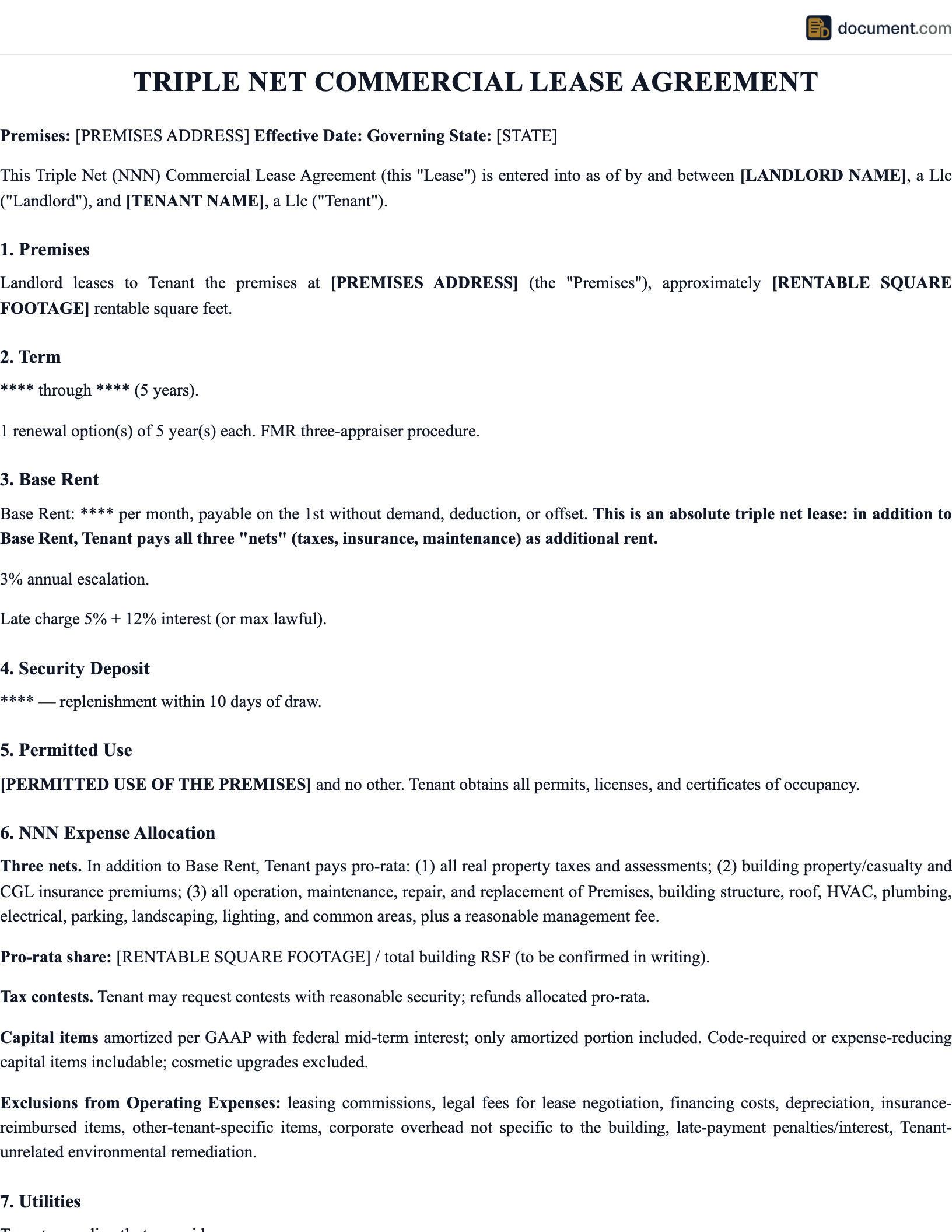
Sample Iowa NNN Lease
Preview of our Iowa-specific template. Your document will include all fields required for recording in any Iowa county.
TRIPLE NET (NNN) COMMERCIAL LEASE
STATE OF IOWA
Legal Document
PARTY INFORMATION
Name: [Full Legal Name]
Address: [Iowa Address]
County: [County]
PROPERTY DESCRIPTION
County: [County] State: Iowa
Legal Description: [Per Recorded Plat]
Parcel No.: [APN]
Iowa NNN Lease FAQ
Common questions about filing in Iowa, including requirements, fees, and tax implications.
Official Iowa Resources
Official state resources for verifying requirements and finding your local recording office.
Important Considerations
Before proceeding with your document, there are several important factors to consider. Each real estate transaction is unique, and understanding the specific requirements and implications of your situation will help ensure a smooth process.
Real estate laws and regulations are subject to change, and local requirements may differ from state-level rules. It is always advisable to verify current requirements with your local recording office before submitting any documents for recording.
If your transaction involves complex circumstances such as multiple parties, commercial properties, trusts, estates, or interstate elements, consulting with a licensed real estate attorney in your state is strongly recommended. An attorney can provide guidance specific to your situation and help you avoid potential legal issues.
Keep copies of all documents related to your real estate transaction in a safe place. Recorded documents become part of the public record, but having your own copies ensures you can reference the terms and conditions at any time. Digital copies stored securely are also recommended as a backup.
Professional Recommendation
While our templates are designed to be comprehensive and legally compliant, we recommend having your completed document reviewed by a licensed attorney before recording, especially for high-value transactions or complex situations. Many attorneys offer flat-fee document review services that provide peace of mind at a reasonable cost.
Related Documents
Depending on your situation, you may need additional documents alongside this one. Below are commonly related documents that are frequently used together in real estate transactions.
Important Considerations
Before proceeding with your document, there are several important factors to consider. Each real estate transaction is unique, and understanding the specific requirements and implications of your situation will help ensure a smooth and legally compliant process.
Real estate laws and regulations are subject to change, and local requirements may differ from state-level rules. It is always advisable to verify current requirements with your local recording office before submitting any documents for recording.
If your transaction involves complex circumstances such as multiple parties, commercial properties, trusts, estates, or interstate elements, consulting with a licensed real estate attorney is strongly recommended. An attorney can provide guidance specific to your situation and help you avoid potential legal issues.
Keep copies of all documents related to your real estate transaction in a safe place. Recorded documents become part of the public record, but having your own copies ensures you can reference the terms and conditions at any time. Digital copies stored securely are also recommended as a backup.
Professional Recommendation
While our templates are designed to be comprehensive and legally compliant, we recommend having your completed document reviewed by a licensed attorney before recording, especially for high-value transactions or complex situations. Many attorneys offer flat-fee document review services that provide peace of mind at a reasonable cost.
Related Documents
Depending on your situation, you may need additional documents alongside this one. Below are commonly related documents that are frequently used together in real estate transactions.
Create your Iowa Commercial Triple Net Lease Agreement in under 5 minutes.
Answer a few questions and download a Iowa-compliant document, ready for the state agency.