



Indiana NNN Lease Overview
A triple net (NNN) lease in Indiana requires the tenant to pay base rent plus property taxes, building insurance, and common area maintenance costs. Indiana is one of the more landlord-friendly and investor-friendly states for NNN commercial real estate because it has no real property transfer tax, no commercial rent tax, and a circuit breaker property tax cap that limits commercial property taxes to 3 percent of assessed value per year. Indianapolis is a consistently active NNN investment market, particularly for industrial, retail, and medical office properties.
Indiana commercial leases are governed by contract law under Indiana Code. There is no specific commercial lease statute mandating minimum tenant protections, which gives parties broad latitude to structure the NNN expense allocation as they see fit. The circuit breaker cap system provides NNN tenants with a degree of property tax predictability that does not exist in states without such caps, though assessed values in Marion County and other urban counties can still increase meaningfully between annual assessments.
No state
Transfer tax
3% cap
Commercial property tax circuit breaker
No state
Commercial rent tax
Optional
Memorandum of lease recording
Indiana NNN Lease Requirements
Indiana NNN leases are governed by contract law under Indiana Code. There are no mandatory commercial lease provisions at the state level, giving the parties full latitude to define the expense structure. The following provisions are essential in any well-drafted Indiana NNN lease.
Indiana Property Tax Circuit Breaker
Indiana's circuit breaker caps commercial property taxes at 3 percent of assessed value. This provides NNN tenants with more cost certainty than in many other states. However, assessed values in Indianapolis's Marion County and surrounding counties can still increase annually. NNN tenants should review three years of assessed value history and the current tax bill before accepting a property tax pass-through obligation.
Required Lease Provisions
- Property Tax Pass-Through: Define whether the tenant pays the full tax bill or a pro-rata share; specify the timing of payments relative to Indiana's spring and fall tax installment due dates
- CAM Definition: List CAM inclusions and exclusions expressly; typical Indiana NNN exclusions include capital expenditures, leasing commissions, management fee percentages above a defined cap, and income taxes
- CAM Cap: Negotiate a controllable CAM expense cap, typically 3 to 5 percent annual growth, excluding non-controllable items such as insurance premiums and snow removal
- Structural Responsibility: Specify who is responsible for the roof, structural components, and building systems; full absolute NNN assigns these to the tenant while modified NNN keeps them with the landlord
- Audit Rights: Include a tenant right to audit CAM and tax reconciliation records within 90 days of receiving the annual statement; require landlord reimbursement of audit costs for overcharges above a defined threshold
How to Prepare an Indiana NNN Lease
Drafting an Indiana NNN lease involves building out the expense structure, not just the rent terms. Follow these steps to prepare a complete and enforceable document.
Review Operating Cost History
Request three years of property tax bills, insurance statements, and CAM reconciliation reports from the landlord. Review the most recent Marion County or local county assessor notice to understand the current assessed value and tax trajectory. Use this data to model the actual total occupancy cost over the lease term.
Define NNN Expense Categories
Draft the lease to define each NNN expense category with explicit inclusions and exclusions. For CAM, separate controllable expenses (landscaping, parking lot, management fees) from non-controllable items (insurance, utilities). Define the base year for CAM cap purposes if a cap is negotiated.
Negotiate Structural Responsibility and Caps
Decide whether the lease is absolute NNN (tenant bears roof and structure) or modified NNN (landlord retains structural obligations). Set the CAM cap rate and define the base year. Separate controllable from non-controllable expenses so the cap applies to what the landlord actually controls.
Set the Reconciliation and Audit Framework
Define the landlord's obligation to deliver an annual CAM and tax reconciliation within 90 to 120 days after year-end, along with monthly estimated payments. Include the tenant's right to audit within 60 to 90 days of receiving the reconciliation and specify that overcharges above a threshold require landlord reimbursement of audit costs.
Execute and Consider Recording a Memorandum
Both parties sign the completed lease. For leases exceeding five years, consider recording a memorandum of lease at the county recorder's office to provide constructive notice to future buyers and lenders. Indiana has no real property transfer tax, so recording costs are minimal and limited to per-page recording fees.
Indiana NNN Lease Fees & Costs
Typical costs associated with an Indiana NNN commercial lease. Property taxes, insurance, and CAM charges are the main variable items beyond the base rent.
| Cost Item | Typical Amount |
|---|---|
| Base Rent | Negotiated; varies by Indianapolis submarket and property class |
| Property Tax Share | Pro-rata share; capped at 3% of assessed value under Indiana circuit breaker |
| Building Insurance Share | Pro-rata share of landlord's property and liability premiums |
| CAM Charges | $2 - $5/sq ft annually; varies by property type |
| Attorney Review | $300 - $1,500+ for Indiana commercial lease review |
| Memorandum of Lease Recording (optional) | Indiana county recorder per-page fees; no transfer tax |
Indiana Tax Implications
Indiana's transfer tax rate is None. Understanding the full tax picture is important for any real property transaction in Indiana.
Gift transfers may require IRS Form 709 if the value exceeds the annual gift tax exclusion. Recipients may receive the transferor's cost basis, potentially resulting in capital gains tax upon future sale.
Property tax reassessment rules vary in Indiana. Some transfers trigger reassessment while others are exempt. Contact the Indiana tax assessor's office for guidance on your specific transaction.
Sample Indiana NNN Lease
Preview of our Indiana-specific template. Your document will include all fields required for recording in any Indiana county.
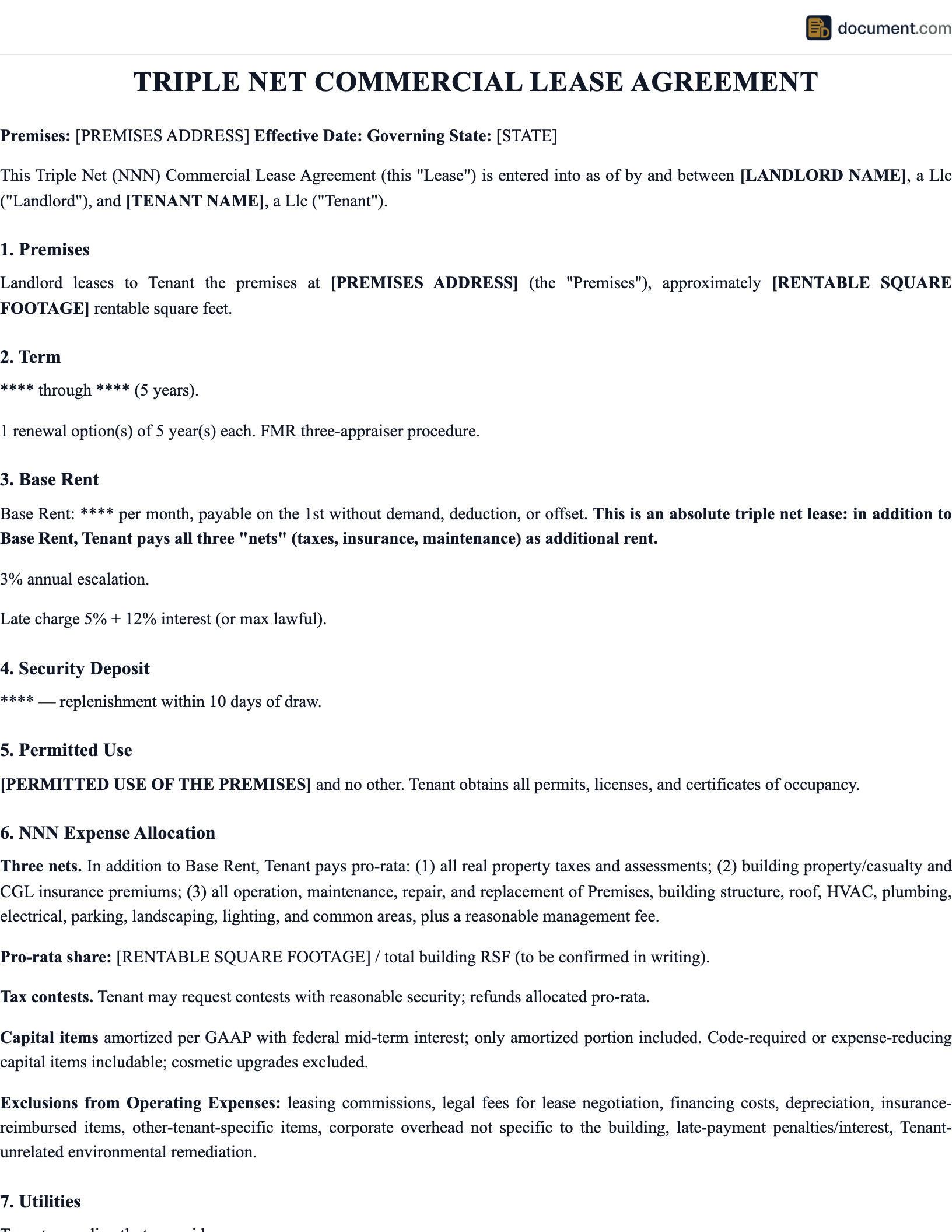
TRIPLE NET (NNN) COMMERCIAL LEASE
STATE OF INDIANA
Legal Document
PARTY INFORMATION
Name: [Full Legal Name]
Address: [Indiana Address]
County: [County]
PROPERTY DESCRIPTION
County: [County] State: Indiana
Legal Description: [Per Recorded Plat]
Parcel No.: [APN]
Indiana NNN Lease FAQ
Common questions about filing in Indiana, including requirements, fees, and tax implications.
Official Indiana Resources
Official state resources for verifying requirements and finding your local recording office.
Important Considerations
Before proceeding with your document, there are several important factors to consider. Each real estate transaction is unique, and understanding the specific requirements and implications of your situation will help ensure a smooth process.
Real estate laws and regulations are subject to change, and local requirements may differ from state-level rules. It is always advisable to verify current requirements with your local recording office before submitting any documents for recording.
If your transaction involves complex circumstances such as multiple parties, commercial properties, trusts, estates, or interstate elements, consulting with a licensed real estate attorney in your state is strongly recommended. An attorney can provide guidance specific to your situation and help you avoid potential legal issues.
Keep copies of all documents related to your real estate transaction in a safe place. Recorded documents become part of the public record, but having your own copies ensures you can reference the terms and conditions at any time. Digital copies stored securely are also recommended as a backup.
Professional Recommendation
While our templates are designed to be comprehensive and legally compliant, we recommend having your completed document reviewed by a licensed attorney before recording, especially for high-value transactions or complex situations. Many attorneys offer flat-fee document review services that provide peace of mind at a reasonable cost.
Related Documents
Depending on your situation, you may need additional documents alongside this one. Below are commonly related documents that are frequently used together in real estate transactions.
Important Considerations
Before proceeding with your document, there are several important factors to consider. Each real estate transaction is unique, and understanding the specific requirements and implications of your situation will help ensure a smooth and legally compliant process.
Real estate laws and regulations are subject to change, and local requirements may differ from state-level rules. It is always advisable to verify current requirements with your local recording office before submitting any documents for recording.
If your transaction involves complex circumstances such as multiple parties, commercial properties, trusts, estates, or interstate elements, consulting with a licensed real estate attorney is strongly recommended. An attorney can provide guidance specific to your situation and help you avoid potential legal issues.
Keep copies of all documents related to your real estate transaction in a safe place. Recorded documents become part of the public record, but having your own copies ensures you can reference the terms and conditions at any time. Digital copies stored securely are also recommended as a backup.
Professional Recommendation
While our templates are designed to be comprehensive and legally compliant, we recommend having your completed document reviewed by a licensed attorney before recording, especially for high-value transactions or complex situations. Many attorneys offer flat-fee document review services that provide peace of mind at a reasonable cost.
Related Documents
Depending on your situation, you may need additional documents alongside this one. Below are commonly related documents that are frequently used together in real estate transactions.
Create your Indiana Commercial Triple Net Lease Agreement in under 5 minutes.
Answer a few questions and download a Indiana-compliant document, ready for the state agency.