



Georgia NNN Lease Overview
A Georgia triple-net lease requires the tenant to pay base rent plus three separate expense categories: property taxes, building insurance, and common area maintenance costs. The tenant bears most or all of the operating cost risk, while the landlord collects a relatively predictable net income stream. Georgia's commercial real estate market, centered on Atlanta and its surrounding metro counties, is one of the most active NNN lease markets in the Southeast. Industrial NNN properties in the Hartsfield-Jackson Airport corridor, office NNN in Buckhead and Midtown, and single-tenant retail NNN along Georgia's major highway corridors all follow the triple-net structure.
Georgia courts enforce commercial lease terms as written under general contract principles. The state does not impose a commercial rent tax or documentary stamp tax on leases, which simplifies the financial structure compared to some neighboring states. Georgia's county-level property tax system means that tax obligations can vary significantly depending on whether the leased property is in Fulton County, Gwinnett County, Cobb County, or one of Georgia's more rural counties. Annual CAM reconciliation disputes and property tax appeal rights are the most common sources of Georgia NNN lease disputes.
$25
Recording fee
$1.00 per $1,000
Transfer tax
Required
Notarization
0
Witnesses required
Georgia NNN Lease Requirements
Georgia enforces commercial leases as written contracts. The state does not imply NNN expense obligations that are not expressly stated in the lease, so defining each expense category clearly is essential. Georgia's county-based property tax system and the metro Atlanta area's competitive commercial market make precise drafting especially important.
Define Each Net Expense Category Precisely
Georgia courts interpret commercial lease terms literally. An NNN lease that uses shorthand language without defining exactly what costs are included in each of the three nets can produce costly disputes during reconciliation. Every expense category should be listed specifically, and the lease should identify which costs are controllable (subject to caps) and which are pass-through costs outside the landlord's control.
Key Lease Provisions
- Expense Definitions: A complete definition of what is included in property taxes, insurance, and CAM, with explicit identification of any excluded costs such as management fees above a specified percentage or capital improvements
- CAM Reconciliation: Annual reconciliation procedure, documentation requirements, reconciliation deadline, and the tenant's audit right with a defined exercise window after receiving the statement
- Property Tax Pass-Through: Confirmation that Georgia county property tax bills are passed through on a pro-rata basis, with tenant participation rights if the landlord pursues a tax appeal that could reduce the tenant's future obligations
- Roof and Structural: Whether the landlord retains responsibility for roof, foundation, and structural elements (modified NNN) or whether the tenant bears those costs (absolute NNN)
- Expense Caps: A cap on controllable operating expenses, typically 3 to 5 percent per year, with clear identification of which categories are controllable and which are excluded from the cap
- Insurance Requirements: Required insurance types, minimum coverage amounts, and the requirement to name the landlord as additional insured on the tenant's commercial general liability policy
How to Negotiate and Execute a Georgia NNN Lease
Negotiating a Georgia NNN lease requires understanding both the local market economics and the lease mechanics. The steps below outline how experienced Georgia commercial real estate practitioners approach these transactions.
Request Historical Expense Statements
Ask the landlord for two to three years of actual operating expense history, including Georgia county property tax bills, insurance invoices, and CAM cost breakdowns. In the Atlanta metro market, Fulton and DeKalb County assessment increases can be significant year-over-year. Reviewing actual tax history before signing tells you whether the tax burden has been stable or growing.
Define Every Expense Category
Work through the CAM and expense definitions line by line. Identify what is included in operating expenses and what is excluded. Common Georgia NNN lease tenant exclusions include management fees above 3 to 4 percent of base rent, costs covered by insurance proceeds, capital improvements that extend the useful life of the property, and costs related to other tenants' spaces. Agree on the pro-rata allocation formula and whether it is based on rentable square footage or some other metric.
Negotiate Caps and Audit Rights
Secure a cap on controllable operating expense increases, typically 3 to 5 percent per year. Confirm that Georgia county property taxes and insurance premiums are excluded from the cap as costs outside the landlord's control. Negotiate an audit right allowing the tenant to verify reconciliation statements for the prior two to three years. Agree on what happens if the audit reveals an overbilling above a threshold, including who bears the audit cost.
Address Roof, Structural, and HVAC
Confirm whether the lease is a modified NNN structure with landlord responsibility for roof, foundation, and structural elements or an absolute NNN with the tenant bearing those costs. Address HVAC responsibility explicitly, particularly for older Atlanta office and retail buildings where deferred HVAC maintenance can produce significant repair costs. For new construction, confirm which party is responsible for capital replacement at end of equipment life.
Execute and Retain Originals
Execute the lease with authorized signatures from both parties. Georgia does not require notarization for a commercial lease to be enforceable between the parties, but notarization is required if the lease will be recorded. Recording with the clerk of superior court in the county where the property is located provides constructive notice; the recording fee is $25. Retain fully executed originals for both parties.
Georgia NNN Lease Transaction Costs
Below are the typical costs associated with negotiating and executing a Georgia commercial NNN lease. Actual amounts depend on the market, transaction complexity, and lease term.
| Fee / Cost | Typical Amount |
|---|---|
| Attorney (Tenant), lease negotiation | $1,000 - $4,500 |
| Attorney (Landlord), lease preparation | $750 - $3,000 |
| CAM Audit (if exercised) | $500 - $2,000 |
| Property Tax Appeal (if pursued) | $1,000 - $5,000+ |
| Optional Clerk of Superior Court Recording | $25 |
Georgia NNN Lease Tax Considerations
Georgia does not impose a commercial rent tax or a documentary stamp tax on lease transactions, which simplifies the NNN lease cost structure compared to states like Florida. The most significant Georgia-specific tax factor in a NNN lease is the county property tax pass-through. Georgia property taxes are levied by individual counties, and assessment levels and mill rates vary substantially across the state. The Atlanta metro counties of Fulton, DeKalb, Gwinnett, Cobb, and Cherokee each have their own assessors and tax rates, and commercial property assessments in Fulton and DeKalb can be aggressively set.
Georgia's commercial property assessment process gives property owners the right to appeal assessed values. For NNN tenants whose lease passes through property taxes on a pro-rata basis, a successful tax appeal by the landlord directly benefits the tenant by reducing the annual reconciliation. NNN leases should address whether the tenant has the right to request or participate in a tax appeal and whether any refund from a successful appeal is shared with the tenant for the lease years in question.
Georgia business personal property is also subject to county-level ad valorem tax. Commercial tenants who install significant equipment, trade fixtures, or personal property improvements may have a separate property tax obligation on those items to the county in which the leased property is located. This is a separate obligation from the building property tax that passes through via the NNN lease.
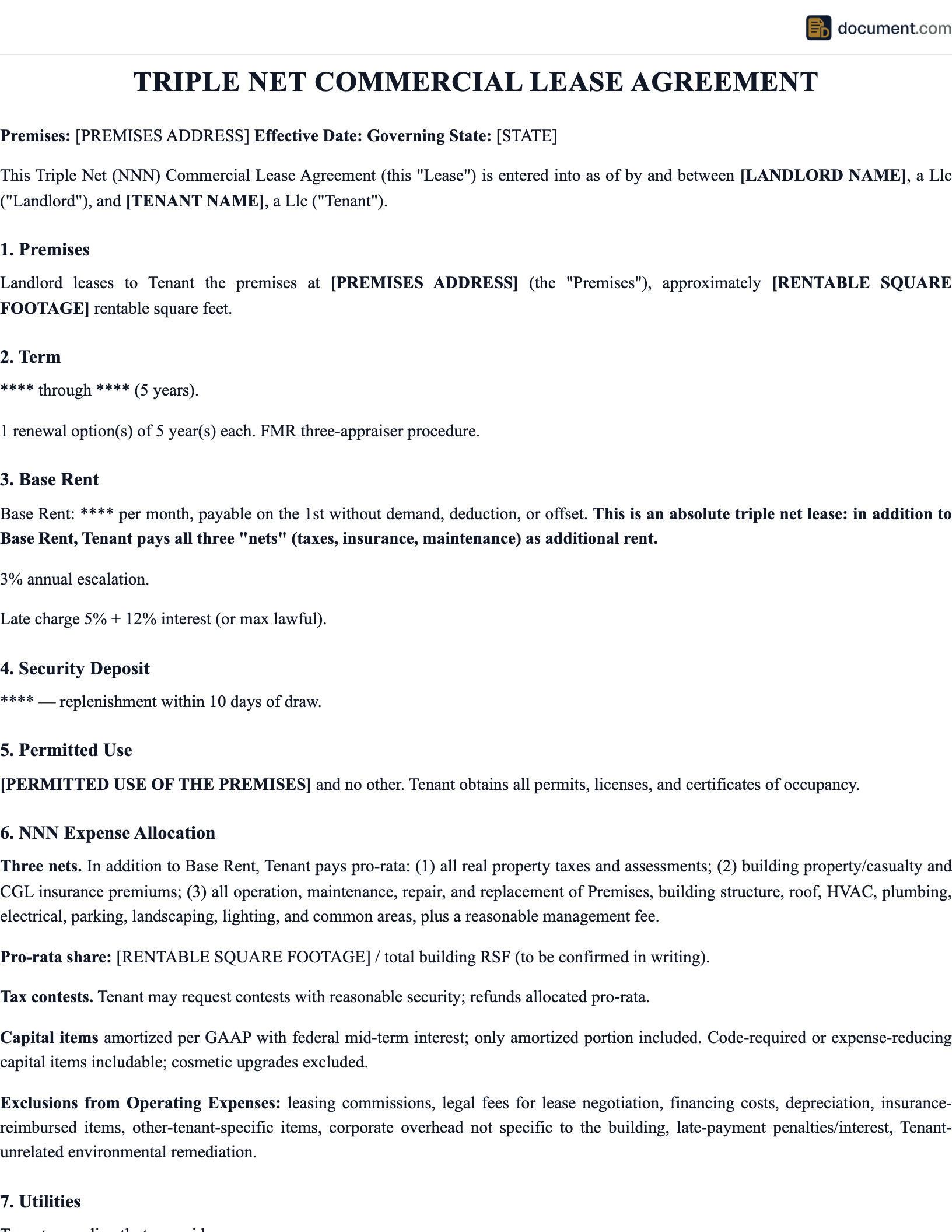
Sample Georgia NNN Lease
Preview of our Georgia-specific template. Your document will include all fields required for recording in any Georgia county.
TRIPLE NET (NNN) COMMERCIAL LEASE
STATE OF GEORGIA
Legal Document
PARTY INFORMATION
Name: [Full Legal Name]
Address: [Georgia Address]
County: [County]
PROPERTY DESCRIPTION
County: [County] State: Georgia
Legal Description: [Per Recorded Plat]
Parcel No.: [APN]
Georgia NNN Lease FAQ
Common questions about filing in Georgia, including requirements, fees, and tax implications.
Official Georgia Resources
Official state resources for verifying requirements and finding your local recording office.
Important Considerations
Before proceeding with your document, there are several important factors to consider. Each real estate transaction is unique, and understanding the specific requirements and implications of your situation will help ensure a smooth process.
Real estate laws and regulations are subject to change, and local requirements may differ from state-level rules. It is always advisable to verify current requirements with your local recording office before submitting any documents for recording.
If your transaction involves complex circumstances such as multiple parties, commercial properties, trusts, estates, or interstate elements, consulting with a licensed real estate attorney in your state is strongly recommended. An attorney can provide guidance specific to your situation and help you avoid potential legal issues.
Keep copies of all documents related to your real estate transaction in a safe place. Recorded documents become part of the public record, but having your own copies ensures you can reference the terms and conditions at any time. Digital copies stored securely are also recommended as a backup.
Professional Recommendation
While our templates are designed to be comprehensive and legally compliant, we recommend having your completed document reviewed by a licensed attorney before recording, especially for high-value transactions or complex situations. Many attorneys offer flat-fee document review services that provide peace of mind at a reasonable cost.
Related Documents
Depending on your situation, you may need additional documents alongside this one. Below are commonly related documents that are frequently used together in real estate transactions.
Important Considerations
Before proceeding with your document, there are several important factors to consider. Each real estate transaction is unique, and understanding the specific requirements and implications of your situation will help ensure a smooth and legally compliant process.
Real estate laws and regulations are subject to change, and local requirements may differ from state-level rules. It is always advisable to verify current requirements with your local recording office before submitting any documents for recording.
If your transaction involves complex circumstances such as multiple parties, commercial properties, trusts, estates, or interstate elements, consulting with a licensed real estate attorney is strongly recommended. An attorney can provide guidance specific to your situation and help you avoid potential legal issues.
Keep copies of all documents related to your real estate transaction in a safe place. Recorded documents become part of the public record, but having your own copies ensures you can reference the terms and conditions at any time. Digital copies stored securely are also recommended as a backup.
Professional Recommendation
While our templates are designed to be comprehensive and legally compliant, we recommend having your completed document reviewed by a licensed attorney before recording, especially for high-value transactions or complex situations. Many attorneys offer flat-fee document review services that provide peace of mind at a reasonable cost.
Related Documents
Depending on your situation, you may need additional documents alongside this one. Below are commonly related documents that are frequently used together in real estate transactions.
Create your Georgia Commercial Triple Net Lease Agreement in under 5 minutes.
Answer a few questions and download a Georgia-compliant document, ready for the state agency.