
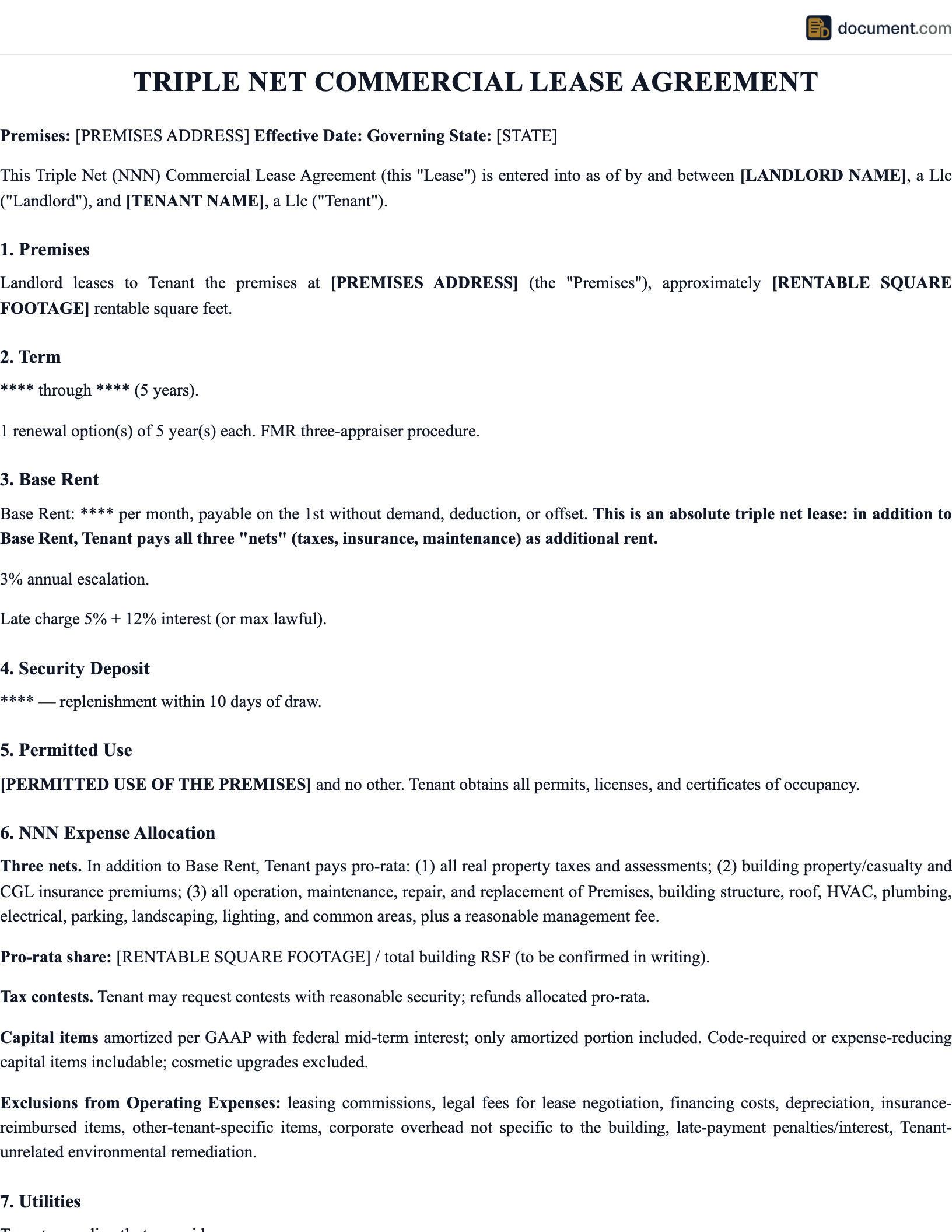



Florida NNN Lease Overview
A Florida triple net lease requires the tenant to pay base rent plus real estate taxes, building insurance premiums, and common area maintenance costs. Florida is one of the most active NNN lease markets in the country, driven by population growth, strong retail and industrial demand in South Florida, the Orlando metro, Tampa Bay, and Jacksonville markets, and a steady flow of investment in single-tenant NNN properties. Florida has no state income tax, which is a significant draw for both landlords and tenants structuring commercial real estate deals.
Florida has a documentary stamp tax on commercial leases that both parties need to understand before executing a long-term NNN deal. The tax applies at $0.35 per $100 of total rent for the full lease term and must be addressed at execution. Florida's coastal insurance market has also become an increasingly significant NNN expense, with wind and flood premiums rising substantially in hurricane-exposed areas. NNN leases in South Florida and along Florida's Gulf and Atlantic coasts require more careful insurance pass-through analysis than comparable leases in less weather-exposed markets.
$10
Recording fee
$0.70 per $100
Transfer tax
Required
Notarization
2
Witnesses required
Florida NNN Lease Requirements
Florida commercial leases are governed by contract law and the terms negotiated between the parties. Florida courts enforce written NNN lease terms as agreed, with no mandatory landlord obligations implied beyond what appears in the document. Several Florida-specific issues should be addressed in every NNN lease.
Florida Documentary Stamp Tax and Insurance Volatility
Florida's documentary stamp tax of $0.35 per $100 of total lease rent applies at execution for commercial leases. For a 10-year lease with $100,000 annual rent, the stamp tax is $3,500. Address who pays this at the start of negotiations. Separately, Florida's coastal insurance market has seen significant premium increases, and NNN leases in hurricane-prone areas should include explicit provisions on insurance cost caps or separate treatment of catastrophic event deductibles.
Key Florida NNN Lease Provisions
- Expense Definitions: Define each NNN expense category specifically; include and exclude costs explicitly rather than relying on general triple net language
- Insurance Pass-Through: Address which insurance policies are included, coverage limits, deductible allocation, and treatment of wind and flood coverage in coastal locations
- CAM Reconciliation: Set the annual statement deadline, supporting documentation requirements, and tenant audit window
- Hurricane and Casualty Provisions: Address storm-related closures, restoration timelines, rent abatement rights, and the landlord's obligation to maintain adequate casualty coverage
- Expense Caps on Controllable Costs: Negotiate annual caps of 3 to 5 percent on manageable operating expenses; exclude insurance, taxes, and utilities from caps due to market volatility
- Property Tax Pass-Through: Specify county tax billing timing, reimbursement procedures, and the tenant's right to contest assessments
How to Negotiate and Execute a Florida NNN Lease
Florida NNN lease negotiations require attention to both the standard expense pass-through provisions and Florida-specific considerations like documentary stamp tax, insurance market volatility, and hurricane provisions. Work through these steps before execution.
Model Total Rent Including Documentary Stamp Tax
Before finalizing base rent and lease term, calculate the Florida documentary stamp tax on the total lease obligation. The tax is $0.35 per $100 of total rent for the full lease term. This tax is typically paid at execution or recording. Agree on which party bears it and model the total cost so neither side is surprised at closing.
Request Historical Expense Statements and Insurance Schedules
Obtain two to three years of actual operating expense statements for the building, with special attention to the insurance premium history. For coastal Florida properties, review the landlord's current wind and flood insurance program, deductible structure, and any recent premium increases. Understand whether insurance premiums have been steady or rising and model the impact on total NNN costs over the full lease term.
Negotiate Expense Caps and Exclusions
Agree on annual caps of 3 to 5 percent on controllable expenses. Exclude insurance, taxes, and utilities from caps due to Florida market volatility. Build a specific exclusion list for non-operating costs: capital expenditures, depreciation, ground lease payments, costs caused by landlord negligence, and costs covered by insurance proceeds. Define CAM reconciliation procedures, audit rights, and the documentation the landlord must provide.
Address Hurricane and Casualty Provisions
Negotiate specific provisions addressing hurricane-related closures, the landlord's obligation to begin casualty restoration within a defined period, rent abatement rights when the premises are substantially damaged, and termination rights if restoration is not completed within a defined timeline. For coastal Florida NNN leases, these provisions are not optional; they are among the most important risk allocations in the document.
Execute with Proper Florida Formalities
Florida requires notarization and two witnesses for recorded documents. Both parties should execute the lease with full Florida formalities if recording is intended. Recording the NNN lease with the county clerk of court provides notice to third parties and protects the tenant's possessory interest. Each party should retain a fully executed original of the lease.
Florida NNN Lease Transaction Costs
Florida NNN lease transactions involve several costs beyond attorney fees, including the documentary stamp tax on the total lease obligation. Budget all of these costs before finalizing negotiations.
| Fee / Cost | Amount |
|---|---|
| Documentary Stamp Tax on Lease | $0.35 per $100 of total rent for full term |
| Attorney Review (Tenant) | $1,000 – $5,000 (higher for South Florida markets) |
| Annual CAM Reconciliation Audit | $500 – $2,000 |
| Property Tax Appeal | $1,000 – $5,000+ |
| County Clerk Recording Fee | $10 base per page |
Florida NNN Lease Tax Considerations
Florida's documentary stamp tax on commercial leases is the most significant lease-specific tax both parties need to address before signing. The tax is calculated at $0.35 per $100 of total rent for the full lease term, including base rent and any rent escalations if the escalation amounts are determinable at execution. Estimated rent under percentage or CPI-escalation clauses may be calculated separately. The stamp tax applies to the lease instrument itself and must be paid to the Florida Department of Revenue.
Florida also imposes a sales tax on commercial rent in some circumstances. The Florida Department of Revenue has specific guidance on which commercial rent transactions are subject to sales tax and which are exempt. NNN tenants and landlords should confirm the sales tax treatment of their specific transaction with a Florida tax professional, particularly for leases that include significant operating expense reimbursements.
Property taxes in Florida are assessed annually at the county level. NNN tenants who are responsible for property tax pass-throughs should understand the Florida property tax assessment cycle, the deadline for contesting assessments, and how the Save Our Homes benefit (which applies to homestead properties, not commercial) differs from the treatment of commercial properties. Florida commercial properties are assessed at full market value without the Save Our Homes cap, which means commercial property taxes can increase more significantly following a sale or significant market value increase than residential taxes.
Sample Florida NNN Lease
Preview of our Florida-specific template. Your document will include all fields required for recording in any Florida county.
TRIPLE NET (NNN) COMMERCIAL LEASE
STATE OF FLORIDA
Legal Document
PARTY INFORMATION
Name: [Full Legal Name]
Address: [Florida Address]
County: [County]
PROPERTY DESCRIPTION
County: [County] State: Florida
Legal Description: [Per Recorded Plat]
Parcel No.: [APN]
Florida NNN Lease FAQ
Common questions about filing in Florida, including requirements, fees, and tax implications.
Official Florida Resources
Official state resources for verifying requirements and finding your local recording office.
Important Considerations
Before proceeding with your document, there are several important factors to consider. Each real estate transaction is unique, and understanding the specific requirements and implications of your situation will help ensure a smooth process.
Real estate laws and regulations are subject to change, and local requirements may differ from state-level rules. It is always advisable to verify current requirements with your local recording office before submitting any documents for recording.
If your transaction involves complex circumstances such as multiple parties, commercial properties, trusts, estates, or interstate elements, consulting with a licensed real estate attorney in your state is strongly recommended. An attorney can provide guidance specific to your situation and help you avoid potential legal issues.
Keep copies of all documents related to your real estate transaction in a safe place. Recorded documents become part of the public record, but having your own copies ensures you can reference the terms and conditions at any time. Digital copies stored securely are also recommended as a backup.
Professional Recommendation
While our templates are designed to be comprehensive and legally compliant, we recommend having your completed document reviewed by a licensed attorney before recording, especially for high-value transactions or complex situations. Many attorneys offer flat-fee document review services that provide peace of mind at a reasonable cost.
Related Documents
Depending on your situation, you may need additional documents alongside this one. Below are commonly related documents that are frequently used together in real estate transactions.
Important Considerations
Before proceeding with your document, there are several important factors to consider. Each real estate transaction is unique, and understanding the specific requirements and implications of your situation will help ensure a smooth and legally compliant process.
Real estate laws and regulations are subject to change, and local requirements may differ from state-level rules. It is always advisable to verify current requirements with your local recording office before submitting any documents for recording.
If your transaction involves complex circumstances such as multiple parties, commercial properties, trusts, estates, or interstate elements, consulting with a licensed real estate attorney is strongly recommended. An attorney can provide guidance specific to your situation and help you avoid potential legal issues.
Keep copies of all documents related to your real estate transaction in a safe place. Recorded documents become part of the public record, but having your own copies ensures you can reference the terms and conditions at any time. Digital copies stored securely are also recommended as a backup.
Professional Recommendation
While our templates are designed to be comprehensive and legally compliant, we recommend having your completed document reviewed by a licensed attorney before recording, especially for high-value transactions or complex situations. Many attorneys offer flat-fee document review services that provide peace of mind at a reasonable cost.
Related Documents
Depending on your situation, you may need additional documents alongside this one. Below are commonly related documents that are frequently used together in real estate transactions.
Create your Florida Commercial Triple Net Lease Agreement in under 5 minutes.
Answer a few questions and download a Florida-compliant document, ready for the state agency.