
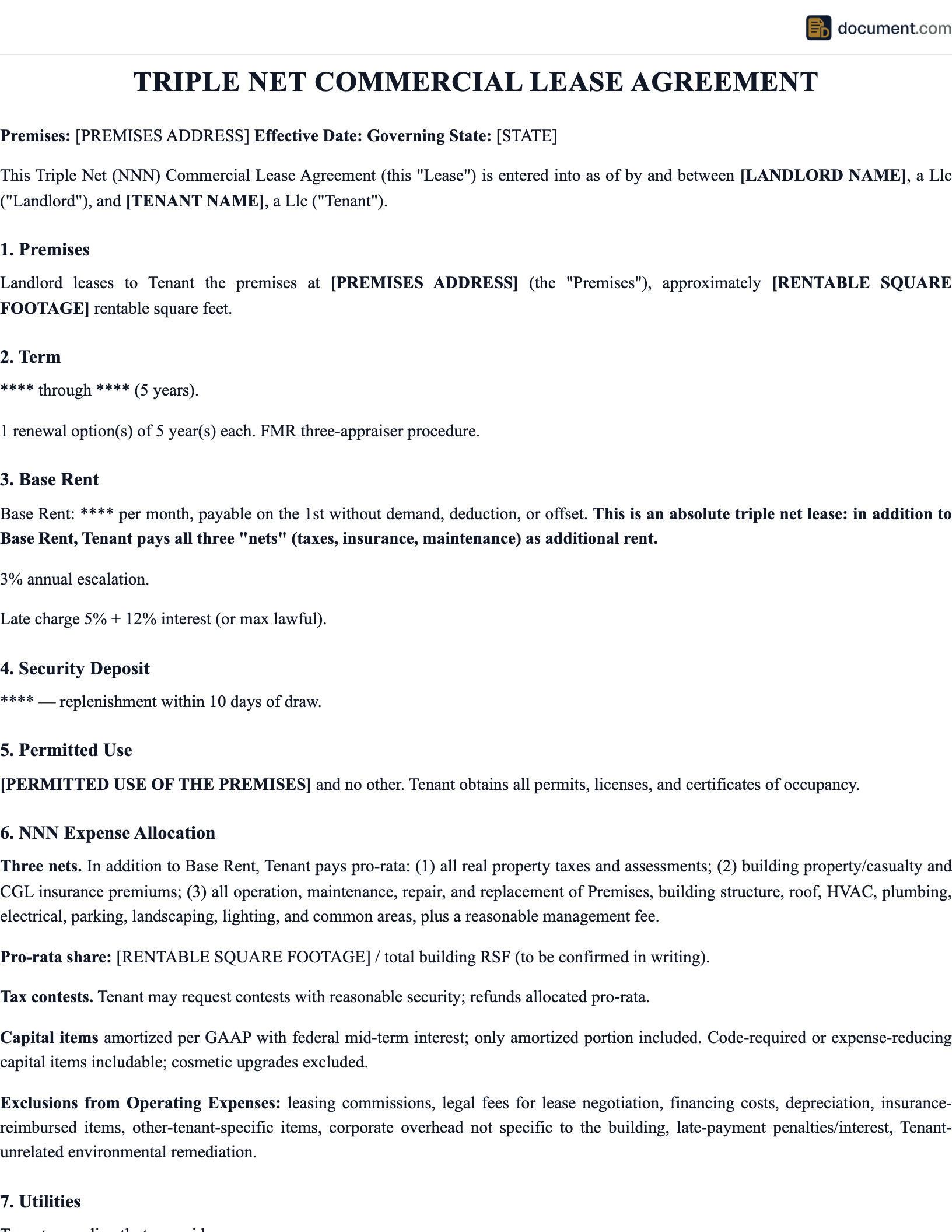



Connecticut NNN Lease Overview
Connecticut's commercial real estate market is divided between two distinct regions with very different NNN lease economics. Fairfield County, particularly Greenwich, Stamford, and Norwalk, has some of the highest commercial rents and property taxes in New England, driven by proximity to New York City and a concentration of financial sector tenants. Hartford and the central Connecticut market is more affordably priced but still carries significant municipal property tax burdens. NNN leases in both markets require careful attention to property tax pass-through mechanics.
Under a Connecticut NNN lease, the tenant pays base rent plus property taxes assessed by the municipality, building insurance premiums, and common area maintenance costs. Connecticut commercial real estate is governed by contract law, with no comprehensive commercial landlord-tenant statute. The written lease terms determine the expense allocation, tax pass-through procedures, and each party's rights in a dispute. CAM reconciliation audit rights and the ability to contest tax assessments are important protections for Connecticut NNN tenants, particularly in high-assessment municipalities.
$60
Recording fee
0.75% - 2.25%
Transfer tax
Required
Notarization
2
Witnesses required
Connecticut NNN Lease Requirements
Connecticut commercial leases exceeding one year must be in writing under the statute of frauds. For NNN leases specifically, the written expense definitions, tax pass-through procedures, and CAM reconciliation rights are the operative mechanisms that make the structure function as intended over a multi-year term.
High Property Tax Warning for Fairfield County NNN Tenants
Fairfield County municipalities, including Greenwich, Stamford, Westport, and Darien, have among the highest commercial property tax rates in the northeastern United States. Before executing a NNN lease in Fairfield County, obtain at least two years of actual tax bills and project what the pass-through will look like after the next town reassessment.
Key Connecticut NNN Lease Provisions
- Property Tax Pass-Through Timing: Specify when the landlord must deliver the tax bill and the timeline for the tenant to pay their allocable share, including any rights to contest the assessment
- CAM Expense Definitions: List which common area maintenance costs are included and which are excluded, particularly capital items and management fee markups
- Insurance Pass-Through: Confirm whether the landlord's building insurance premium (including any Connecticut-specific property insurance increases) passes through in full or subject to a cap
- Audit Rights: Negotiate the right to audit the landlord's CAM and expense records within a specified window after the annual reconciliation is delivered
- Roof and Structural Responsibility: Clarify whether this is an absolute NNN (tenant responsible for everything) or modified NNN (landlord retains structural obligations)
How to Execute a Connecticut NNN Lease
Negotiating a NNN lease in Connecticut, especially in the high-stakes Fairfield County market, requires thorough due diligence on expenses before execution. Here is a practical approach.
Obtain Historical Tax and Expense Records
Request two to three years of actual property tax bills, insurance renewal premiums, and CAM expense statements for the building. In Connecticut's high-tax municipalities, this due diligence is essential before committing to NNN obligations.
Negotiate the NNN Expense Definitions
Work through each expense category to confirm what is included and excluded. Negotiate caps on controllable CAM increases and clarify the procedure for challenging property tax assessments through the Connecticut town's appeal process.
Confirm Insurance Requirements
Connecticut property insurance costs have increased in recent years. Confirm whether the landlord's building insurance is included in the NNN pool, review the coverage types and amounts, and clarify whether you have any say in carrier selection or coverage levels.
Negotiate Audit Rights and Reconciliation Timeline
Secure the right to audit the landlord's expense records annually and set a clear deadline for the landlord to deliver the reconciliation statement. Most Connecticut commercial leases allow 90 to 180 days after year-end for the annual statement.
Execute and Distribute
Both parties execute with authorized signatures. Provide fully executed copies to landlord, tenant, property manager, and lenders. Long-term Connecticut commercial leases are sometimes recorded with the local town clerk for constructive notice purposes.
Connecticut NNN Lease Costs
Typical transaction costs for a Connecticut NNN commercial lease. Fairfield County transactions typically involve higher attorney fees due to the complexity of high-value lease negotiations.
| Cost Item | Typical Range |
|---|---|
| Attorney Review (Tenant) | $1,000 - $5,000 for Fairfield County; $750 - $3,000 for other CT markets |
| Annual CAM Reconciliation Review | $500 - $2,000 if accountant involvement needed |
| Property Tax Appeal (if pursued) | $1,500 - $8,000+ depending on assessed value |
| Optional Town Clerk Recording | $60 per document plus per-page fees |
Connecticut Tax Implications
Connecticut's transfer tax rate is 0.75% - 2.25%. Understanding the full tax picture is important for any real property transaction in Connecticut.
Gift transfers may require IRS Form 709 if the value exceeds the annual gift tax exclusion. Recipients may receive the transferor's cost basis, potentially resulting in capital gains tax upon future sale.
Property tax reassessment rules vary in Connecticut. Some transfers trigger reassessment while others are exempt. Contact the Connecticut tax assessor's office for guidance on your specific transaction.
Sample Connecticut NNN Lease
Preview of our Connecticut-specific template. Your document will include all fields required for recording in any Connecticut county.
TRIPLE NET (NNN) COMMERCIAL LEASE
STATE OF CONNECTICUT
Legal Document
PARTY INFORMATION
Name: [Full Legal Name]
Address: [Connecticut Address]
County: [County]
PROPERTY DESCRIPTION
County: [County] State: Connecticut
Legal Description: [Per Recorded Plat]
Parcel No.: [APN]
Connecticut NNN Lease FAQ
Common questions about filing in Connecticut, including requirements, fees, and tax implications.
Official Connecticut Resources
Official state resources for verifying requirements and finding your local recording office.
Important Considerations
Before proceeding with your document, there are several important factors to consider. Each real estate transaction is unique, and understanding the specific requirements and implications of your situation will help ensure a smooth process.
Real estate laws and regulations are subject to change, and local requirements may differ from state-level rules. It is always advisable to verify current requirements with your local recording office before submitting any documents for recording.
If your transaction involves complex circumstances such as multiple parties, commercial properties, trusts, estates, or interstate elements, consulting with a licensed real estate attorney in your state is strongly recommended. An attorney can provide guidance specific to your situation and help you avoid potential legal issues.
Keep copies of all documents related to your real estate transaction in a safe place. Recorded documents become part of the public record, but having your own copies ensures you can reference the terms and conditions at any time. Digital copies stored securely are also recommended as a backup.
Professional Recommendation
While our templates are designed to be comprehensive and legally compliant, we recommend having your completed document reviewed by a licensed attorney before recording, especially for high-value transactions or complex situations. Many attorneys offer flat-fee document review services that provide peace of mind at a reasonable cost.
Related Documents
Depending on your situation, you may need additional documents alongside this one. Below are commonly related documents that are frequently used together in real estate transactions.
Important Considerations
Before proceeding with your document, there are several important factors to consider. Each real estate transaction is unique, and understanding the specific requirements and implications of your situation will help ensure a smooth and legally compliant process.
Real estate laws and regulations are subject to change, and local requirements may differ from state-level rules. It is always advisable to verify current requirements with your local recording office before submitting any documents for recording.
If your transaction involves complex circumstances such as multiple parties, commercial properties, trusts, estates, or interstate elements, consulting with a licensed real estate attorney is strongly recommended. An attorney can provide guidance specific to your situation and help you avoid potential legal issues.
Keep copies of all documents related to your real estate transaction in a safe place. Recorded documents become part of the public record, but having your own copies ensures you can reference the terms and conditions at any time. Digital copies stored securely are also recommended as a backup.
Professional Recommendation
While our templates are designed to be comprehensive and legally compliant, we recommend having your completed document reviewed by a licensed attorney before recording, especially for high-value transactions or complex situations. Many attorneys offer flat-fee document review services that provide peace of mind at a reasonable cost.
Related Documents
Depending on your situation, you may need additional documents alongside this one. Below are commonly related documents that are frequently used together in real estate transactions.
Create your Connecticut Commercial Triple Net Lease Agreement in under 5 minutes.
Answer a few questions and download a Connecticut-compliant document, ready for the state agency.