
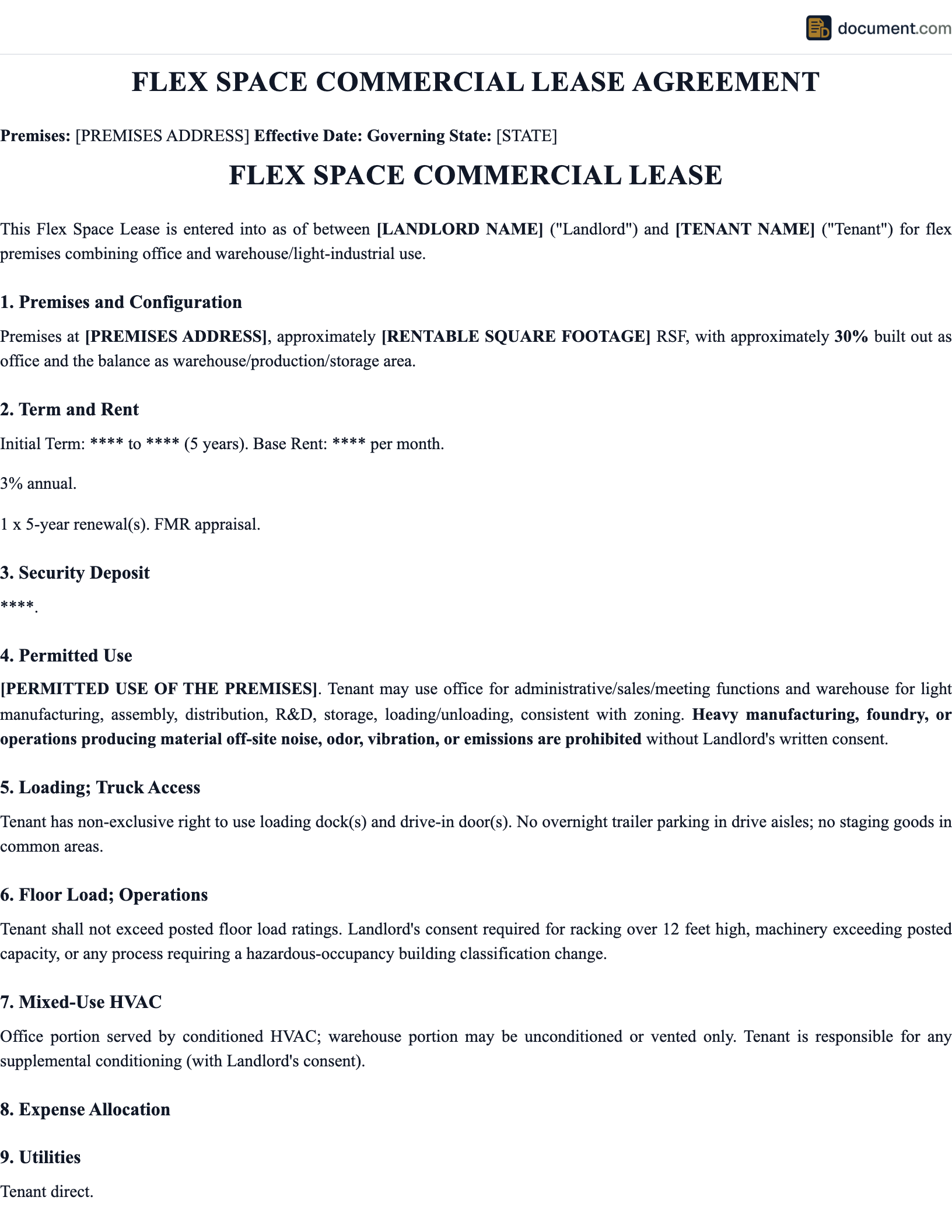



Oregon Flex Space Rental Agreement Overview
Oregon flex space is shaped by the state's unique land use planning framework and the economic diversity of its major metro areas. Portland's urban growth boundary restricts new commercial and industrial development, keeping flex vacancy low and rents on an upward trajectory over time. The Silicon Forest technology cluster in Hillsboro and Beaverton drives significant flex demand from semiconductor, clean energy, and technology companies needing the warehouse-office combination. Portland's port provides Pacific Rim connectivity that attracts distribution and import-related flex users. Willamette Valley and Bend markets serve more regional demand from food processing, university-adjacent businesses, and the growing outdoor recreation technology sector.
Oregon's Measure 50 assessed value growth limitation — which caps annual increases in assessed value at 3% — makes NNN property tax exposure more predictable than in most states. However, real market values in the Portland metro have grown substantially faster than assessed values, creating a large gap that could affect tax exposure if the property is sold or reassessed following new construction or major improvements. Oregon has no sales tax, which simplifies some commercial cost calculations, but the state's high personal income tax and corporate minimum tax affect the overall cost structure for businesses locating here.
$15
Filing fee
Required
Notarization
0
Witnesses required
County
Filing office
Oregon Requirements
Oregon commercial flex space leases are governed by general contract law and Oregon commercial property statutes. Leases for terms exceeding one year must be in writing under the Oregon Statute of Frauds. There is no mandatory state commercial lease form or disclosure requirement. Key provisions are premises description, permitted use compatible with zoning (IG, IP, or other industrial classification), rent and escalation terms, and NNN cost allocation with Measure 50 assessed value context.
Oregon Specific Note
Oregon's urban growth boundary restricts new flex space supply across most metro areas, keeping vacancy low and giving landlords leverage in most Portland area submarkets. Tenants who do not secure renewal options at lease execution may face significantly higher rents or loss of space at term end. In addition, confirm the zoning classification of your target space — Portland's IG and IP zones have different permitted uses that affect what industrial activities are allowed.
Key Lease Provisions
- Renewal options: Oregon UGB constraints mean flex supply is limited; securing renewal rights at execution is particularly valuable given landlord leverage at re-leasing in most Portland area submarkets
- Permitted use and zoning: Confirm the specific Portland zoning district (IG vs. IP) and verify your intended industrial or manufacturing activities are permitted without conditional use approval
- Measure 50 NNN structure: Oregon assessed values grow at a maximum of 3% annually under Measure 50; confirm the base assessed value and trend to understand NNN property tax cost over the lease term
- Environmental use clause: Technology, manufacturing, and food processing flex tenants should confirm Oregon DEQ compliance requirements and address pre-existing site conditions in the lease
- TI allowance adequacy: Portland construction costs have increased substantially; confirm that the offered TI allowance covers your specific build-out requirements before signing
How to Execute an Oregon Flex Space Lease
Executing a flex space lease in Oregon requires confirming zoning for your specific use, understanding the Measure 50 property tax structure, and securing renewal options in a supply-constrained market. These steps apply across Portland metro and Willamette Valley flex markets.
Confirm Zoning and Permitted Use
Identify your target Oregon flex submarket and confirm the specific zoning classification (Portland IG, IP, or other municipal code). Verify your intended industrial, manufacturing, or technology activities are permitted without variance or conditional use approval. Get written landlord confirmation.
Understand Measure 50 NNN Property Tax Structure
Request the current assessed value and three-year history. Oregon Measure 50 limits assessed value growth to 3% annually, making NNN tax exposure relatively predictable. Confirm whether any recent sale or major improvement may trigger a reassessment affecting this limit.
File With the County Clerk
Oregon urban growth boundary constraints limit flex supply in most metro areas. Securing renewal options with defined rent parameters at lease execution is particularly important — landlords in tight Portland submarkets have strong leverage at re-leasing when options have not been negotiated.
Address Environmental and DEQ Compliance
If your operations involve manufacturing, food processing, chemicals, or other regulated activities, confirm Oregon DEQ compliance requirements before signing. Request landlord representations on the premises' current environmental condition and allocate pre-existing contamination responsibility.
Execute and Distribute Copies
Both parties sign. Oregon does not require notarization for commercial lease enforceability. Leases for terms exceeding one year must be in writing. If recording a memorandum at the county clerk for a longer-term lease, notarize at that stage. Distribute fully executed copies to all parties.
Oregon Fees & Costs
Below is a breakdown of the typical costs associated with filing this document in Oregon. Actual fees may vary by county.
| Fee / Cost | Amount |
|---|---|
| Filing Fee | $15 per page |
| Notarization | $5 - $25 per signature |
| Certified Copy | $1 - $10 per page |
| Attorney Review (optional) | $150 - $500 |
Sample Oregon Flex Space Rental Agreement
Below is a preview of our Oregon-specific template. Your customized document will include all fields and provisions required for filing in any Oregon county.
FLEX SPACE RENTAL AGREEMENT
STATE OF OREGON
Legal Document Template
LANDLORD
Name: [Full Legal Name]
Address: [Business Address]
Phone: [Contact Number]
TENANT
Name: [Full Legal Name / Entity]
Address: [Business Address]
EIN/SSN: [Tax ID]
PREMISES
Address: [Property Address]
Suite/Unit: [Unit Number]
Office SF: [Square Feet]
Warehouse SF: [Square Feet]
LEASE TERMS
Commencement: [Start Date]
Expiration: [End Date]
Base Rent: $[Amount]/month
CAM: $[Amount]/month
Oregon Flex Space Rental Agreement FAQ
Answers to common questions about filing an flex space rental agreement in Oregon, including requirements, fees, and procedures.
Official Oregon Resources
Use these official state resources to verify requirements, find your local filing office, and access government forms for Oregon.
Related Oregon Documents
Depending on your situation, you may need additional documents alongside your Oregon flex space rental agreement.
Create your Oregon Commercial Flex Space Lease Agreement in under 5 minutes.
Answer a few questions and download a Oregon-compliant document, ready for the state agency.