



North Carolina Flex Space Rental Agreement Overview
North Carolina's flex space market has grown substantially alongside the state's technology, life sciences, and financial services sectors. The Research Triangle area is one of the country's premier flex space markets for life sciences and technology companies, with demand driven by proximity to Duke, UNC, NC State, and the concentration of pharmaceutical, biotech, and research organizations in and around Research Triangle Park. Charlotte's flex market serves a diverse mix of technology, financial services, and distribution tenants. The Triad region has established flex inventory serving manufacturing, logistics, and furniture industry tenants. North Carolina flex leases are governed by general contract and commercial real property law.
North Carolina has become one of the most competitive southeastern states for business attraction, and sustained in-migration has kept commercial real estate markets tight in Raleigh-Durham and Charlotte. Tenants should expect landlord leverage in these markets and focus negotiation energy on renewal options, TI allowance adequacy, and HVAC maintenance allocation. North Carolina property taxes are assessed at the county level and reassessments occur on a regular cycle; NNN tenants should confirm the current assessed value trend before committing to NNN terms.
$26
Filing fee
Required
Notarization
0
Witnesses required
Register
Filing office
North Carolina Requirements
North Carolina commercial flex space leases are governed by general contract law and the North Carolina commercial landlord-tenant framework. There is no mandatory state lease form. Key legal requirements are a written agreement for terms longer than three years under the Statute of Frauds, clear premises identification, permitted use language, and NNN or gross cost allocation provisions. Recording a memorandum of lease at the register of deeds is advisable for terms of five or more years.
North Carolina Specific Note
North Carolina property taxes are assessed at the county level on a regular reassessment cycle. Research Triangle area counties — Wake, Durham, and Orange — and Mecklenburg County (Charlotte) have seen significant assessed value increases. NNN flex tenants should review the current assessment and trend before signing and negotiate a base year with a cap on property tax increases above the base to limit NNN exposure during a long lease term.
Key Lease Provisions
- Permitted use: Life sciences and research flex tenants should confirm that their specific activities — wet lab, animal research, chemical use — are expressly permitted by lease and zoning
- Property tax base year: Wake, Durham, and Mecklenburg county assessments have increased significantly; establish a NNN base year and cap on tenant liability for increases above the base
- Renewal options: Research Triangle and Charlotte flex markets are tight; negotiate renewal rights at execution with defined rent parameters to protect against market-rate resets
- TI allowance adequacy: Life sciences build-out costs are substantially higher than standard office; confirm the allowance is sufficient for your specific fit-out requirements before signing
- Hurricane and storm risk: Eastern North Carolina flex properties carry wind and flood risk; confirm building insurance covers hurricane and storm damage and address landlord restoration obligations in the lease
How to Execute a North Carolina Flex Space Lease
Executing a flex space lease in North Carolina requires confirming permitted use for your specific operations, understanding property tax trends in your target county, and negotiating key provisions before signing. These steps apply across Research Triangle, Charlotte, and Triad flex markets.
Identify Submarket and Confirm Zoning
Select your target North Carolina flex submarket. Confirm the county zoning classification and verify your intended use is permitted. Life sciences, research, and manufacturing uses may have specific requirements under county zoning codes. Get written confirmation from the landlord.
Review NNN Property Tax History
Request three years of property tax bills and CAM reconciliation statements. Wake, Durham, and Mecklenburg county assessments have increased significantly. Establish a base year and negotiate a cap on NNN tax increase exposure before signing.
File With the Register of Deeds
Confirm that the offered TI allowance is adequate for your required build-out. Standard office flex fit-out has one cost range; life sciences wet lab or specialized research space build-out is substantially higher. Confirm allowance scope and disbursement conditions.
Negotiate Renewal Options and Rent Escalation
Secure renewal options at execution with defined rent parameters — particularly important in the tight Research Triangle and Charlotte markets. Agree on annual rent escalation methodology, whether fixed percentage or CPI-linked.
Execute and Distribute Copies
Both parties sign. North Carolina does not require notarization for commercial lease enforceability. Leases longer than three years must be in writing under the Statute of Frauds. If recording a memorandum at the register of deeds, notarize at that stage. Distribute fully executed copies to all parties.
North Carolina Fees & Costs
Below is a breakdown of the typical costs associated with filing this document in North Carolina. Actual fees may vary by county.
| Fee / Cost | Amount |
|---|---|
| Filing Fee | $26 first page |
| Notarization | $5 - $25 per signature |
| Certified Copy | $1 - $10 per page |
| Attorney Review (optional) | $150 - $500 |
Sample North Carolina Flex Space Rental Agreement
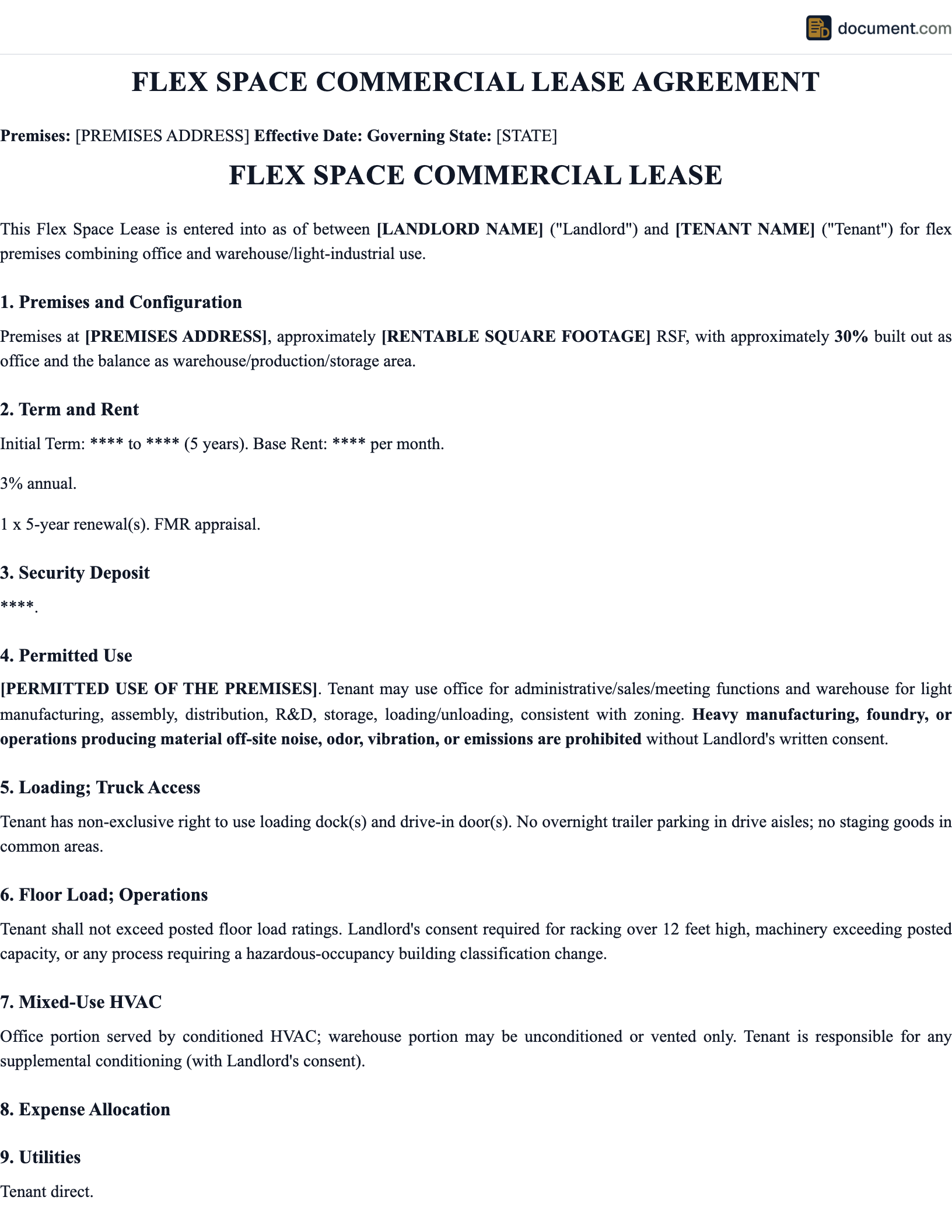
Below is a preview of our North Carolina-specific template. Your customized document will include all fields and provisions required for filing in any North Carolina county.
FLEX SPACE RENTAL AGREEMENT
STATE OF NORTH CAROLINA
Legal Document Template
LANDLORD
Name: [Full Legal Name]
Address: [Business Address]
Phone: [Contact Number]
TENANT
Name: [Full Legal Name / Entity]
Address: [Business Address]
EIN/SSN: [Tax ID]
PREMISES
Address: [Property Address]
Suite/Unit: [Unit Number]
Office SF: [Square Feet]
Warehouse SF: [Square Feet]
LEASE TERMS
Commencement: [Start Date]
Expiration: [End Date]
Base Rent: $[Amount]/month
CAM: $[Amount]/month
North Carolina Flex Space Rental Agreement FAQ
Answers to common questions about filing a flex space rental agreement in North Carolina, including requirements, fees, and procedures.
Official North Carolina Resources
Use these official state resources to verify requirements, find your local filing office, and access government forms for North Carolina.
Related North Carolina Documents
Depending on your situation, you may need additional documents alongside your North Carolina flex space rental agreement.
Create your North Carolina Commercial Flex Space Lease Agreement in under 5 minutes.
Answer a few questions and download a North Carolina-compliant document, ready for the state agency.