



Vermont Non-Compliance Eviction Overview
Vermont requires a 30-day cure-or-quit notice for lease violations under 9 V.S.A. 4467, one of the longest cure periods in the nation. Vermont's strong tenant protections reflect the state's commitment to housing stability. The Residential Rental Agreements Act provides comprehensive guidelines that landlords must follow carefully.
Under 9 V.S.A. 4467, the landlord must deliver a written notice specifying the violation and giving the tenant at least 30 days to cure the breach. If the tenant remedies the violation, the lease continues. Vermont takes tenant protections seriously, and courts closely scrutinize whether the landlord followed all procedural requirements before granting an eviction.
Vermont Superior Courts handle ejectment actions. Burlington, Montpelier, Rutland, and other areas follow state law. Self-help evictions are strictly prohibited. Vermont also has some of the strongest seasonal eviction protections in the country, and the state's small population means that courts can often provide individualized attention to eviction cases.
30 Days
Cure period
9
Governing statute
$75-$125
Filing fees
Superior
Superior Court
Vermont's 30 Days Cure Period Under 9 V.S.A. 4467
The 30-day cure period is central to Vermont's non-compliance eviction process. Under 9 V.S.A. 4467, the landlord must deliver a written notice specifying the nature of the breach and providing the tenant with 30 calendar days to remedy the violation before the rental agreement can be terminated.
Vermont 30 Days Notice Requirement
Vermont requires a 30-day written cure-or-quit notice before a landlord can file for eviction based on lease non-compliance under 9 V.S.A. 4467. The notice must identify the specific violation and give the tenant the full 30-day period to remedy the breach. Failing to provide the required notice or using the wrong period will result in dismissal of the eviction case.
Key Rules for Non-Compliance Notices
- 30-day cure required: Tenants must receive 30 days' written notice to cure material violations under 9 V.S.A. 4467
- Specific violation identification: The notice must identify the exact lease provision being violated and provide enough factual detail for the tenant to understand the issue
- Written format mandatory: All notices must be in writing under Vermont law. Verbal or oral notices are not legally sufficient and will not support a court eviction action
- Calendar day counting: Count calendar days from the day after service. The tenant must have the full 30 days before the landlord can file for eviction
- Documentation essential: Keep copies of all notices, evidence of violations, and proof of service for court proceedings. Thorough documentation significantly strengthens the landlord's case
Common Lease Violations in Vermont
Non-compliance evictions in Vermont cover a wide range of lease violations beyond nonpayment of rent. Below are the most frequently encountered violations that lead landlords to serve a 30-day cure-or-quit notice under 9 V.S.A. 4467.
Unauthorized Pets
Keeping animals in violation of the lease terms including breed restrictions, weight limits, or number limits. Vermont landlords must accommodate documented service animals and emotional support animals under the federal Fair Housing Act regardless of any no-pet policy in the lease.
Noise and Nuisance
Persistent noise disturbances, late-night parties, loud music, or disruptive behavior that violates quiet enjoyment clauses in the lease agreement. Document violations with neighbor complaints, police reports, and incident logs with dates and times.
Unauthorized Occupants
Allowing individuals not named on the lease to reside in the rental unit without the landlord's prior written consent. This changes occupancy levels, can affect the landlord's insurance coverage, and increases property wear beyond what was anticipated.
Property Damage
Intentional or negligent damage to the rental unit or common areas beyond normal wear and tear. Document all damage with dated photographs, repair estimates from licensed contractors, and inspection reports before and after.
Unauthorized Subletting
Renting or subletting the unit without the landlord's written approval, including listing the property on short-term rental platforms like Airbnb or VRBO in violation of the lease terms.
Failure to Maintain Unit
Not keeping the dwelling in a clean and safe condition as required by the lease and Vermont law. This includes improper garbage disposal, creating unsanitary conditions, failing to report maintenance issues, and causing health hazards.
How to Serve a Non-Compliance Notice in Vermont
Proper service is essential for the notice to be legally effective under Vermont law. Improper service is one of the most common reasons eviction cases are dismissed in Vermont courts. Follow these steps carefully to protect your case if the matter proceeds to litigation.
Document the Violation Thoroughly
Gather concrete evidence of the lease breach including dated photographs, written complaints from neighbors, police reports if applicable, building inspection findings, and records of any prior warnings. Identify the specific lease clause that is being violated.
Draft the Written Notice
Include the tenant's full name, complete property address, specific violation description with factual detail, the 30-day cure deadline, and a statement that the lease terminates if not cured. Reference 9 V.S.A. 4467.
Serve the Notice Properly
Deliver by personal hand-delivery to the tenant, by leaving at the dwelling with a person of suitable age and discretion, or by certified mail with return receipt requested for proof of service. Personal delivery with a witness provides the strongest evidence in court.
Wait the Required Period
Allow the full 30 calendar days from the day after service to expire. Do not file in court until the entire notice period has fully expired without the tenant curing or vacating.
File in Court
If the tenant does not cure or vacate, file an ejectment action in Vermont Superior Court. Filing fees typically range from $75-$125. Prepare all evidence for the hearing.
Vermont Legal Requirements for Non-Compliance Notices
Vermont courts will scrutinize the eviction notice for compliance with all statutory and procedural requirements before allowing the case to proceed. A deficient notice is one of the most common reasons eviction cases are dismissed. The following elements must be present in every non-compliance notice.
Required Notice Elements
- Tenant identification: Full legal names of all tenants listed on the lease agreement
- Property address: Complete street address of the rental property including apartment or unit number
- Violation description: Specific identification of the lease provision violated with detailed factual basis for the claim
- Cure period statement: Clear statement giving the tenant 30 days to remedy the breach
- Termination consequence: Explicit language stating that the rental agreement terminates if the breach is not cured within the notice period
- Date and landlord signature: The notice must be dated and signed by the landlord or an authorized property management agent
Self-Help Evictions Are Prohibited
Vermont prohibits self-help evictions. Landlords may not unilaterally change locks, shut off or interrupt utility services, remove doors or windows, or remove a tenant's personal property to force an eviction. The only lawful method of regaining possession of a rental property is through the court system by filing an ejectment action and obtaining a court order.
Vermont Eviction Court Process
After the notice period expires without the tenant curing the violation or vacating the premises, the landlord files an ejectment action in Vermont Superior Court. The eviction process follows a specific timeline from filing through enforcement.
| Stage | Timeframe | Details |
|---|---|---|
| Serve Notice | Day 0 | Deliver 30-day cure-or-quit notice to tenant |
| Cure Period Runs | Days 1-30 | Tenant has the opportunity to remedy the violation |
| File ejectment action | Day 31+ | File in Superior Court ($75-$125 filing fee) |
| Court Hearing | 5-14 days after filing | Both landlord and tenant present evidence before the judge |
| Enforcement | After judgment is entered | Sheriff, constable, or marshal enforces removal if tenant does not vacate voluntarily |
The total eviction process in Vermont from initial notice through court enforcement typically takes 4 to 8 weeks for uncontested cases where the tenant does not raise defenses. Contested cases where the tenant files an answer and the matter proceeds to trial can extend to 2 to 3 months or longer, particularly in busy court jurisdictions.
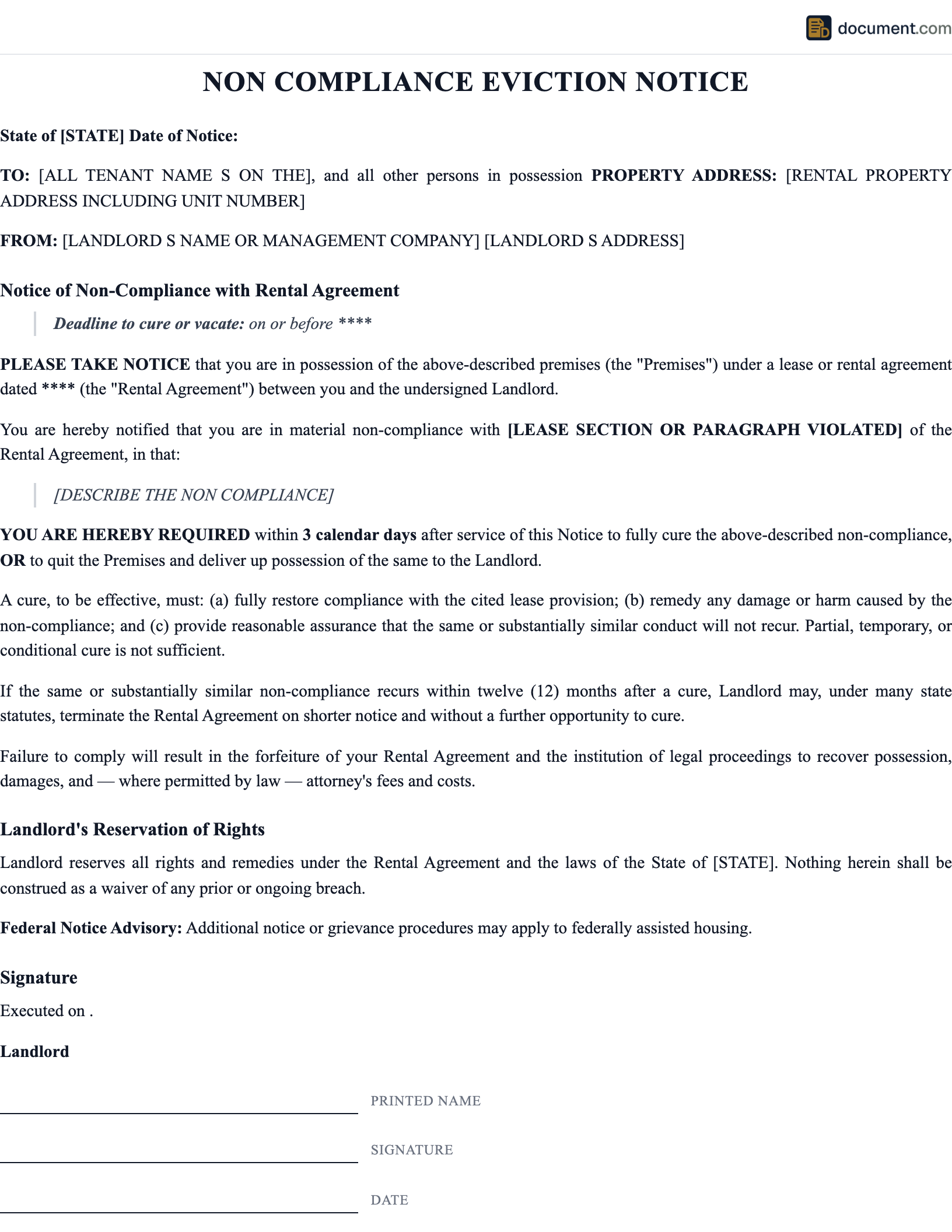
Sample Vermont Non-Compliance Notice
Below is a preview of a Vermont-specific notice for lease non-compliance. Your customized document will include all required fields and statutory language under 9 V.S.A. 4467.
NOTICE OF NON-COMPLIANCE
30 DAYS CURE-OR-QUIT NOTICE
Pursuant to 9 V.S.A. 4467
TO TENANT(S):
Name: [Full Legal Name]
Address: [Vermont Property Address]
NATURE OF VIOLATION:
You are in violation of the following provision of your lease agreement:
[Specific lease clause and factual description of the violation]
CURE DEMAND
Pursuant to 9 V.S.A. 4467, you have 30 days from the date of service of this notice to remedy the above violation. If you fail to cure the breach within the notice period, your rental agreement will terminate and the landlord will pursue legal action to recover possession of the premises through Vermont Superior Court.