



California Non-Compliance Eviction Overview
California's eviction process for lease non-compliance is among the most heavily regulated in the nation. Under Civil Code Section 1161(3), landlords must serve a 3-day notice to perform or quit for material lease violations. Despite the short notice period, California provides extensive tenant protections through the Tenant Protection Act of 2019 (AB 1482), numerous local rent control and just-cause eviction ordinances, and robust anti-retaliation provisions under Civil Code 1942.5.
The 3-day notice must specify the exact violation and give the tenant 3 days to cure the breach. The period excludes the day of service, Saturdays, Sundays, and judicial holidays. If served by mail only, add 5 additional calendar days. AB 1482 requires just cause for evictions of tenants in qualifying properties after 12 months of tenancy, and lease violations qualify as at-fault just cause but the cure notice must still be served first.
Many California cities including Los Angeles, San Francisco, Oakland, San Jose, Berkeley, and Santa Monica have additional just-cause eviction ordinances that may impose stricter requirements than state law. Some local laws require landlords to provide relocation assistance, prohibit eviction for certain minor violations, or extend notice periods beyond the state minimum. Self-help evictions are strictly prohibited under Civil Code 789.3, with penalties of $100 per day minimum plus actual damages and potential criminal liability.
3 Days
Cure period
Cal.
Governing statute
$240-$435
Filing fees
Superior
Superior Court
California's 3 Days Cure Period Under Cal. Civ. Code 1161(3)
The 3-day cure period is central to California's non-compliance eviction process. Under Cal. Civ. Code 1161(3), the landlord must deliver a written notice specifying the nature of the breach and providing the tenant with 3 calendar days to remedy the violation before the rental agreement terminates.
California 3-Day Period Excludes Weekends and Holidays
In California, the 3-day cure period under CCP 1161(3) excludes the day of service, all Saturdays, Sundays, and judicial holidays. If served by mail only, add 5 additional days. Many California cities also have additional just-cause eviction requirements under local ordinances. Always verify both state and local rules before serving a non-compliance notice.
Key Rules for Non-Compliance Notices
- 3-day cure-or-quit: Tenant has 3 days (excluding service day, Saturdays, Sundays, and judicial holidays) to cure the lease violation or vacate the premises
- Specific violation required: The notice must describe the exact lease provision violated with sufficient specificity for the tenant to understand precisely what must be corrected
- AB 1482 just-cause compliance: Under the Tenant Protection Act, landlords of qualifying properties must have just cause for eviction after 12 months of tenancy. Lease violations are at-fault just cause
- Local ordinance compliance: Many California cities have stricter requirements including extended notice periods, mandatory relocation assistance, and limitations on which violations support eviction
- CCP 1162 service methods: Must use personal delivery, substituted service (leaving with competent adult and mailing), or post-and-mail service per Code of Civil Procedure 1162
Common Lease Violations in California
Non-compliance evictions in California cover a wide range of lease violations beyond nonpayment of rent. Below are the most frequently encountered violations that lead landlords to serve a 3-day cure-or-quit notice.
Unauthorized Pets
Keeping animals in violation of the lease. California landlords cannot charge pet rent or deposits for documented service animals or emotional support animals under the Fair Employment and Housing Act. Standard lease violations for unauthorized pets require the 3-day cure-or-quit notice.
Unauthorized Subletting or Occupants
Renting the unit or allowing non-lease occupants without written consent. Under AB 1482, tenants in qualifying properties may have rights to add certain occupants. Short-term rental restrictions vary significantly by city across California.
Nuisance and Disturbance
Creating a nuisance as defined by Civil Code 3479 or substantially interfering with the comfort, safety, or enjoyment of other tenants. Persistent noise, illegal activity, and disruptive behavior fall into this category.
Property Damage
Willful or negligent destruction of the premises beyond normal wear and tear. Document thoroughly with photographs, repair estimates, and contractor assessments before serving the notice.
Unauthorized Business Operations
Operating a commercial enterprise from a residential unit in violation of the lease and local zoning ordinances. Home-based businesses may be permitted under some local zoning codes even if the lease restricts commercial use.
Health and Safety Violations
Tenant-caused code violations including hoarding creating fire hazards, blocking fire exits, tampering with smoke or carbon monoxide detectors, and creating severely unsanitary conditions that violate local health department regulations.
How to Serve a Non-Compliance Notice in California
Proper service is essential for the notice to be legally effective under California law. Improper service is one of the most common reasons eviction cases are dismissed in California courts.
Verify Just-Cause Requirements
Determine whether AB 1482 or any local just-cause ordinance applies to your property. If so, confirm that the lease violation qualifies as at-fault just cause for eviction. Some minor violations may not support eviction under local law.
Draft the 3-Day Notice
Prepare a notice specifying the exact violation and citing the lease clause that has been breached. State that the tenant has 3 days to cure or quit. Never combine a cure demand with a rent demand in the same notice, as this invalidates the notice.
Serve Per CCP 1162
Serve using an approved method: personal delivery to the tenant, substituted service (leaving with a competent person at the dwelling and mailing a copy), or post-and-mail (posting conspicuously on the door and mailing). If served by mail only, add 5 days to the period.
Count the 3 Days Correctly
Exclude the day of service, all Saturdays, all Sundays, and all judicial holidays. The tenant has until the end of the third qualifying day to cure the violation. Keep careful records of the day-by-day calculation.
File Unlawful Detainer
After the 3 days expire without cure or vacating, file an unlawful detainer action in the Superior Court for the county where the property is located. Filing fees range from $240 to $435 depending on the amount demanded. The tenant has 5 days after service to file a response.
California Legal Requirements for Non-Compliance Notices
California courts will scrutinize the eviction notice for compliance with all statutory requirements before allowing the case to proceed. A deficient notice is one of the most common reasons cases are dismissed.
Required Notice Elements
- Tenant names: Full legal names of all tenants listed on the lease agreement
- Property address: Complete address of the rental unit including apartment or unit number
- Specific violation: Exact lease clause violated with detailed factual description of the breach
- 3-day cure demand: Clear statement that the tenant has 3 days to cure the violation or quit the premises
- Proper service method: Must use one of the three methods specified in CCP 1162 (personal, substituted, or post-and-mail)
- Just-cause compliance: If AB 1482 or a local ordinance applies, the violation must qualify as at-fault just cause for eviction
Self-Help Evictions Are Prohibited
California Civil Code Section 789.3 strictly prohibits all forms of self-help eviction. Landlords who change locks, shut off or interrupt any utility service including water, heat, light, or electricity, remove outside doors or windows, or remove the tenant's personal property are liable for actual damages suffered by the tenant plus a penalty of not less than $100 for each day the violation continues, with a minimum penalty of $250. Criminal misdemeanor charges may also be filed against the landlord.
California Eviction Court Process
After the notice period expires without the tenant curing the violation or vacating, the landlord files an unlawful detainer action in California Superior Court.
| Stage | Timeframe | Details |
|---|---|---|
| Serve 3-Day Notice | Day 0 | Deliver cure-or-quit notice per CCP 1162 service methods |
| Cure Period | 3 days (excl. weekends/holidays) | Tenant may cure the violation during this period |
| File Unlawful Detainer | After 3-day period expires | File complaint in Superior Court ($240-$435 filing fee) |
| Tenant Response Period | 5 days after service of summons | Tenant files written answer or default is entered |
| Trial | ~20 days after trial request | Expedited trial on eviction; judgment issued |
| Writ of Possession Enforced | 5 days after judgment | Sheriff posts notice and enforces lockout |
California's eviction process typically takes 5 to 8 weeks for uncontested cases where the tenant does not file a response. Contested cases where the tenant files an answer and the matter proceeds to trial can take 2 to 4 months or longer, especially in courts with heavy caseloads such as Los Angeles County, San Francisco County, and Alameda County. Some cities impose additional mandatory waiting periods.
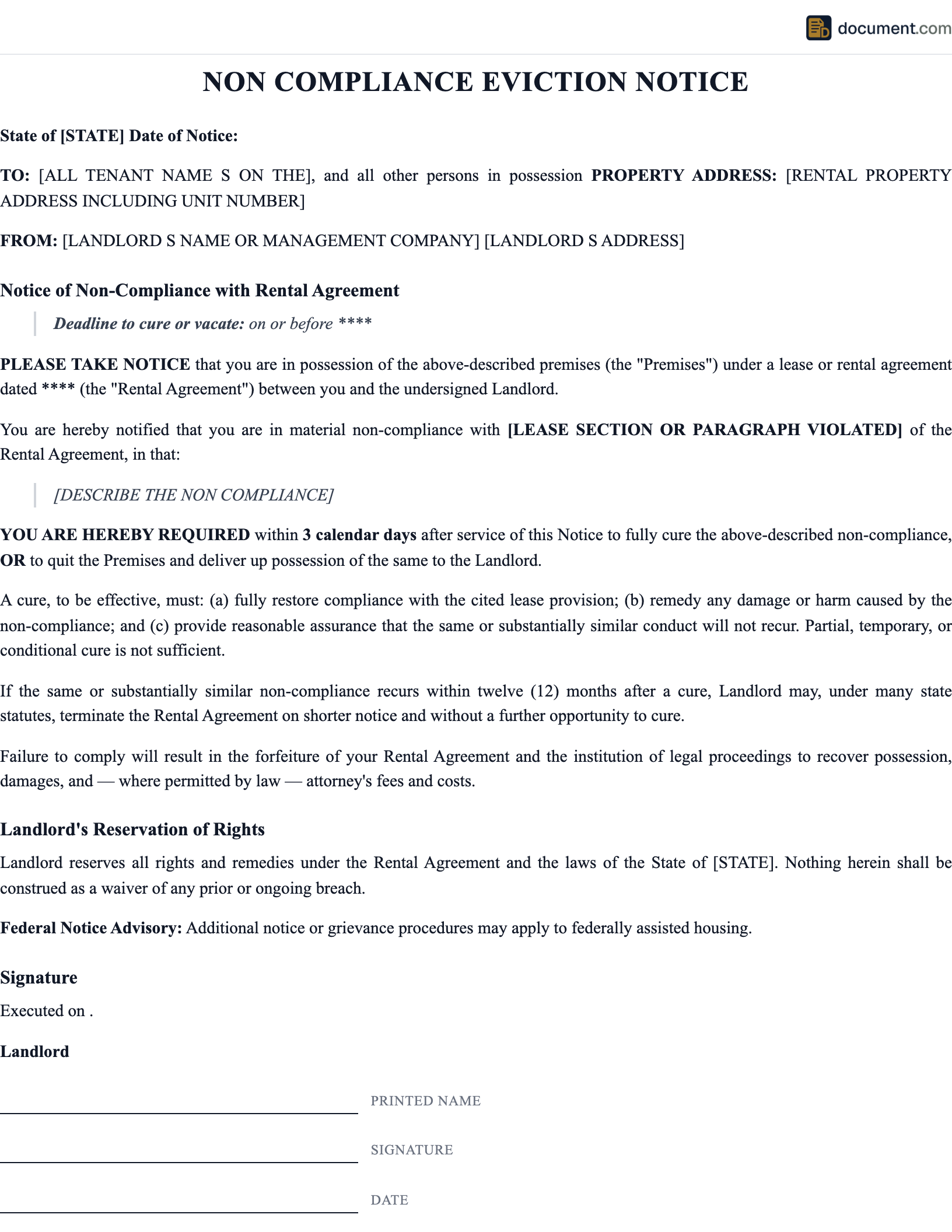
Sample California Non-Compliance Notice
Below is a preview of a California-specific notice for lease non-compliance under Cal. Civ. Code 1161(3).
NOTICE OF NON-COMPLIANCE
3 DAYS CURE-OR-QUIT NOTICE
Pursuant to Cal. Civ. Code 1161(3)
TO TENANT(S):
Name: [Full Legal Name]
Address: [California Property Address]
NATURE OF VIOLATION:
You are in violation of the following provision of your lease agreement:
[Specific lease clause and factual description]
CURE DEMAND
Pursuant to Cal. Civ. Code 1161(3), you have 3 days from the date of service of this notice to remedy the above violation. If you fail to cure the breach within the notice period, your rental agreement will terminate and the landlord will pursue legal action to recover possession.