



Arkansas Non-Compliance Eviction Overview
Arkansas is one of the least tenant-protective states in the nation when it comes to eviction for lease non-compliance. The state does not have a comprehensive residential landlord-tenant act like most other states, and critically, there is no statutory cure period for lease violations. This means Arkansas landlords are not required by state law to give tenants any specific number of days to fix a violation before filing for eviction in court.
Arkansas eviction procedures are governed primarily by A.C.A. 18-17-901 et seq. (unlawful detainer) and the specific terms of the lease agreement between the parties. If the lease specifies a cure period or notice requirement for violations, the landlord must honor those contractual provisions. If the lease is silent on the process, the landlord can generally proceed to file an unlawful detainer action after providing reasonable written notice, which Arkansas courts typically interpret as at least a few days.
Despite the lack of a statutory cure period, the 2021 Act 1052 (the Landlord-Tenant Responsibilities Act) introduced some basic protections including requirements for written notice before certain eviction actions and defined tenant obligations for property maintenance. Self-help evictions remain prohibited even in Arkansas. Cities like Little Rock, Fayetteville, Fort Smith, and Jonesboro may have additional local ordinances that landlords should review before proceeding.
No Cure Period
No mandatory cure
A.C.A.
Governing statute
$65-$165
Filing fees
District
District Court
Arkansas's Notice Requirements Under A.C.A. 18-17-901
Arkansas does not mandate a specific statutory cure period for lease violations. However, landlords should still follow proper notice procedures under A.C.A. 18-17-901 to ensure their eviction case will be upheld in court. Providing written notice is strongly recommended.
No Statutory Cure Period in Arkansas
Arkansas does not require landlords to give tenants any specific number of days to cure a lease violation before filing for eviction. However, many lease agreements include cure provisions that the landlord is contractually obligated to honor. Even without a contractual cure period, providing reasonable written notice of the violation is strongly recommended to avoid having the case dismissed for procedural deficiencies.
Key Rules for Non-Compliance Notices
- No state-mandated cure period: Arkansas law does not require any specific number of days for tenants to cure lease violations before eviction proceedings can begin
- Lease terms control: If the lease agreement includes a cure period or specific notice requirement for violations, the landlord must follow those contractual provisions exactly as written
- Reasonable notice recommended: Even without a statutory requirement, providing written notice identifying the violation is expected by Arkansas courts and strengthens the landlord's position
- Act 1052 notice requirements: The 2021 Landlord-Tenant Responsibilities Act requires written notice before certain eviction actions, establishing minimum procedural standards
- Criminal activity exception: For criminal activity on the premises including drug manufacturing and distribution, landlords may file for eviction immediately under expedited provisions
Common Lease Violations in Arkansas
Non-compliance evictions in Arkansas cover a wide range of lease violations beyond nonpayment of rent. Below are the most frequently encountered violations that lead landlords to serve a no mandatory cure period notice.
Unauthorized Pets
Keeping animals in violation of the lease terms. Arkansas has no statewide pet deposit cap, so landlords often include very detailed pet provisions in their leases. Violations include keeping unauthorized breeds, exceeding number limits, or having any pet in a no-pet property. Service and emotional support animals are protected under federal law.
Property Damage
Intentional or negligent damage to the rental unit or premises beyond normal wear and tear. Arkansas landlords can hold tenants liable for damage costs under the lease terms and may pursue both eviction for non-compliance and monetary damages in the same court action.
Noise and Nuisance
Disruptive behavior including consistently loud music, frequent parties, yelling, or other conduct that disturbs neighbors and violates quiet enjoyment clauses in the lease. Municipal noise ordinances in cities like Little Rock, Fayetteville, and Fort Smith may provide additional grounds for documenting the violation.
Unauthorized Occupants
Allowing people not named on the lease to move into the rental unit as permanent residents without the landlord's written permission. This changes the occupancy levels, can affect the landlord's insurance coverage, and increases wear on the property beyond what was anticipated.
Illegal Activity
Drug manufacturing, distribution, possession, or use on the rental premises. Arkansas has specific criminal activity eviction provisions that allow landlords to pursue expedited proceedings for drug-related lease violations. File a police report and include it with the eviction filing.
Failure to Maintain Premises
Under the 2021 Act 1052, tenants have defined obligations to maintain the rental unit in a clean condition, dispose of waste properly, and not deliberately damage fixtures or appliances. Violations include creating unsanitary conditions, improperly disposing of garbage, and damaging landlord-provided appliances.
How to Serve a Non-Compliance Notice in Arkansas
Proper service is essential for the notice to be legally effective under Arkansas law. Improper service is one of the most common reasons eviction cases are dismissed in Arkansas courts.
Document the Violation Thoroughly
Gather evidence of the lease breach including dated photographs, written complaints from neighbors, police reports, building inspection findings, and records of prior warnings. Identify which specific lease clause is being violated.
Review Your Lease Terms
Check whether your lease includes a cure period or specific notice requirement for violations. If the lease specifies a process, you must follow those contractual terms before filing for eviction, even though state law does not require it.
Provide Written Notice
Even though Arkansas does not require a statutory cure period, deliver a clear written notice identifying the specific violation to the tenant. Consider giving at least 3 to 5 days for the tenant to respond, which courts view favorably. Use certified mail for proof of delivery.
File Unlawful Detainer Action
If the tenant does not correct the violation within your notice period, or if no cure period applies, file an unlawful detainer action in the District Court for the county where the rental property is located. Filing fees typically range from $65 to $165.
Attend the Court Hearing
Present your evidence at the hearing, which is typically scheduled within 5 to 10 days of filing. Bring copies of the signed lease agreement, your written notice, all evidence of the violation, proof of service, and any witness statements.
Arkansas Legal Requirements for Non-Compliance Notices
Arkansas courts will scrutinize the eviction notice for compliance with all statutory requirements before allowing the case to proceed. A deficient notice is one of the most common reasons cases are dismissed.
Required Notice Elements
- Lease violation evidence: Thorough documentation proving the tenant breached a specific term of the rental agreement
- Written notice: A written notice identifying the violation, strongly recommended even though no specific cure period is required by state statute
- Signed lease agreement: A copy of the lease showing the provision that has been violated
- Proof of service: Evidence that the tenant actually received the notice (certified mail receipt, witness statement)
- No self-help eviction: Despite limited statutory tenant protections in Arkansas, self-help evictions including lock changes and utility shutoffs remain prohibited
- Proper court filing: The unlawful detainer complaint must be filed in the correct District Court jurisdiction where the property is located
Self-Help Evictions Are Prohibited
Even in Arkansas, self-help evictions are not permitted under the law. Landlords cannot change locks, remove doors or windows, shut off utilities including water, gas, or electricity, or physically remove a tenant's personal belongings from the premises. The only lawful path for a landlord to regain possession of a rental property is through the court system by filing an unlawful detainer action and obtaining a court order.
Arkansas Eviction Court Process
After the notice period expires without the tenant curing the violation or vacating, the landlord files an unlawful detainer action in Arkansas District Court.
| Stage | Timeframe | Details |
|---|---|---|
| Serve Written Notice | Day 0 | Deliver written notice identifying the specific violation |
| File Unlawful Detainer | Day 1-5 (or per lease terms) | File in District Court ($65-$165 filing fee) |
| Court Hearing | 5-10 days after filing | Judge hears evidence from both landlord and tenant |
| Judgment Entered | Same day or shortly after hearing | Court issues judgment for possession if landlord prevails |
| Writ of Possession | 24 hours after judgment | Sheriff enforces physical removal of tenant and belongings |
Arkansas has one of the fastest eviction processes in the entire country. Without a mandatory cure period, landlords can file for eviction within days of the violation occurring. The entire process from initial notice through sheriff enforcement of removal typically takes just 2 to 4 weeks for uncontested cases. Contested cases where the tenant raises defenses may take 4 to 6 weeks.
Sample Arkansas Non-Compliance Notice
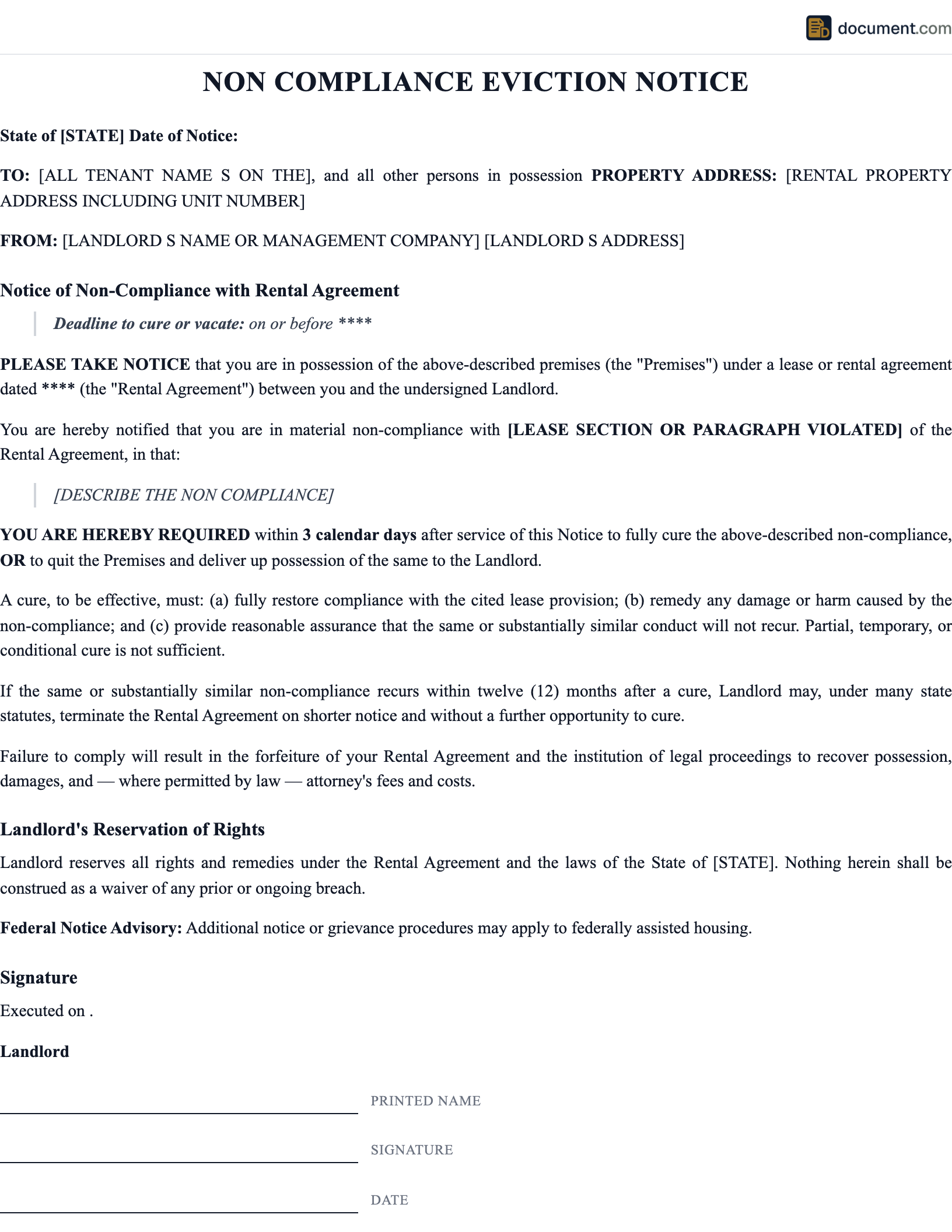
Below is a preview of a Arkansas-specific notice for lease non-compliance under A.C.A. 18-17-901.
NOTICE OF NON-COMPLIANCE
LEASE VIOLATION NOTICE
Pursuant to A.C.A. 18-17-901
TO TENANT(S):
Name: [Full Legal Name]
Address: [Arkansas Property Address]
NATURE OF VIOLATION:
You are in violation of the following provision of your lease agreement:
[Specific lease clause and factual description]
NOTICE
You are hereby notified of the above lease violation. The landlord demands that you immediately cease and correct this violation. Failure to do so will result in the landlord pursuing legal action to recover possession of the premises.