



Alaska Non-Compliance Eviction Overview
Alaska's landlord-tenant law is codified in the Uniform Residential Landlord and Tenant Act (URLTA), found at Alaska Statutes Title 34, Chapter 03. This comprehensive statute applies uniformly across the entire state to all residential rental agreements, from Anchorage high-rises to Fairbanks duplexes and remote bush community housing. For lease violations not involving nonpayment of rent, AS 34.03.160 establishes a tiered notice system based on the severity and recurrence of violations.
Under AS 34.03.160(a), landlords must deliver a written 10-day cure-or-quit notice for first-time material lease violations. The notice must clearly specify the nature of the breach and state that the rental agreement will terminate in not fewer than 10 days after receipt if the violation is not remedied. If the tenant successfully cures the breach but the same type of violation recurs within six months, the landlord may issue a 5-day unconditional quit notice with no cure opportunity.
For violations involving deliberate or negligent property destruction, or conduct that constitutes a threat to the health or safety of other tenants, AS 34.03.160(b) permits a 24-hour unconditional termination notice with no cure period. Alaska's extreme climate creates unique enforcement considerations. Violations involving heating system misuse, failure to maintain minimum interior temperatures that can cause frozen pipes, or improper waste disposal that attracts bears and other wildlife are treated with particular seriousness by Alaska courts.
10 Days
Cure period
AS
Governing statute
~$75
Filing fees
District
District Court
Alaska's 10 Days Cure Period Under AS 34.03.160
The 10-day cure period is central to Alaska's non-compliance eviction process. Under AS 34.03.160, the landlord must deliver a written notice specifying the nature of the breach and providing the tenant with 10 calendar days to remedy the violation before the rental agreement terminates.
Alaska's Tiered Notice System: 10-Day, 5-Day, and 24-Hour
Alaska uses three distinct notice periods: (1) 10 days with cure opportunity for first-time violations, (2) 5 days without cure for repeat violations of the same type within 6 months under AS 34.03.160(a), and (3) 24 hours without cure for deliberate destruction or health/safety threats under AS 34.03.160(b). Using the wrong notice type for the situation will invalidate the eviction proceeding.
Key Rules for Non-Compliance Notices
- First offense (10-day cure): Tenant has 10 calendar days to fully remedy the violation. If the tenant cures the breach within the notice period, the lease continues unchanged and no further action can be taken for that occurrence
- Repeat within 6 months (5-day quit): If the tenant commits a substantially similar violation within 6 months of a prior cure notice, the landlord may serve a 5-day unconditional termination notice with no cure opportunity under AS 34.03.160(a)
- Health/safety threats (24-hour quit): For deliberate or negligent destruction of the premises or conduct threatening the health or safety of others, AS 34.03.160(b) allows a 24-hour unconditional termination notice with no cure
- Written form required: All notice types must be delivered in writing. Verbal or oral notices do not satisfy Alaska URLTA requirements and will not support a court eviction action
- Calendar days: The notice period is counted in calendar days beginning the day after service. If the last day falls on a Saturday, Sunday, or legal holiday, it extends to the next business day
Common Lease Violations in Alaska
Non-compliance evictions in Alaska cover a wide range of lease violations beyond nonpayment of rent. Below are the most frequently encountered violations that lead landlords to serve a 10-day cure-or-quit notice.
Unauthorized Pets
Keeping pets in no-pet units or exceeding breed, size, or number restrictions specified in the lease. Alaska landlords frequently encounter issues with sled dogs, large breeds, and exotic animals. Service animals and emotional support animals with proper documentation are protected under the Fair Housing Act regardless of pet policies.
Heating System Misuse
Tampering with shared heating systems, failing to maintain minimum interior temperatures, or using unauthorized portable space heaters that create fire hazards. In Alaska's extreme cold with temperatures reaching -40°F or below, these violations can cause frozen and burst water pipes, resulting in thousands of dollars in property damage.
Noise and Nuisance
Persistent noise disturbances in multi-unit buildings common in Anchorage, Fairbanks, and Juneau. Violations of quiet hours provisions, loud parties, excessive music, and disruptive behavior that substantially interferes with other tenants' quiet enjoyment of their homes.
Unauthorized Occupants
Allowing individuals not named on the lease to move into the unit without the landlord's prior written approval. This is particularly common during Alaska's seasonal work periods when fishing, oil, and tourism workers seek temporary housing with friends or family members who hold leases.
Property Damage
Damage to the rental unit or common areas beyond normal wear and tear. Under AS 34.03.120, tenants are obligated to maintain the dwelling in a clean and safe condition and must not deliberately or negligently destroy, deface, or damage the premises or permit any person to do so.
Improper Waste Disposal
Failure to properly dispose of garbage and refuse, which is a serious safety concern in many Alaska communities where wildlife including bears, moose, and wolves may be attracted to improperly stored waste. Many leases and local ordinances require bear-proof containers in designated areas.
How to Serve a Non-Compliance Notice in Alaska
Proper service is essential for the notice to be legally effective under Alaska law. Improper service is one of the most common reasons eviction cases are dismissed. Follow these steps carefully to protect your case if the matter proceeds to court.
Document the Violation
Gather concrete evidence of the breach including dated photographs, written complaints from neighbors, building inspection reports, and police reports if applicable. Identify the specific lease provision or statutory obligation under AS 34.03.120 that the tenant is violating.
Prepare the Written Notice
Draft a notice that identifies all tenants on the lease, the property address, the specific violation in detail, and the applicable notice period (10 days, 5 days, or 24 hours). Include a clear statement that the rental agreement will terminate if the violation is not remedied. Reference AS 34.03.160.
Deliver the Notice Properly
Serve by personal hand-delivery to the tenant, by leaving the notice at the tenant's dwelling in a conspicuous place if the tenant is absent per AS 34.03.140, or by mailing via certified mail with return receipt requested for proof of service. Personal delivery with a witness provides the strongest evidence in court.
Record and Preserve Proof of Service
Carefully document the exact date and time of delivery, the method used, and the name and contact information of any witness present. Retain the original signed copy of the notice, any certified mail receipts, and take a timestamped photograph if posting the notice on the door.
File in Court After the Period Expires
If the tenant does not cure the violation or vacate within the notice period, file a forcible entry and detainer (FED) action in the Alaska District Court for the judicial district where the rental property is located. The filing fee is approximately $75. Prepare your evidence package for the hearing.
Alaska Legal Requirements for Non-Compliance Notices
Alaska courts will scrutinize the eviction notice for compliance with statutory requirements before allowing the case to proceed. A deficient notice is one of the most common reasons eviction cases are dismissed. The following elements must be present in every non-compliance notice.
Required Notice Elements
- Tenant identification: Full legal names of all tenants named on the rental agreement
- Property address: Complete street address of the rental unit including apartment or unit number and city
- Specific violation described: A clear and detailed description of the breach, identifying what lease term or statutory obligation is being violated and the factual basis for the claim
- Applicable cure deadline: A statement of the specific number of days the tenant has to remedy the violation (10, 5, or 24 hours as applicable)
- Termination consequence: Explicit language stating that the rental agreement will terminate if the breach is not cured within the notice period
- Date and landlord signature: The notice must be dated and signed by the landlord or an authorized property management agent
Self-Help Evictions Are Prohibited
Under AS 34.03.210, Alaska strictly prohibits self-help evictions. Landlords may not change locks, shut off or interrupt utility services including heat, remove doors or windows, or take any other action designed to force a tenant to vacate without a valid court order. A landlord who violates this prohibition is liable to the tenant for actual damages sustained, an amount up to one and one-half months' periodic rent, and reasonable attorney's fees. Given Alaska's extreme winter conditions, utility shutoffs can be particularly dangerous and courts treat such violations seriously.
Alaska Eviction Court Process
After the notice period expires without the tenant curing the violation or vacating, the landlord files a forcible entry and detainer (FED) in Alaska District Court. The eviction process follows a specific timeline.
| Stage | Timeframe | Details |
|---|---|---|
| Serve Notice | Day 0 | Deliver the 10-day cure-or-quit notice to the tenant |
| Cure Period Runs | Days 1-10 | Tenant has the opportunity to remedy the violation |
| File FED Action | Day 11 or later | File forcible entry and detainer in District Court (~$75 filing fee) |
| Court Hearing | 10-15 days after filing | Both landlord and tenant present evidence before the judge |
| Writ of Assistance | After judgment is entered | A peace officer enforces the removal if tenant does not vacate voluntarily |
The total eviction process from initial notice through enforcement typically takes 4 to 7 weeks for uncontested cases in Alaska. Contested cases where the tenant raises defenses or requests continuances can extend to 2 to 3 months. In remote Alaska communities accessible only by air or water, scheduling and logistical challenges may add additional time to the court process.
Sample Alaska Non-Compliance Notice
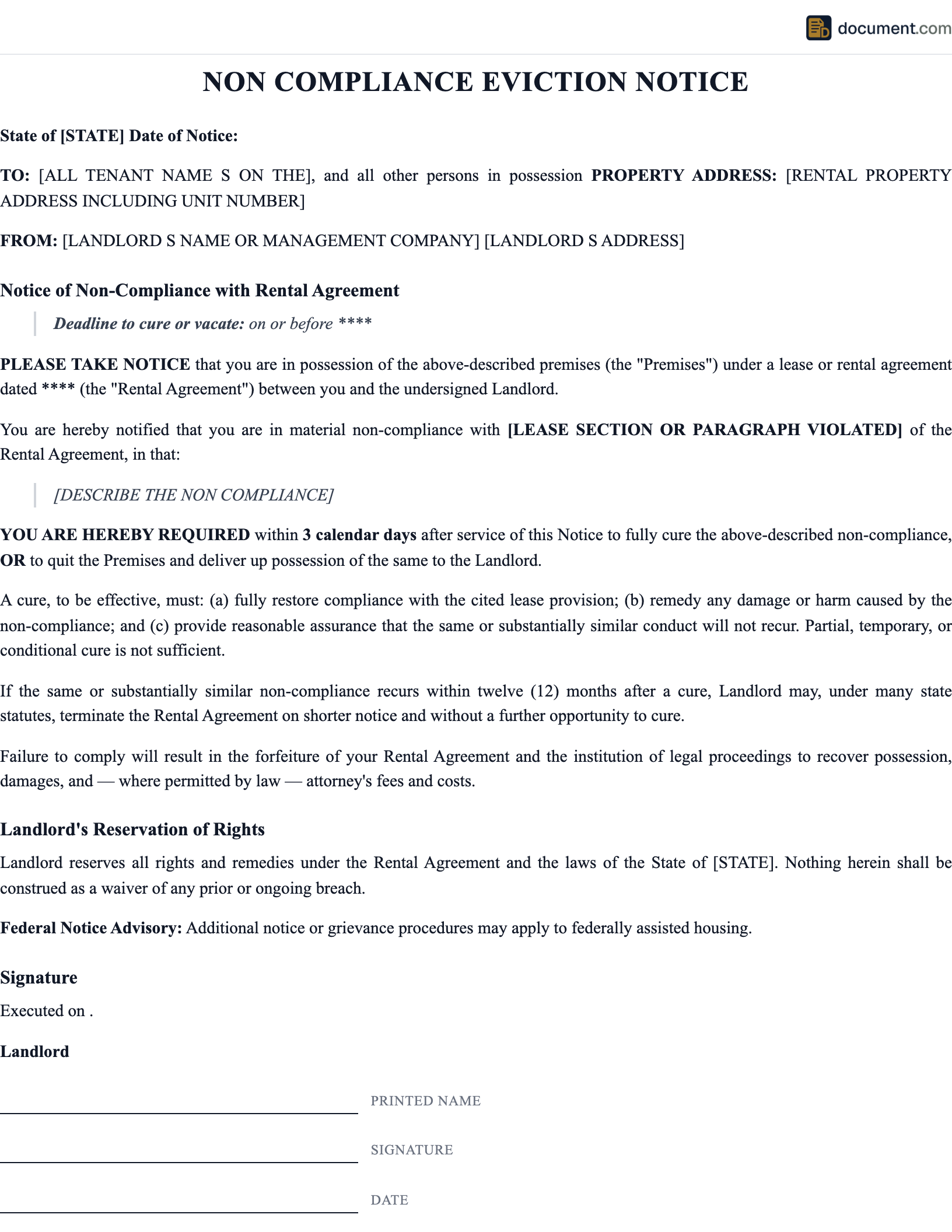
Below is a preview of a Alaska-specific notice for lease non-compliance. Your customized document will include all fields and statutory language required under AS 34.03.160.
NOTICE OF NON-COMPLIANCE
10 DAYS CURE-OR-QUIT NOTICE
Pursuant to AS 34.03.160
TO TENANT(S):
Name: [Full Legal Name]
Address: [Alaska Property Address]
NATURE OF VIOLATION:
You are in violation of the following provision of your lease agreement:
[Specific lease clause and factual description of the violation]
CURE DEMAND
Pursuant to AS 34.03.160, you have 10 days from the date of service of this notice to remedy the above violation. If you fail to cure the breach within the notice period, your rental agreement will terminate and the landlord will pursue legal action to recover possession of the premises through Alaska District Court.