
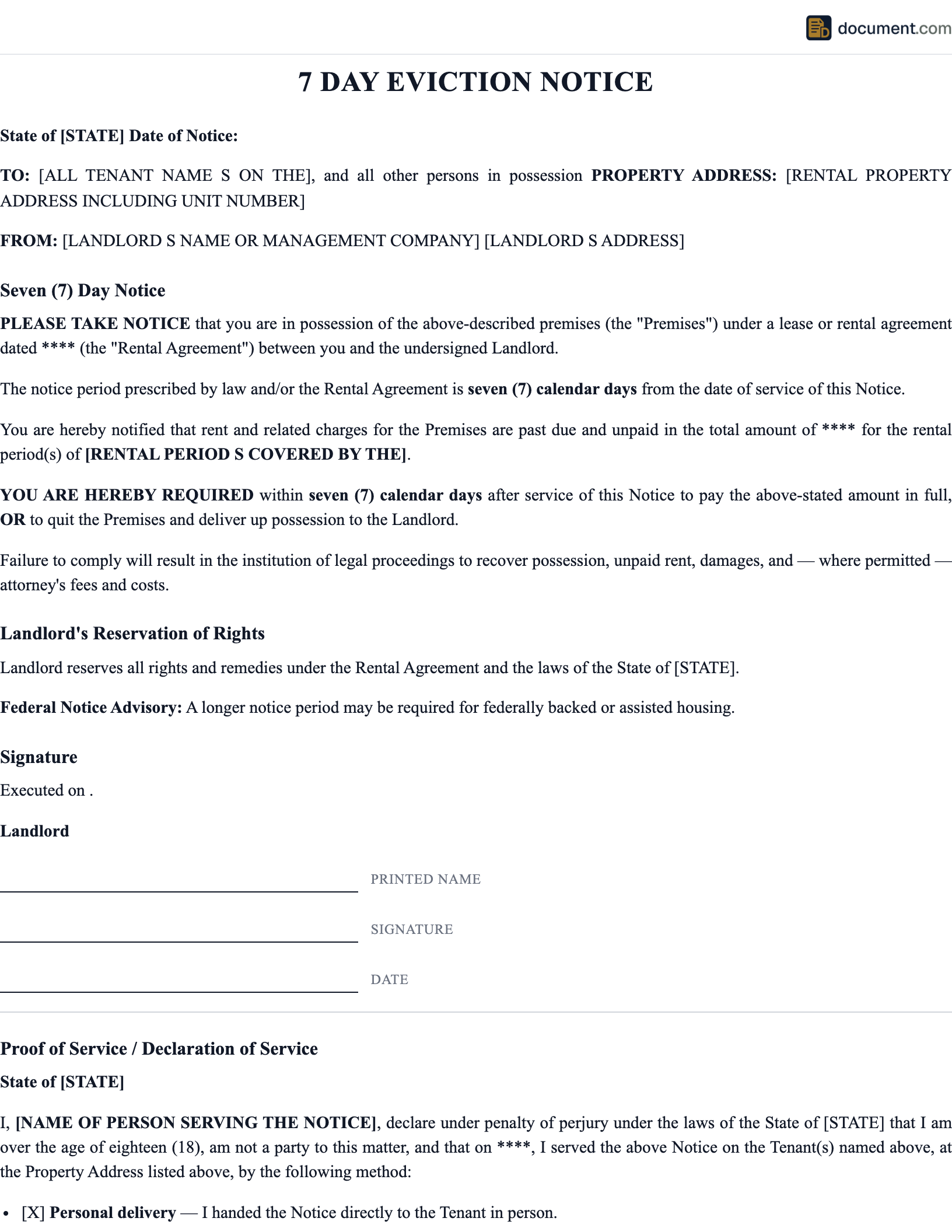



Florida Eviction Notice Overview
Florida uses a 3-day notice for non-payment of rent under FL Stat. 83.56(3), not 7 days. However, Florida does require a 7-day notice for material lease violations that are curable under FL Stat. 83.56(2)(b). This makes Florida a partial 7-day state — the 7-day period applies only to lease violations, not to non-payment. The 3-day notice period excludes weekends and legal holidays, which is an important counting distinction.
Florida's residential landlord-tenant law is codified in FL Stat. Chapter 83, Part II (the Florida Residential Landlord and Tenant Act). Eviction cases are filed in County Court and follow a specific statutory procedure including mandatory requirements for the notice format. Florida has 67 counties, and cases are filed where the rental property is located. Miami-Dade, Broward, Orange, and Hillsborough counties handle the highest eviction volumes in the state.
3 Days
Notice period
$185
Filing fee
FL Code
Governing law
County
Court level
Why Florida Uses 3 Days, Not 7
Florida Uses 3 Days for Rent, 7 Days for Violations
Florida has split notice periods: 3 business days for non-payment of rent (FL Stat. 83.56(3), excluding weekends and holidays) and 7 calendar days for curable lease violations (FL Stat. 83.56(2)(b)). For non-curable violations, a 7-day unconditional quit notice applies under FL Stat. 83.56(2)(a). Make sure you use the correct notice type.
Florida Notice Periods at a Glance
- 3-Day Notice — Non-Payment (FL Stat. 83.56(3)): Tenant has 3 business days (excluding weekends and holidays) to pay all rent owed
- 7-Day Notice — Curable Violations (FL Stat. 83.56(2)(b)): Tenant has 7 calendar days to cure a material lease violation
- 7-Day Unconditional Quit (FL Stat. 83.56(2)(a)): For non-curable violations; no opportunity to cure before eviction
- 15-Day Notice — No-Cause Termination: 15 days notice to terminate a month-to-month tenancy
Florida Notice Requirements
Florida courts require that eviction notices meet specific content and format standards. An incomplete or incorrectly timed notice will result in dismissal of the eviction case.
Required Notice Content
- Property Address: Full address including unit number, city, and zip code
- Tenant Names: All tenants named on the lease or rental agreement
- Amount Owed or Violation: Exact dollar amount of rent due, or specific description of the lease violation
- Correct Notice Period: 3 days for non-payment as required by Florida law
- Consequence Statement: That eviction proceedings will be filed if the tenant does not cure or vacate
- Landlord Information: Name and contact information of the landlord or property manager
How to Serve an Eviction Notice in Florida
Florida law provides specific methods for serving eviction notices. Proper service and documentation are essential for the court filing.
Personal Service
Hand-deliver to the tenant in person. This is the preferred method in Florida courts and starts the notice period immediately. Use a witness for documentation.
Substitute Service
Leave with a person of suitable age and discretion at the tenant's residence. Must also mail a copy to the tenant's address. Both steps are required for valid service.
Posting and Mailing
Post the notice on the property door in a conspicuous place and mail a copy via first-class mail. This method is used when personal and substitute service have failed.
Document Service
Prepare a written certificate of service with the date, time, and method of delivery. Take timestamped photos if posting on the door. Florida courts require proof of service with the eviction complaint.
Florida Eviction Timeline
The Florida eviction process follows a specific timeline from notice through court proceedings to enforcement.
Serve 3-day notice for non-payment under FL Stat. 83.56(3) — the 3 days exclude weekends and legal holidays
If the tenant has not paid after the 3 business days expire, file eviction complaint in County Court
Court issues summons; tenant has 5 days to respond after being served with court papers
If no response filed, request default judgment for possession; if contested, hearing is scheduled
Writ of possession issued; sheriff posts 24-hour notice on the property then executes physical removal
Uncontested Florida evictions typically take 3-5 weeks from notice to removal. Contested cases take 5-10 weeks or longer. Miami-Dade and Broward counties often have longer wait times for hearings due to case volume. The sheriff must post a 24-hour notice before executing the writ of possession. Florida landlords can recover attorney fees if the lease contains an attorney fees provision.
Florida Eviction Fees & Costs
Below are the typical costs for an eviction proceeding in Florida County Court. Actual fees may vary by county.
| Fee / Cost | Typical Amount |
|---|---|
| County Court Filing Fee | $185 |
| Sheriff Service of Process | $40 - $70 |
| Writ of Possession | $90 - $115 |
| Attorney Fees (optional) | $800 - $2,500 |
| Appeal Filing Fee | $300 |
Sample Florida Eviction Notice
Below is a preview of a Florida-compliant eviction notice that meets the requirements of FL Stat. 83.56.
3-DAY NOTICE TO PAY RENT OR VACATE
STATE OF FLORIDA
Pursuant to FL Stat. 83.56(3)
LANDLORD:
Name: [Full Legal Name]
Address: [Florida Address]
TENANT(S):
Name(s): [All Tenant Names]
Rental Address: [Full Property Address]
NOTICE:
You are hereby notified that rent in the amount of $[Amount] for the rental period of [Dates] is past due. You have THREE (3) BUSINESS DAYS (excluding weekends and legal holidays) from the date of delivery to pay the above amount in full or deliver possession of the premises to the landlord.
FLORIDA COMPLIANCE NOTE
Florida uses a 3-day notice for non-payment (excluding weekends and holidays) per FL Stat. 83.56(3). For curable lease violations, a separate 7-day notice is required under FL Stat. 83.56(2)(b). Do not include late fees, utilities, or other charges in the 3-day notice — only the rent amount owed.