



Washington 60-Day Notice Overview
Washington underwent a fundamental shift in landlord-tenant law with the passage of HB 1236 in 2021, which added RCW 59.18.650 to the Residential Landlord-Tenant Act. Before this law, Washington landlords could terminate month-to-month tenancies with just 20 days notice for any reason. Now, all residential evictions require a qualifying just-cause reason, and no-fault terminations demand 60 days written notice.
The 60-day notice under RCW 59.18.650(2)(c) is specifically for landlord-reason (no-fault) terminations such as owner move-in, sale to an owner-occupant, demolition, or substantial rehabilitation. For tenant-fault terminations like non-payment or lease violations, shorter notice periods of 14 days (curable violations) or 3 days (waste, nuisance, or unlawful activity) still apply. Washington's system is distinct from other states because it requires just cause from day one of the tenancy, not just after a qualifying period.
60 Days
No-fault termination
$43-$240
UD filing fees
HB 1236
Just-cause required
3-6 wks
UD court process
When a 60-Day Notice Applies in Washington
Under RCW 59.18.650(2)(c), a 60-day notice is required for specific no-fault landlord reasons. Unlike California or Oregon, Washington does not allow no-cause terminations at all.
Owner or Family Member Move-In
The property owner or an immediate family member (spouse, domestic partner, parent, grandparent, child, or grandchild) intends to occupy the dwelling as a primary residence for at least 12 consecutive months. The notice must identify by name and relationship who will occupy the unit.
Sale to Owner-Occupant Buyer
The owner has accepted a bona fide offer to purchase the property from a buyer who intends to occupy the unit as their primary residence. The notice must be served after mutual acceptance of the purchase agreement and include evidence of the pending sale.
Demolition, Renovation, or Change of Use
The owner intends to demolish the unit, undertake substantial rehabilitation that cannot be accomplished with the tenant in the unit, or convert the property to a non-residential use. Applicable permits must be obtained or applied for before serving the notice.
Washington Just-Cause Requirements (HB 1236)
HB 1236 established Washington as one of a handful of states requiring just cause for all residential evictions from the first day of tenancy. The law enumerates specific at-fault and no-fault grounds, each with its own notice period and procedural requirements.
Bad-Faith Penalties
Under RCW 59.18.650(2)(c)(ii), if a landlord serves a 60-day owner-move-in notice but the owner or family member does not actually occupy the unit for at least 12 months, the former tenant may recover actual damages plus a civil penalty of up to three months rent, together with court costs and reasonable attorney fees. Seattle's local ordinance (SMC 22.206.160C) imposes penalties of up to $2,000 per day for bad-faith owner-move-in claims.
Washington 60-Day Notice Legal Requirements
The notice must comply with RCW 59.18.650 and identify the specific just-cause ground relied upon.
Required Notice Content
- Just-Cause Reason: Clearly state the specific statutory basis from RCW 59.18.650(2)(c) for the termination
- Tenant and Property Details: Full names of all tenants on the rental agreement and the complete property address
- Termination Date: Specify a date at least 60 days from service aligned with the end of a rental period
- Owner-Occupancy Details: If owner move-in, name and relationship of the person who will occupy for at least 12 months
- Local Ordinance Compliance: In Seattle, Tacoma, and Burien include locally mandated disclosures and relocation amounts
How to Serve a 60-Day Notice in Washington
Service must comply with RCW 59.12.040. The method chosen affects the 60-day period computation.
Personal Service
Hand-deliver the notice directly to the tenant or a person of suitable age and discretion residing at the premises. The 60-day period begins on the date of delivery
Posting and Mailing
Post the notice on the main entrance in a conspicuous location, then send copies via regular first-class and certified mail with return receipt. Add 3 days for the mailing component
Complete Proof of Service
Document the service in a sworn declaration with date, time, location, method, and description of person served. Retain certified mail receipts and photographs
File Unlawful Detainer Action
If the tenant does not vacate after 60 days, file an unlawful detainer complaint in district or superior court. Attach the original notice and proof of service
Washington Unlawful Detainer Timeline
Washington's unlawful detainer process under RCW Chapter 59.12 provides a summary procedure. After filing, the tenant has 7 days to file a written answer. A show-cause hearing is typically set within 7 to 14 days. If the landlord prevails, the writ of restitution is issued and the sheriff posts a 3-day notice before physical removal.
Uncontested cases take approximately 3 to 6 weeks from filing. In King County (Seattle) and Pierce County (Tacoma), court backlogs can push contested cases to 8 to 12 weeks. Combined with the 60-day notice period, the entire process ranges from 11 to 20 weeks.
Washington courts may grant stays of execution if the tenant demonstrates hardship, particularly for tenants with children, elderly tenants, or those with disabilities. Landlords should plan for the possibility of additional delays and consider cash-for-keys arrangements for faster resolution.
Washington Court Fees & Costs
Washington filing fees vary by court type. Most unlawful detainer actions are filed in district court.
| Fee / Cost | Typical Amount |
|---|---|
| District Court Filing Fee | $43 - $53 |
| Superior Court Filing Fee | $200 - $240 |
| Service of Process | $40 - $100 |
| Sheriff Writ Execution | $75 - $175 |
| Seattle Relocation (local) | $2,000 - $4,500 |
Sample Washington 60-Day Notice
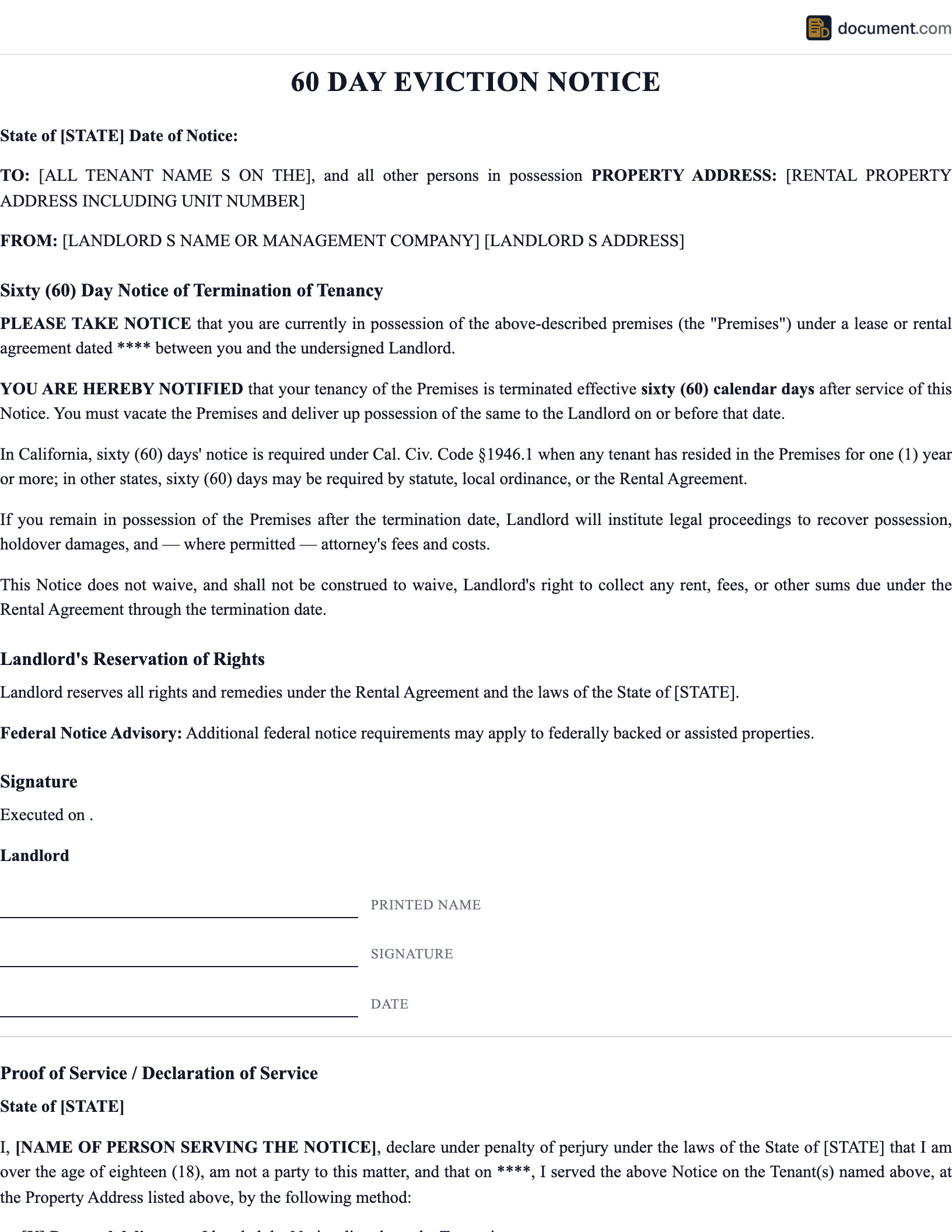
Below is a preview of our Washington-specific 60-day notice. This template includes the required just-cause reason statement under RCW 59.18.650.
60-DAY NOTICE OF TERMINATION
STATE OF WASHINGTON
Pursuant to RCW 59.18.650(2)(c)
LANDLORD / PROPERTY OWNER:
Name: [Full Legal Name]
Address: [Washington Mailing Address]
TENANT(S):
Name(s): [All Tenant Names]
Rental Address: [Full Property Address + Unit]
JUST-CAUSE REASON FOR TERMINATION:
Pursuant to RCW 59.18.650(2)(c), this tenancy is terminated because:[State specific statutory reason]. You must vacate on or before [Date 60+ days out].
OWNER OCCUPANCY DECLARATION
[If applicable] The undersigned owner / family member [name, relationship] intends to occupy this unit as a primary residence for a minimum of 12 consecutive months.