



Vermont 60-Day Notice Overview
Vermont is one of a small number of states that explicitly requires 60 days notice for no-cause termination of residential tenancies. Under Title 9, Chapter 137 of the Vermont Statutes Annotated (9 V.S.A. Section 4467(c)), a landlord who wishes to terminate a tenancy without alleging fault by the tenant must provide at least 60 days written notice for tenancies that have lasted less than two continuous years. For tenancies of two years or more, the required notice period increases to 90 days.
Vermont's landlord-tenant law is considered moderately tenant-friendly. The state does not have rent control, but it does impose meaningful procedural requirements on landlords seeking to terminate tenancies. Vermont's eviction process is notably slower than many states because it does not have a summary eviction procedure. Instead, evictions proceed through the regular civil litigation process in Superior Court, which can take several months from filing to judgment. The combination of 60-day notice and a deliberate court process means landlords should plan for a total timeline of 4 to 6 months from initial notice to physical removal.
60 Days
No-cause (<2 yrs)
$90-$295
Filing fees
9 V.S.A.
Ch. 137 governs
6-12 wks
Court process
When a 60-Day Notice Is Required in Vermont
The 60-day notice under 9 V.S.A. 4467(c) applies only to no-cause terminations. For-cause evictions use different, shorter timelines depending on the nature of the violation.
No-Cause Termination (Under 2 Years)
A tenancy that has been in effect for less than two continuous years may be terminated without cause by providing 60 days written notice. The landlord is not required to state a reason. This covers most month-to-month tenancies and lease non-renewals where the tenant has occupied for less than 24 months.
No-Cause Termination (2+ Years = 90 Days)
Tenancies that have lasted two or more continuous years require 90 days notice for no-cause termination. If you are uncertain whether a 60-day or 90-day notice is required, always use the longer period. Providing 90 days when only 60 is needed is always valid, but providing 60 when 90 is required will invalidate the notice.
Shorter Notices for Cause
Non-payment of rent requires 14 days notice (9 V.S.A. 4467(a)). Material lease violations require 30 days notice with an opportunity to cure within the first 14 days (9 V.S.A. 4467(b)). Criminal activity or behavior threatening safety may justify immediate action through emergency court proceedings.
Vermont Tenant Protections
While Vermont does not have a statewide just-cause eviction law, it provides robust procedural protections for tenants facing eviction. The 60/90-day tiered notice system itself is a form of protection, giving tenants meaningful time to find alternative housing.
Retaliatory Eviction Prohibition
Under 9 V.S.A. Section 4465, Vermont prohibits retaliatory evictions. A landlord may not terminate a tenancy in retaliation for the tenant reporting code violations, joining a tenant organization, or exercising any legal right. If the tenant has taken a protected action within the preceding 90 days, there is a rebuttable presumption that the termination is retaliatory. The burden shifts to the landlord to prove a legitimate non-retaliatory purpose. This defense is frequently raised in Vermont ejectment proceedings.
Vermont 60-Day Notice Legal Requirements
The notice must meet the requirements of 9 V.S.A. Chapter 137 and be clear enough that a court would find the tenant was adequately informed of the termination.
Required Notice Content
- Written Form: Vermont requires all termination notices to be in writing. Verbal notice is not sufficient under 9 V.S.A. 4467
- Tenant and Property ID: Full legal names of all tenants and the complete address of the rental premises including unit number
- Termination Date: The date the tenancy will end, which must be at least 60 days from service and should align with the end of a rental period
- Statement of No-Cause: While not required to state a reason, the notice should clearly state the tenancy is being terminated and the tenant must vacate by the specified date
- Landlord Contact: Name, mailing address, and phone number of the landlord or property manager for tenant communications
How to Serve a 60-Day Notice in Vermont
Vermont law does not prescribe a specific service method for pre-litigation termination notices, but courts evaluate whether the tenant actually received the notice.
Personal Delivery
Hand-deliver the notice to the tenant. Have a third-party witness present who can testify to the delivery. The 60-day period begins on the date of personal delivery
Certified Mail with Return Receipt
Send via USPS certified mail with return receipt requested to the tenant at the rental address. The 60-day period starts when the tenant signs for the letter. Keep the green return receipt card as proof
Dual Method (Recommended)
The safest approach is to use both personal delivery and certified mail simultaneously. This ensures proof of delivery even if the tenant refuses to accept one method
Document Service Thoroughly
Keep copies of the notice, proof of delivery, witness statements, and all postal receipts. Vermont courts require clear evidence of proper notice in ejectment proceedings
File Ejectment Action if Needed
After the 60-day period expires and the tenant remains, file an ejectment complaint in Vermont Superior Court, Civil Division. Attach the notice and all proof of service to the complaint
Vermont Eviction Timeline
Vermont does not have a summary eviction process. Ejectment actions proceed through the regular civil docket in Superior Court, Civil Division. This makes Vermont one of the slowest states for the eviction court process.
After the complaint is filed, the tenant has 20 days to file an answer. The court may schedule a pretrial conference or case management conference before setting the matter for hearing. A contested eviction trial in Vermont Superior Court typically occurs 6 to 12 weeks after filing, though backlogs in Chittenden County (Burlington) can extend this.
If the court rules for the landlord, a writ of possession is issued. The tenant may request a stay of execution, which judges occasionally grant for vulnerable tenants. The sheriff then enforces the writ, typically within 5 to 10 days. Total timeline from 60-day notice service to physical removal ranges from 4 to 6 months for uncontested cases and 6 to 9 months for contested cases.
Vermont Court Fees & Costs
Vermont Superior Court filing fees are set by the Judiciary and apply uniformly across all 14 counties.
| Fee / Cost | Typical Amount |
|---|---|
| Superior Court Filing Fee | $90 - $295 |
| Service of Process (Sheriff) | $30 - $75 |
| Attorney Fees (if hired) | $1,000 - $3,500 |
| Writ of Possession | $25 - $75 |
| Sheriff Enforcement | $50 - $200 |
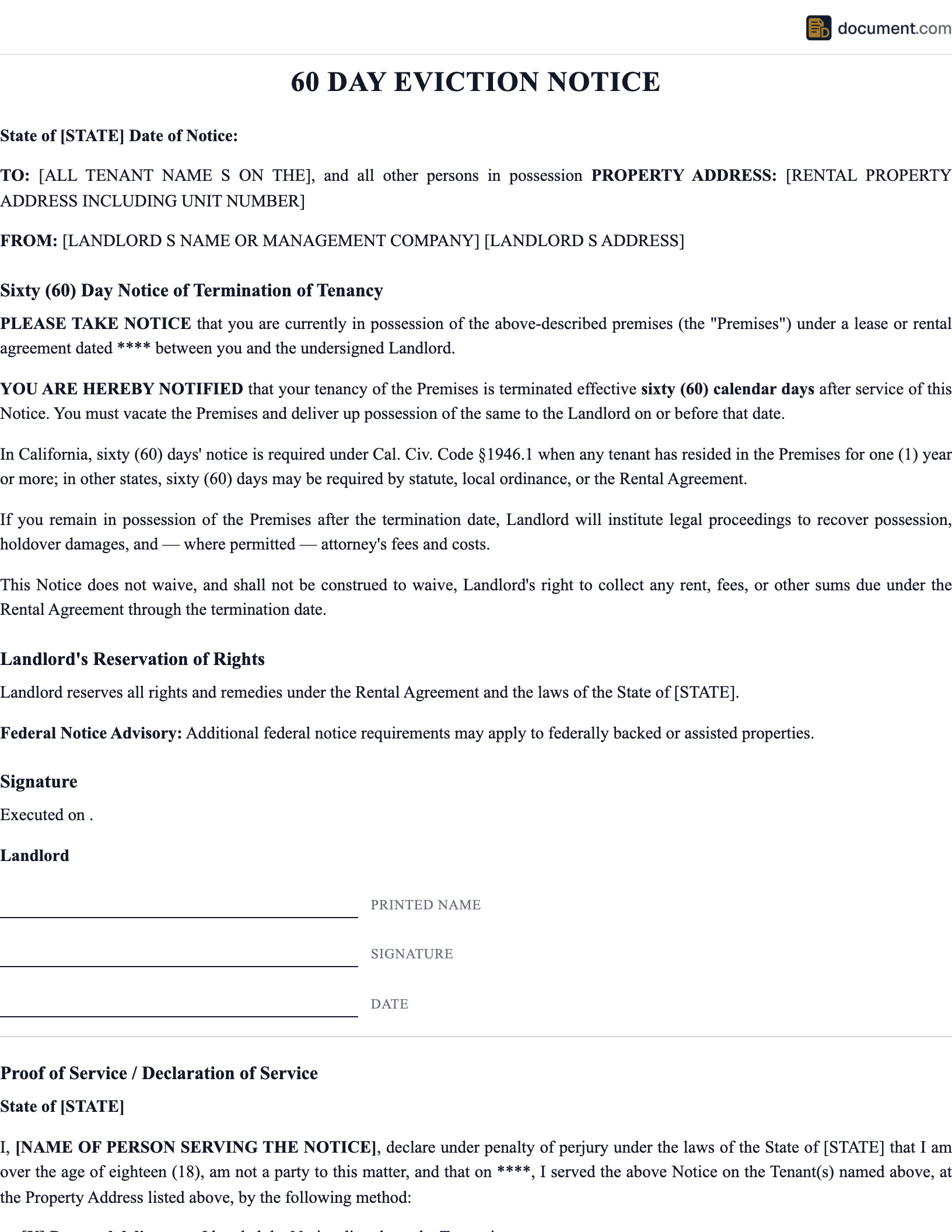
Sample Vermont 60-Day Notice
Below is a preview of our Vermont-specific 60-day termination notice. This template references 9 V.S.A. Section 4467(c) for the no-cause notice period.
60-DAY NOTICE OF TERMINATION
STATE OF VERMONT
Pursuant to 9 V.S.A. Section 4467(c)
LANDLORD / PROPERTY OWNER:
Name: [Full Legal Name]
Address: [Vermont Mailing Address]
TENANT(S):
Name(s): [All Tenant Names]
Rental Address: [Full Property Address]
NOTICE OF TERMINATION:
Pursuant to 9 V.S.A. Section 4467(c), you are hereby given 60 days written notice that your tenancy will terminate on [Date]. Your tenancy has been in effect for less than two continuous years.
SECURITY DEPOSIT
Your security deposit will be returned per 9 V.S.A. Section 4461 within 14 days of vacating. Provide a forwarding address for the refund.