



Tennessee 60-Day Notice Overview
Tennessee does not require a 60-day notice for standard residential tenancy terminations. Under the Tennessee Uniform Residential Landlord and Tenant Act (Tenn. Code 66-28-101 et seq.), month-to-month tenancies can be terminated with 30 days written notice under Tenn. Code 66-28-512.
Tennessee is one of the most landlord-friendly states. The state has no rent control, no just-cause eviction requirements, no state income tax, and a fast eviction process through General Sessions Courts. Security deposits are not capped by the URLTA. Nashville's rapid population growth has created one of the most competitive rental markets in the Southeast.
30 Days
Statutory default
$50-$90
Court filing fees
Written
Notice required
1-3 wks
Court process
When a 60-Day Notice Applies in Tennessee
Since Tennessee's statutory default for month-to-month termination is 30 days, understanding when a 60-day notice is actually required or advisable is essential for landlords.
Lease-Required Extended Notice
Many Tennessee property managers, particularly in Nashville and the surrounding suburbs, include 60-day non-renewal clauses. The contractual obligation overrides the 30-day minimum.
THDA Programs
Federal Section 8 programs administered through the Tennessee Housing Development Agency (THDA) and local PHAs like the Metropolitan Development and Housing Agency (Nashville) frequently require 60-90 days notice.
Nashville Growth Pressure
Nashville's explosive growth has made it one of the tightest rental markets in the South. Providing 60 days gives long-term tenants time to find housing in a market where rents have increased substantially.
Tennessee Legal Requirements
Tennessee's landlord-tenant statutes establish specific requirements for termination notices that must be followed precisely.
Tennessee URLTA Coverage Varies
The Tennessee URLTA (Tenn. Code 66-28-101 et seq.) applies to most residential tenancies but exempts certain arrangements including properties with fewer than 5 units where the owner resides on-site. In non-covered situations, common law notice rules may apply. Landlords should verify whether the URLTA applies to their specific property before relying on the 30-day provision.
Notice Content Requirements
- Written Notice: Tenn. Code 66-28-512 requires written notice. Oral notice is insufficient under Tennessee law
- Tenant and Property ID: Include all tenant names from the lease and the complete property address including city, county, and ZIP code
- Termination Date: State the exact date at least 60 days from service, aligned with the end of the monthly rental period
- Landlord Contact: Include the landlord or property manager name, Tennessee mailing address, and telephone number
- Security Deposit Reference: Tenn. Code 66-28-301 requires return of the deposit within 30 days with an itemized statement. No statutory cap on deposit amounts
How to Serve a 60-Day Eviction Notice in Tennessee
Proper service is critical in Tennessee. If the landlord cannot prove the notice was properly delivered, the court will dismiss the eviction action.
Prepare the Notice
Draft using a Tennessee-specific template referencing Tenn. Code 66-28-512. Include all tenant names, property address, and the 60-day termination date
Personal Delivery (Preferred)
Hand-deliver to the tenant at the rental premises. Tennessee courts prefer personal service. Use a process server or witness
Certified Mail Alternative
Send via certified mail with return receipt. Tennessee accepts mailed service for URLTA notices
Complete Proof of Service
Document date, time, method, and location of service. Keep certified mail receipts and return cards for court proceedings
File Detainer Warrant in General Sessions Court
After 60 days expire without the tenant vacating, file an eviction action in General Sessions Court where the property is located
Tennessee Eviction Timeline
Tennessee's eviction process uses a Detainer Warrant filed in General Sessions Court under Tenn. Code 29-18-101 et seq. After filing, the court schedules a hearing within 6-10 days. Tennessee has a fast eviction process.
At the hearing, both parties present evidence. If the landlord prevails, the court issues a judgment for possession. The tenant has 10 days to appeal to Circuit Court. If no appeal, a writ of possession is issued.
Total court timeline: 1-3 weeks uncontested, 3-6 weeks contested. Davidson County (Nashville), Shelby County (Memphis), and Knox County (Knoxville) have the heaviest caseloads. Combined with the 60-day notice period, the full process spans 9-14 weeks.
Tennessee Filing Fees & Costs
Eviction costs in Tennessee vary by county and court type. Below are typical expenses.
| Fee / Cost | Typical Amount |
|---|---|
| General Sessions Court Filing | $50 - $90 |
| Service of Process | $25 - $60 |
| Attorney Fees | $400 - $1,500 |
| Writ of Possession | $20 - $40 |
| Sheriff Enforcement | $50 - $150 |
Sample Tennessee 60-Day Notice
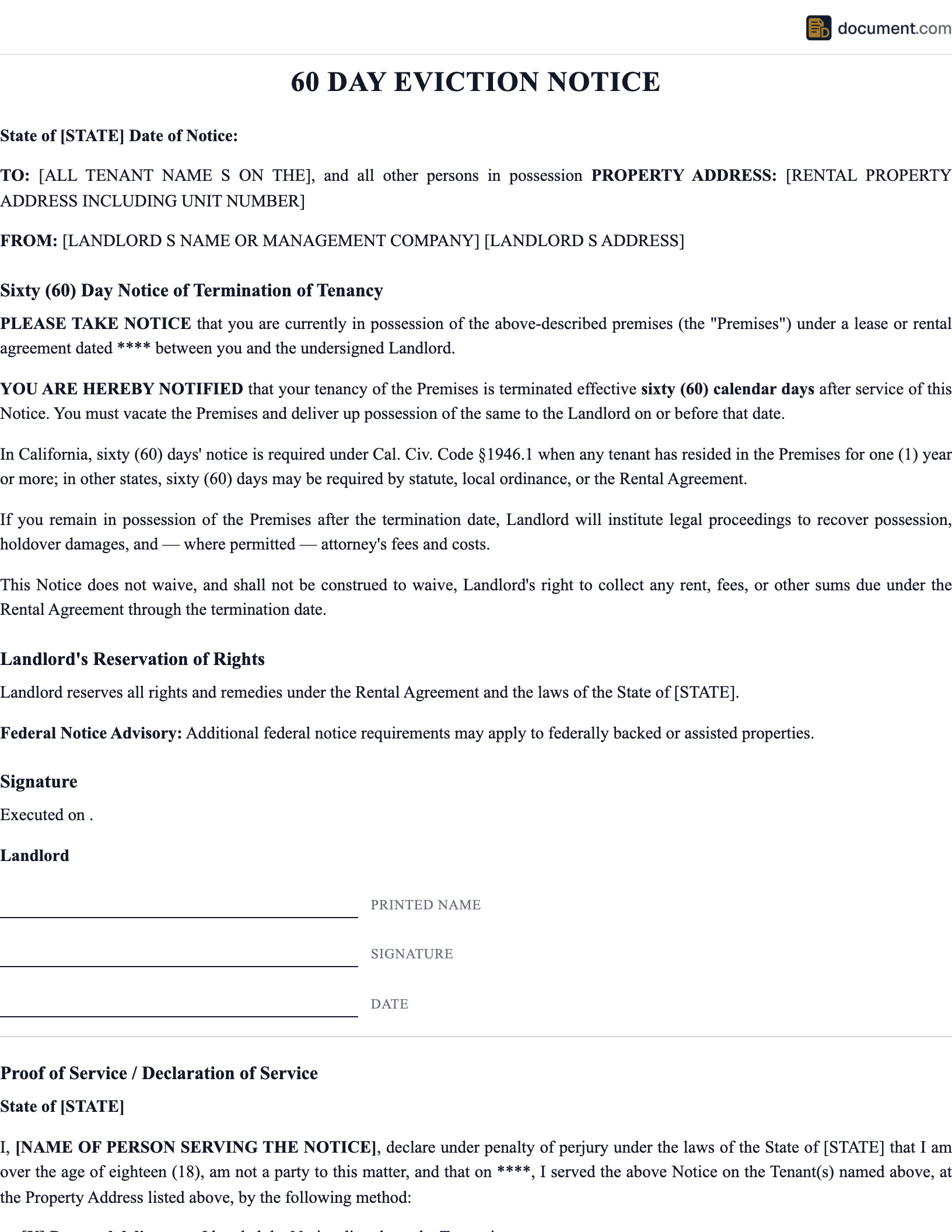
Below is a preview of our Tennessee-specific 60-day termination notice template.
60-DAY NOTICE OF TERMINATION
STATE OF TENNESSEE
Pursuant to Tenn. Code 66-28-512
LANDLORD / PROPERTY OWNER:
Name: [Full Legal Name]
Address: [Tennessee Mailing Address]
TENANT(S):
Name(s): [All Tenant Names]
Rental Address: [Full Property Address]
NOTICE OF TERMINATION:
You are hereby notified that your tenancy at the above premises will terminate on[Date — 60 days from service]. You must vacate and surrender possession by that date.
TENNESSEE COMPLIANCE NOTE
Your security deposit will be returned within 30 days of vacating per Tenn. Code 66-28-301, with an itemized statement of deductions. Please provide a forwarding address upon vacating.