



Oregon 60-Day Notice Overview
Oregon's approach to 60-day notices is defined by a critical threshold: the first year of tenancy. Under ORS 90.427(3)(b), landlords may serve a 60-day no-cause termination notice during the first 12 months of a month-to-month tenancy. This is an unconditional right during that period, meaning no reason for the termination needs to be stated. However, once the tenancy crosses the one-year mark, Oregon's landmark SB 608 (2019) eliminates the ability to serve no-cause notices entirely.
After the first year, landlords must use a 90-day notice and cite one of the qualifying landlord reasons enumerated in ORS 90.427(5), such as owner move-in, demolition, or substantial renovation. Additionally, relocation assistance of one month's rent must be paid for both 60-day no-cause terminations (in cities with 10,000+ population) and all 90-day landlord-reason terminations. Oregon was the first state to enact these statewide protections, and they have served as a model for similar laws in other jurisdictions.
60 Days
First year only
$88-$281
FED filing fees
SB 608
No-cause limits
3-5 wks
FED court process
When a 60-Day Notice Applies in Oregon
The 60-day no-cause notice window is narrower in Oregon than in most other states. Landlords must carefully track the tenancy start date to ensure they are within the permissible period.
First Year of Month-to-Month Tenancy
A landlord may serve a 60-day no-cause notice at any point during the first 12 months of a month-to-month tenancy. The notice must be served so that the 60-day period expires on or before the one-year anniversary. If the 60-day period would extend past the one-year mark, consult an attorney about whether the notice remains valid.
Exempt Properties (Any Time)
Properties exempt from SB 608 can use a 60-day no-cause notice at any time. This includes new construction occupied after February 13, 2015, landlord-occupied shared facilities, and buildings with two or fewer units where the landlord resides. The exemption period for new construction is 15 years from first occupancy.
Fixed-Term Lease Non-Renewal
For fixed-term leases, the landlord does not need to serve a separate termination notice if the lease simply expires by its own terms. However, if the lease converts to month-to-month and the landlord wants to terminate, the 60-day / 90-day framework under ORS 90.427 applies based on total occupancy duration.
SB 608 No-Cause Eviction Restrictions
Senate Bill 608 (2019) was Oregon's landmark tenant protection legislation. It fundamentally changed the landlord-tenant relationship statewide by banning no-cause evictions after the first year of occupancy and capping annual rent increases. These protections apply to almost all residential tenancies in Oregon.
Relocation Assistance Requirement
Under ORS 90.427(6), landlords must pay relocation assistance equal to one month's rent when serving a 60-day no-cause notice in any city with a population of 10,000 or more. This covers Portland, Salem, Eugene, Gresham, Hillsboro, Beaverton, Bend, Medford, Springfield, Corvallis, Albany, and many other Oregon cities. Payment must be made by the termination date stated in the notice. Portland's local ordinance requires even higher amounts based on unit size: approximately $2,900 for studios, $3,300 for one-bedrooms, and $4,500 for three-bedrooms.
Oregon 60-Day Notice Legal Requirements
ORS 90.427 sets forth the content and procedural requirements for no-cause termination notices in Oregon. The notice must satisfy all of the following elements to be enforceable.
Required Notice Content
- Written Format: The notice must be in writing. Oregon does not accept oral termination notices for any residential tenancy under ORS 90.427
- Tenant Names and Address: Identify all tenants by full legal name and specify the complete property address including unit number
- 60-Day Termination Date: State that the tenancy terminates not less than 60 days from the date of delivery. The termination date must fall on or after the rental due date
- Relocation Assistance Notice: If the property is in a city of 10,000+ population, include the relocation amount (one month rent) and payment details per ORS 90.427(6)
- Portland Addendum: In Portland, attach the mandatory renter protection notice per City Code 30.01.085 and state the unit-size-based relocation amount
How to Serve a 60-Day Notice in Oregon
Oregon service requirements are governed by ORS 90.155. The method of service determines when the 60-day clock begins running.
Personal Delivery (ORS 90.155(1)(a))
Hand-deliver the notice directly to the tenant. The 60-day period begins on the date of personal delivery. Have the server note the date, time, and location on a proof of service form
First-Class Mail (ORS 90.155(1)(b))
Mail the notice via first-class mail to the tenant at the rental address. When served by mail, the notice period is extended by 3 days, meaning you must mail the notice at least 63 days before the termination date
Posting on Door (ORS 90.155(1)(c))
Attach or affix the notice to the main entrance door of the dwelling unit in a secure manner. Also mail a copy by first-class mail the same day. The 60-day period begins 3 days after mailing
Pay Relocation Assistance
If required, ensure relocation assistance is paid by the termination date. Failure to pay relocation assistance renders the termination notice void under ORS 90.427(6), and the tenant may remain in the unit
File FED if Tenant Does Not Vacate
After the termination date passes and the tenant has not surrendered possession, file a Forcible Entry and Detainer complaint in the circuit court of the county where the rental property is located
Oregon FED Court Timeline
Oregon's Forcible Entry and Detainer process is a summary proceeding designed to resolve possession disputes quickly. After the 60-day notice period expires, the landlord files an FED complaint and summons with the circuit court. The tenant must be served with the complaint and has 7 calendar days to file an appearance or answer (ORS 105.135).
A first appearance is set within 15 days of filing. If the case goes to trial, it is typically heard within 2 to 4 weeks of the first appearance. Oregon FED trials are bench trials (no jury) unless a jury is requested and the appropriate fee paid. If the landlord prevails, the court enters a judgment of restitution. The sheriff then posts a 4-day notice before executing the physical eviction.
From FED filing to physical eviction, uncontested cases take approximately 3 to 5 weeks. Contested cases with defenses such as retaliation, discrimination, or failure to pay relocation assistance can extend to 6 to 10 weeks. Combined with the 60-day notice period, the total process from initial notice to lockout ranges from 11 to 18 weeks.
Oregon Court Fees & Costs
Oregon circuit court filing fees for FED actions are set by ORS 21.135. Additional costs may include relocation assistance, which is mandatory in most urban areas.
| Fee / Cost | Typical Amount |
|---|---|
| FED Filing Fee (Circuit Court) | $88 - $281 |
| Service of Process | $40 - $75 |
| Sheriff Execution of Writ | $50 - $150 |
| Relocation Assistance (state) | 1 month rent |
| Portland Relocation (local) | $2,900 - $4,500 |
Sample Oregon 60-Day Notice
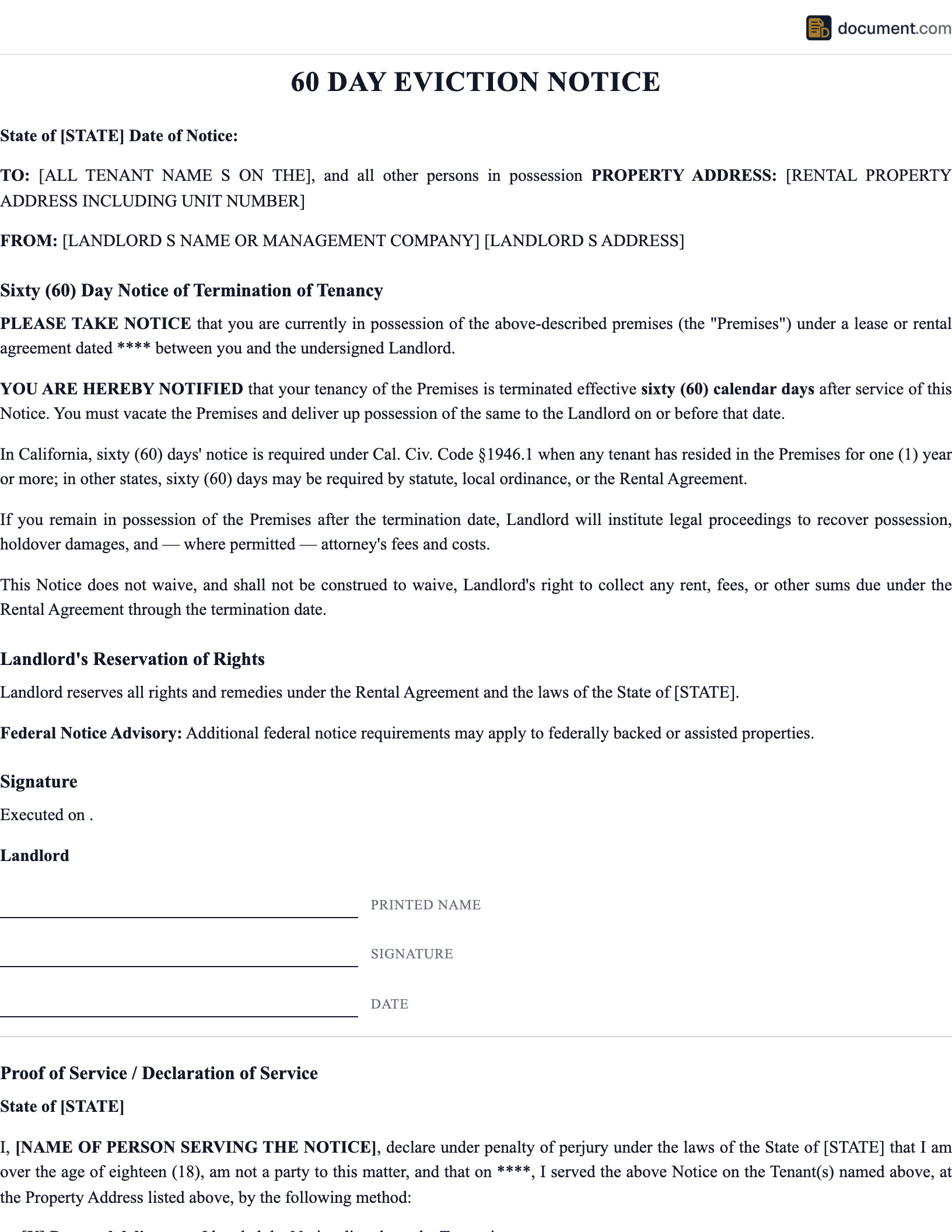
Below is a preview of our Oregon-specific 60-day no-cause termination notice. This template references ORS 90.427(3)(b), includes the relocation assistance disclosure required under ORS 90.427(6), and provides Portland-specific addendum language where needed.
60-DAY NOTICE OF TERMINATION WITHOUT CAUSE
STATE OF OREGON
Pursuant to ORS 90.427(3)(b)
LANDLORD / PROPERTY OWNER:
Name: [Full Legal Name]
Address: [Oregon Mailing Address]
TENANT(S):
Name(s): [All Tenant Names]
Rental Address: [Full Property Address + Unit]
TERMINATION NOTICE:
You are hereby given not less than 60 days written notice that your month-to-month tenancy is terminated. You must vacate on or before[Date]. This tenancy commenced on [Date]and is within the first year of occupancy.
RELOCATION ASSISTANCE (ORS 90.427(6))
[If applicable] Relocation assistance in the amount of $____ (equal to one month periodic rent) will be paid to you on or before the termination date stated above.