



New York 60-Day Notice Overview
New York's tenant notice requirements underwent a major overhaul with the Housing Stability and Tenant Protection Act (HSTPA) of 2019. Before HSTPA, landlords in most of New York could terminate month-to-month tenancies with just 30 days notice regardless of how long the tenant had lived in the unit. The HSTPA created a graduated notice system under Real Property Law Section 226-c, requiring 30, 60, or 90 days notice based on the duration of the tenancy or lease term.
The 60-day notice applies specifically to tenancies of one to two years. This covers a large segment of New York renters who have completed their initial one-year lease and are continuing on a month-to-month basis, as well as tenants in the middle of a two-year lease term. For tenancies exceeding two years, the landlord must provide 90 days notice. New York City adds an additional layer: rent-stabilized tenants have separate protections under the Rent Stabilization Code, and the 2024 good-cause eviction law further restricts non-renewals.
60 Days
1-2 year tenancy
$15-$210
Filing fees
HSTPA
2019 protections
3-6 mos
Court process (NYC)
When a 60-Day Notice Is Required in New York
RPL 226-c creates a three-tier notice structure. The 60-day tier applies to the middle range of tenancy durations. Landlords must correctly calculate the tenancy length to determine which notice period applies, as using the wrong period will invalidate the notice.
Tenancy Duration: 1 to 2 Years
A tenant who has occupied the unit for at least 12 months but less than 24 months is entitled to 60 days notice. This includes the total period of continuous occupancy, not just the current lease term. If a tenant signed a one-year lease and has been month-to-month for six months, the total occupancy is 18 months, requiring 60-day notice.
Lease Non-Renewal with 1-2 Year Term
If the lease itself has a term of one to two years, the landlord must provide 60 days notice of intent not to renew, even if the tenant has only been in occupancy for a few months. The notice period is measured from either the tenancy duration or the lease term, whichever triggers the higher notice requirement.
Rent Increase Above Threshold
RPL 226-c also requires 60-day notice before implementing a rent increase of 5% or more for tenancies of 1-2 years. Landlords must give tenants advance warning of significant rent increases, not just non-renewals. This applies to both lease renewals with higher rent and month-to-month rent adjustments.
HSTPA 2019 and Good-Cause Eviction
The Housing Stability and Tenant Protection Act of 2019 was the most comprehensive tenant protection legislation in New York in decades. Beyond the graduated notice requirement in RPL 226-c, the HSTPA eliminated preferential rent resets, restricted security deposits to one month's rent, and strengthened rent stabilization protections in New York City.
Good-Cause Eviction Law (2024)
New York enacted statewide good-cause eviction protections effective April 20, 2024, under RPAPL Section 711. This law prohibits landlords from refusing to renew leases or substantially increasing rent without demonstrating good cause. Even with a valid 60-day notice, landlords of covered properties may need to prove a qualifying reason for non-renewal. Exempt properties include owner-occupied buildings with 10 or fewer units, new construction (for 30 years), and units with rent above 245% of fair market rent. Consult a New York attorney to determine whether your property is covered.
New York 60-Day Notice Legal Requirements
The notice must comply with RPL 226-c and should clearly communicate the landlord's intent to either terminate the tenancy or not renew the lease. New York courts will scrutinize the notice for completeness and proper statutory references.
Required Notice Content
- Tenant Identification: Full legal names of all tenants and occupants. In New York City, include the apartment number, floor, and building address
- Property Address: Complete address of the rental premises including unit or apartment number, borough (in NYC), city, and ZIP code
- Termination Statement: Clear statement that the tenancy or lease will not be renewed, with the specific termination date at least 60 days from service
- Statutory Reference: Cite Real Property Law Section 226-c as the basis for the notice period. Courts may question notices that lack proper statutory authority
- Good-Cause Reason (if applicable): For properties covered by the 2024 good-cause eviction law, state the qualifying reason for non-renewal
- Landlord Contact Information: Name, mailing address, and phone number of the landlord or property management company
How to Serve a 60-Day Notice in New York
New York courts are exacting about service requirements. While RPL 226-c does not specify a particular service method for pre-litigation notices, following the RPAPL 735 standards used for court proceedings provides the strongest protection against service challenges.
Personal Delivery (Preferred)
Hand the notice directly to the tenant. Have the server complete an affidavit of service noting the date, time, location, and physical description of the person served. This is the most reliable method in New York courts
Substituted Service
If the tenant is unavailable after reasonable attempts, leave the notice with a person of suitable age and discretion at the tenant's residence and mail a copy via certified and regular first-class mail within one day. Under RPAPL 735, at least one attempt at personal service must be made before substituted service
Conspicuous Place Service (Nail and Mail)
As a last resort after diligent attempts at personal service, affix the notice to the door in a manner reasonably calculated to give notice, and mail a copy via certified and first-class mail. Document all prior failed attempts
File Affidavit of Service
Prepare a sworn affidavit of service that details each attempt and the final method used. This document will be filed with the holdover petition if the tenant does not vacate
Commence Holdover Proceeding
After 60 days expire and the tenant remains, file a holdover petition in the appropriate court: NYC Housing Court (Civil Court), city court, town court, or village court depending on the property location
New York Eviction Proceeding Timeline
New York's eviction process is among the slowest in the nation, particularly in New York City. After the 60-day notice period expires, the landlord files a holdover petition. The court schedules a hearing date, which in NYC Housing Court may be 2 to 4 weeks out due to volume.
At the initial court appearance, the case may be adjourned one or more times. If the tenant retains an attorney (free legal representation is available to low-income NYC tenants through the Right to Counsel program), the case may be adjourned for discovery or motion practice. A trial, if needed, is typically scheduled weeks to months after the initial appearance.
After judgment, the court issues a warrant of eviction with a mandatory 14-day stay. The tenant may seek additional stays from the court. Once the warrant becomes executable, the NYC City Marshal or sheriff schedules the physical eviction, which may take another 2 to 4 weeks. Outside NYC, the process is faster but still typically spans 2 to 4 months from filing.
New York Court Fees & Costs
New York eviction filing fees are relatively low compared to many states, but the extended timeline increases total costs through attorney fees and lost rent during the proceeding.
| Fee / Cost | Typical Amount |
|---|---|
| Holdover Petition Filing (NYC) | $45 |
| Holdover Petition (outside NYC) | $15 - $45 |
| Service of Process | $40 - $100 |
| Marshal / Sheriff Execution | $75 - $200 |
| Attorney Fees (if hired) | $2,000 - $7,000 |
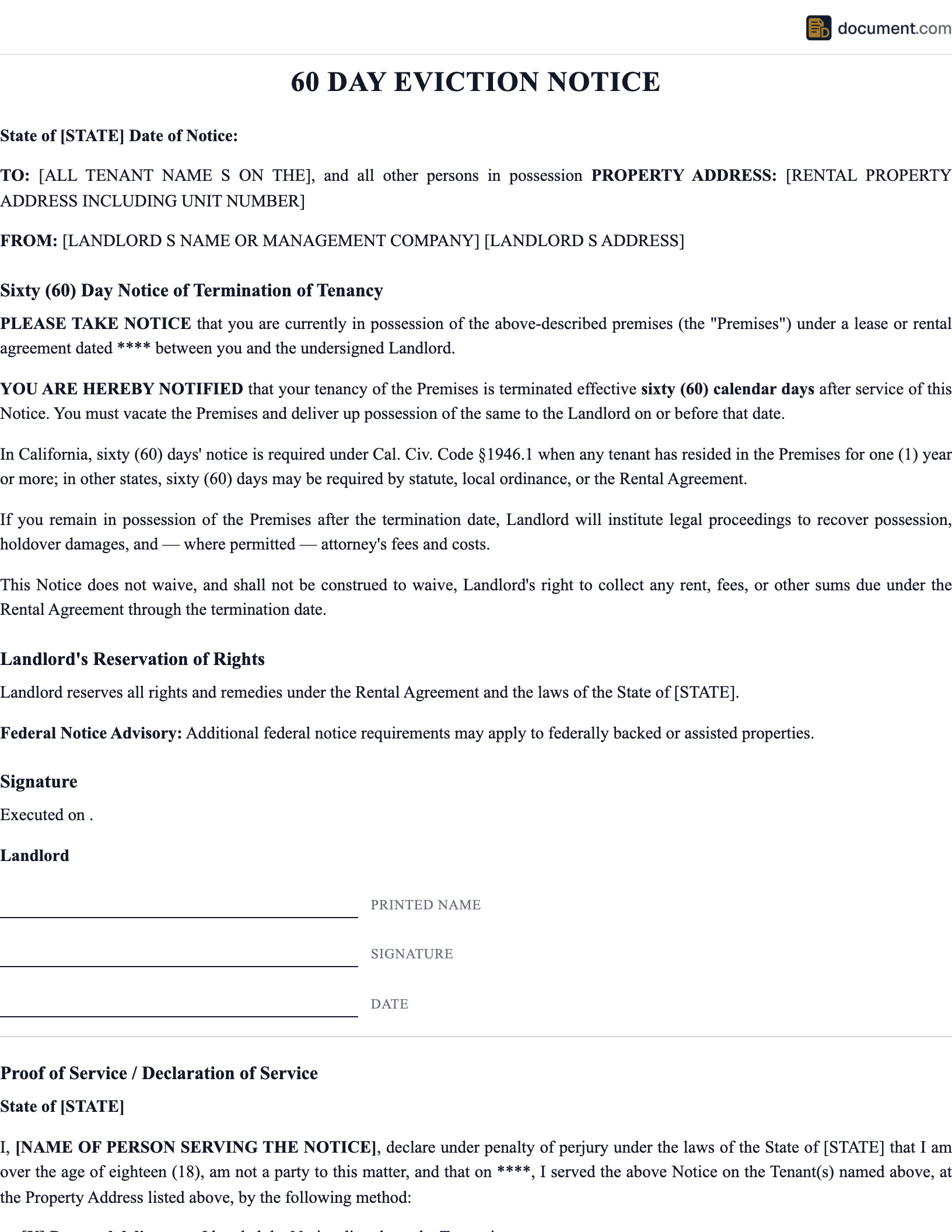
Sample New York 60-Day Notice
Below is a preview of our New York-specific 60-day termination notice. This template incorporates RPL 226-c requirements and includes provisions for the 2024 good-cause eviction law where applicable.
60-DAY NOTICE OF TERMINATION
STATE OF NEW YORK
Pursuant to Real Property Law Section 226-c
LANDLORD / PROPERTY OWNER:
Name: [Full Legal Name]
Address: [New York Mailing Address]
TENANT(S) AND ALL OCCUPANTS:
Name(s): [All Tenant Names]
Premises: [Apartment #, Address, City, NY ZIP]
NOTICE OF NON-RENEWAL:
Pursuant to RPL 226-c, you are hereby notified that your tenancy at the above premises will not be renewed and will terminate on [Date at least 60 days out]. You must vacate and surrender possession by that date.
TENANCY DURATION VERIFICATION
Your tenancy commenced on [date] and has been in effect for [X months/years], which falls within the 1-2 year range requiring 60-day notice under RPL 226-c.