
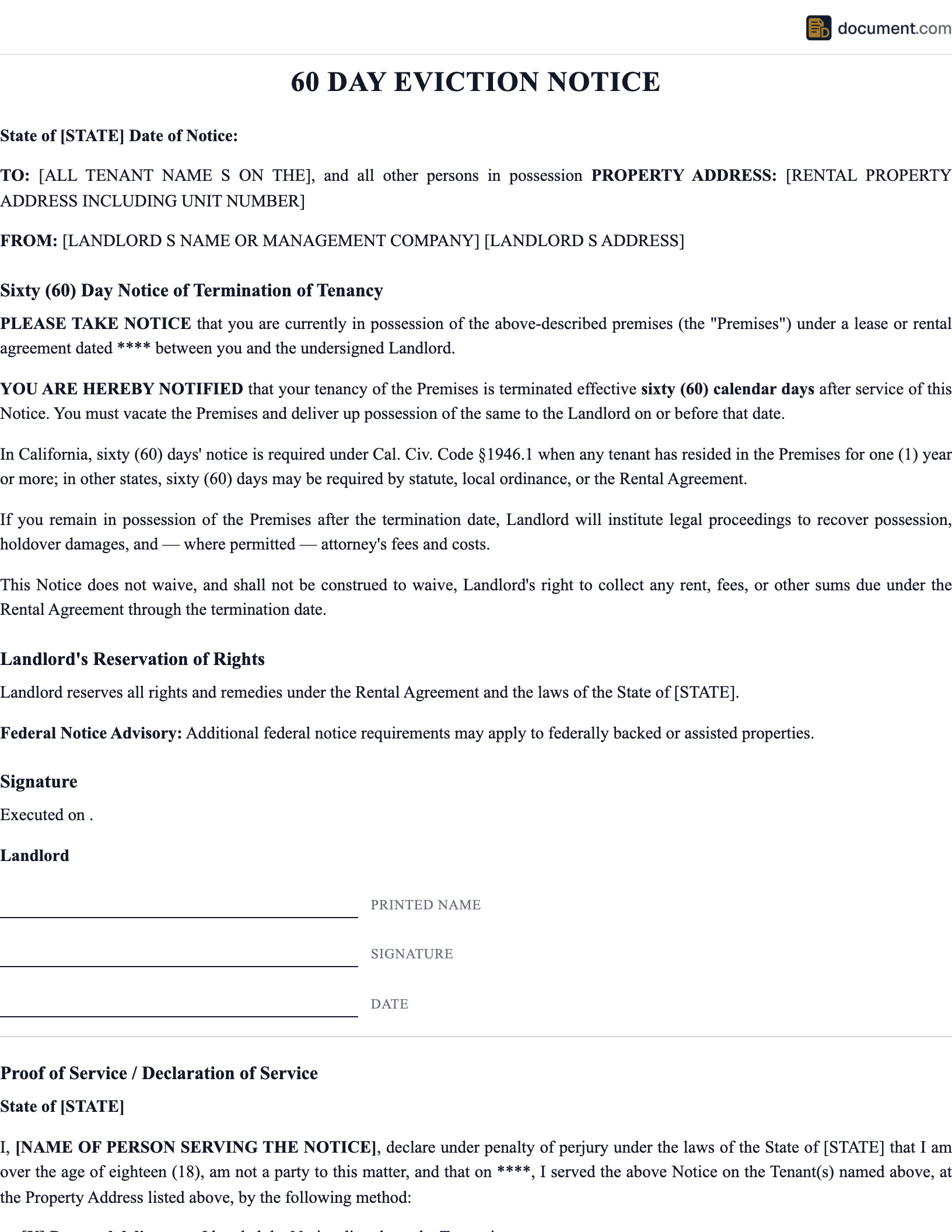



Kansas 60-Day Notice Overview
Kansas does not require a 60-day notice for standard residential tenancy terminations. Under the Kansas Residential Landlord and Tenant Act (K.S.A. 58-2540 et seq.), month-to-month tenancies require 30 days written notice under K.S.A. 58-2570. The notice must be given at least 30 days before the periodic tenancy ends. Kansas\'s landlord-tenant framework is straightforward and moderately landlord-friendly.
Kansas has no statewide rent control, no just-cause eviction requirements, and a relatively quick eviction process. The state does provide some tenant protections including habitability standards under K.S.A. 58-2553, retaliatory eviction prohibitions under K.S.A. 58-2572, and security deposit limits of one month\'s rent for unfurnished and one-and-a-half months for furnished units under K.S.A. 58-2550. Kansas District Courts handle eviction proceedings efficiently across the state.
30 Days
Statutory default
$45-$60
Court filing fees
Written
Notice required
2-3 wks
Court process
When a 60-Day Notice Applies in Kansas
Since Kansas's statutory default for month-to-month termination is 30 days, understanding when a 60-day notice is actually required or advisable is essential for landlords.
Lease-Required Extended Notice
Many Kansas property management companies include 60-day non-renewal clauses. When the lease specifies 60 days, the contractual obligation overrides the 30-day statutory minimum. This is common in Johnson County (Overland Park, Olathe) and Sedgwick County (Wichita) rental markets.
Kansas Housing Resources Corporation Programs
Federal Section 8 programs administered through the Kansas Housing Resources Corporation (KHRC) and local PHAs like the Wichita Housing Authority frequently require 60-90 days notice before termination of subsidized housing tenancies.
Long-Term Tenant Best Practice
In Kansas\'s growing Kansas City metro area (Johnson County, Wyandotte County) and Wichita, providing 60 days notice for long-term tenants reduces legal challenges and gives tenants adequate time to find replacement housing in competitive markets.
Kansas Legal Requirements
Kansas's landlord-tenant statutes establish specific requirements for termination notices that must be followed precisely.
Kansas Retaliatory Eviction Protection
Under K.S.A. 58-2572, a landlord cannot terminate a tenancy in retaliation for the tenant\'s good-faith complaint about code violations, exercise of legal rights, or tenant organization activities. Kansas courts can dismiss retaliatory evictions and award damages. Landlords should document legitimate business reasons for any termination to defend against retaliation claims in court.
Notice Content Requirements
- Written Notice: K.S.A. 58-2570 requires written notice. Oral notice is insufficient under Kansas law for residential tenancy terminations
- Tenant and Property ID: Include all tenant names from the lease and the complete property address including city, county, and ZIP code
- Termination Date: State the exact date at least 60 days from service, aligned with the periodic tenancy date
- Landlord Contact: Include the landlord or property manager name, Kansas mailing address, and phone number
- Security Deposit Reference: K.S.A. 58-2550 requires return of the deposit within 30 days of termination with an itemized list of deductions
How to Serve a 60-Day Eviction Notice in Kansas
Proper service is critical in Kansas. If the landlord cannot prove the notice was properly delivered, the court will dismiss the eviction action.
Prepare the Notice
Draft using a Kansas-specific template referencing K.S.A. 58-2570. Include all tenant names, property address, and the 60-day termination date
Personal Delivery (Preferred)
Hand-deliver the notice to the tenant at the rental premises. Kansas courts prefer personal service. Use a process server or witness for documentation
Certified Mail Alternative
Send via certified mail with return receipt requested. Kansas accepts mailed service as valid for notice purposes under state law
Complete Proof of Service
Document date, time, method, and location of service. Keep certified mail receipts and return cards for court proceedings
File Forcible Detainer in District Court
After 60 days expire without the tenant vacating, file an eviction action in District Court where the property is located
Kansas Eviction Timeline
Kansas\'s eviction process is filed in District Court under K.S.A. 61-3801 et seq. (Forcible Detainer). After filing, the court issues a summons and the tenant has 14 days to file an answer. If no answer is filed, the landlord can obtain a default judgment for possession.
If the tenant answers, the District Court schedules a trial within 7-14 days. Kansas eviction hearings are relatively brief and focused on the right to possession. If the landlord prevails, a journal entry of judgment is issued and the tenant has a brief period to vacate.
Total court timeline: 2-3 weeks uncontested, 3-6 weeks contested. Johnson County and Sedgwick County courts have heavier caseloads that may extend timelines. Combined with the 60-day notice period, the full process spans 10-14 weeks. Self-help evictions are prohibited under Kansas law.
Kansas Filing Fees & Costs
Eviction costs in Kansas vary by county and court type. Below are typical expenses.
| Fee / Cost | Typical Amount |
|---|---|
| District Court Filing Fee | $45 - $60 |
| Service of Process | $20 - $50 |
| Attorney Fees | $400 - $1,500 |
| Writ of Restitution | $15 - $30 |
| Sheriff Enforcement | $50 - $150 |
Sample Kansas 60-Day Notice
Below is a preview of our Kansas-specific 60-day termination notice template.
60-DAY NOTICE OF TERMINATION
STATE OF KANSAS
Pursuant to K.S.A. 58-2570
LANDLORD / PROPERTY OWNER:
Name: [Full Legal Name]
Address: [Kansas Mailing Address]
TENANT(S):
Name(s): [All Tenant Names]
Rental Address: [Full Property Address]
NOTICE OF TERMINATION:
You are hereby notified that your tenancy at the above premises will terminate on[Date — 60 days from service]. You must vacate and surrender possession by that date.
KANSAS COMPLIANCE NOTE
Your security deposit will be returned within 30 days of vacating per K.S.A. 58-2550, with an itemized list of any deductions. Please provide a forwarding address upon vacating.