



Hawaii 60-Day Notice Overview
Hawaii does not require a 60-day notice by statute for standard residential tenancy terminations. Under the Hawaii Residential Landlord-Tenant Code (HRS Chapter 521), month-to-month tenancies require 45 days written notice under HRS 521-71, and week-to-week tenancies require 28 days. Hawaii's notice periods are already longer than the 30-day standard in most mainland states, reflecting the state's constrained housing market and high cost of living.
Hawaii has the highest cost of living in the nation, and its island geography creates severe housing constraints. On Oahu alone, the median rent exceeds mainland averages significantly. The state provides moderate tenant protections including anti-retaliation provisions under HRS 521-74, security deposit limits of one month under HRS 521-44, and habitability requirements. While Hawaii has no statewide rent control, the extremely tight market means providing 60 days notice for long-term tenants is considered responsible practice, particularly on Oahu, Maui, and the Big Island.
45 Days
M2M statutory
$120-$200
District Court filing
Written
Notice required
3-6 wks
Court process
When a 60-Day Notice Applies in Hawaii
Since Hawaii's statutory default is already 45 days for month-to-month tenancies, a 60-day notice provides only 15 additional days. Understanding when this extended notice is required or advisable is important.
Lease-Required Extended Notice
Many Hawaii property management companies include 60-day non-renewal clauses in their leases. When the lease specifies 60 days, the contractual obligation overrides the 45-day statutory minimum. This is common in Honolulu, Maui, and Kona rental markets where professional management firms handle most rentals.
Military Housing and Section 8
Hawaii has one of the largest military populations per capita in the nation. Federal Section 8 programs administered through the Hawaii Public Housing Authority (HPHA) and military housing offices often require 60-90 days notice. Properties near bases like Schofield Barracks, Pearl Harbor, and Kaneohe Bay frequently have extended notice requirements.
Island Housing Market Reality
Hawaii's island geography severely limits housing options. On smaller islands like Molokai, Lanai, and parts of the Big Island, rental inventory is extremely scarce. Providing 60 days gives tenants the time needed to find replacement housing, arrange inter-island moves, or coordinate moving logistics in a market with very few vacancies.
Hawaii Legal Requirements
Hawaii's Residential Landlord-Tenant Code (HRS Chapter 521) establishes detailed requirements for termination notices.
Hawaii Anti-Retaliation Protection
Under HRS 521-74, a landlord cannot terminate a tenancy in retaliation for the tenant's good-faith complaint to a governmental agency about code violations, participation in a tenant organization, or exercise of rights under the landlord-tenant code. If the termination occurs within 6 months of such protected activity, the court presumes retaliation. Hawaii courts take retaliatory eviction claims seriously, and landlords should document legitimate business reasons for any termination.
Notice Content Requirements
- Written Notice: HRS 521-71 requires written notice. Oral notice is not sufficient under Hawaii law for any tenancy termination
- Tenant and Property ID: Include all tenant names from the lease and the complete property address including island, city, and ZIP code
- Termination Date: State the exact date at least 60 days from service, aligned with the end of the rental period
- Landlord Contact: Include the landlord or property manager name, Hawaii mailing address, and telephone number
- Security Deposit Reference: HRS 521-44 requires return within 14 days of vacating with an itemized list of deductions
How to Serve a 60-Day Eviction Notice in Hawaii
Proper service is critical in Hawaii. The District Court will require proof that the notice was properly delivered before proceeding with the Summary Possession action.
Prepare the Notice
Draft using a Hawaii-specific template referencing HRS 521-71. Include all tenant names, property address with island designation, and the 60-day termination date
Personal Delivery (Preferred)
Hand-deliver to the tenant at the rental premises. Hawaii courts prefer personal service. Use a process server or witness for documentation
Certified Mail Alternative
Send via certified mail with return receipt requested. Given Hawaii's island geography, allow extra days for inter-island mail delivery
Complete Proof of Service
Document date, time, method, and location of service. Keep certified mail receipts and return cards for court proceedings
File Summary Possession if Needed
After 60 days expire without the tenant vacating, file a Summary Possession action in the District Court for the circuit where the property is located under HRS 666-6
Hawaii Eviction Timeline
Hawaii's Summary Possession process is handled in the District Courts across four judicial circuits. After the landlord files the complaint, the court issues a summons with a hearing date typically set 12-20 days from filing. The First Circuit (Oahu) has the heaviest caseload.
At the hearing, both parties present evidence. Hawaii District Court hearings allow self-representation but attorneys are common. If the landlord prevails, the court enters a judgment for possession. The tenant may appeal to the Circuit Court. If no appeal is filed, a writ of possession is issued and the sheriff enforces removal.
Total court timeline is approximately 3-6 weeks for uncontested cases. Contested cases can extend 2-4 months, especially on Oahu. Combined with the 60-day notice period, the full process spans 12-20 weeks. Self-help evictions are prohibited under Hawaii law, and landlords must go through the court process.
Hawaii Filing Fees & Costs
Eviction costs in Hawaii are moderate. Below are typical expenses for a residential eviction.
| Fee / Cost | Typical Amount |
|---|---|
| District Court Filing Fee | $120 - $200 |
| Service of Process | $40 - $80 |
| Attorney Fees | $750 - $3,000 |
| Writ of Possession | $50 - $100 |
| Sheriff Enforcement | $75 - $200 |
Sample Hawaii 60-Day Notice
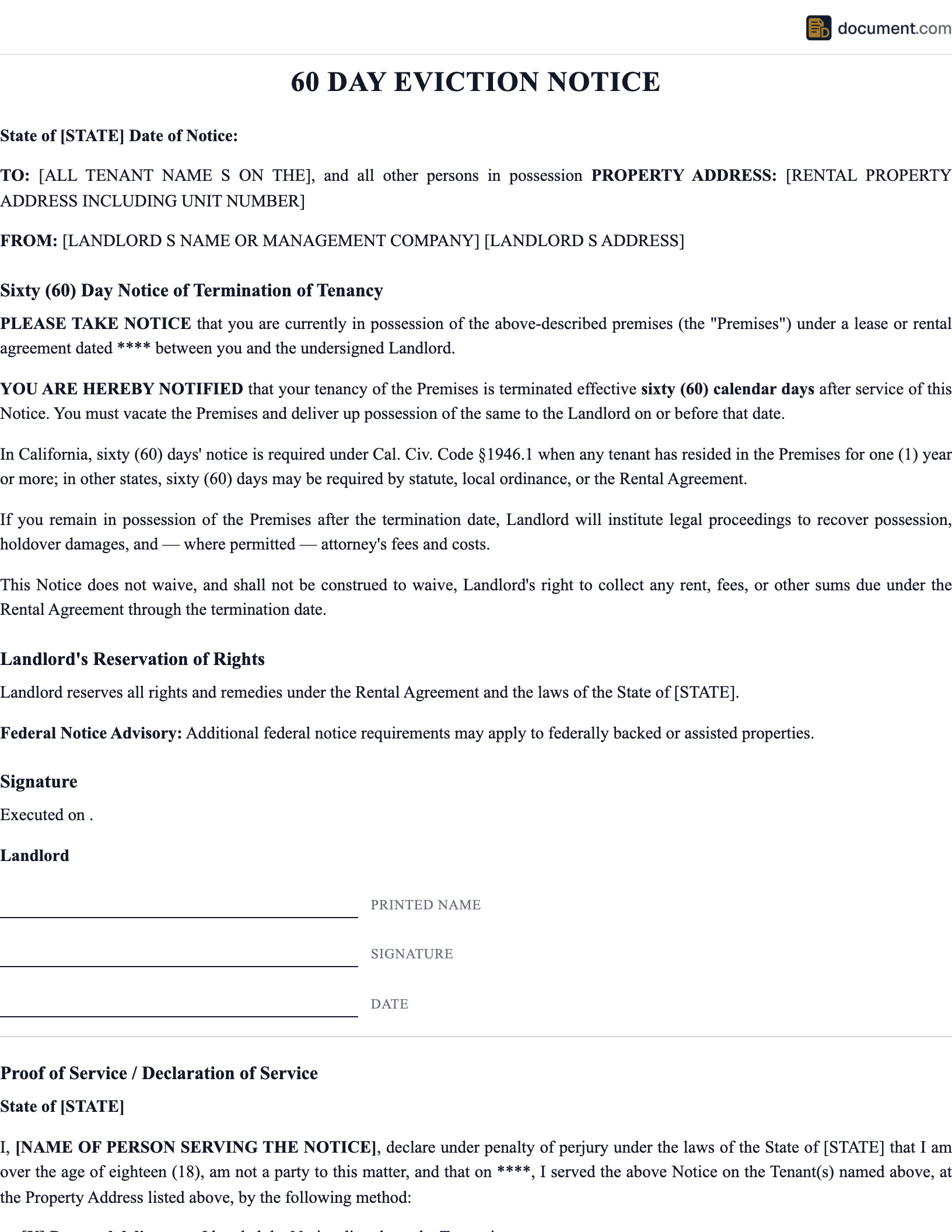
Below is a preview of our Hawaii-specific 60-day termination notice template.
60-DAY NOTICE OF TERMINATION
STATE OF HAWAII
Pursuant to HRS 521-71
LANDLORD / PROPERTY OWNER:
Name: [Full Legal Name]
Address: [Hawaii Mailing Address]
TENANT(S):
Name(s): [All Tenant Names]
Rental Address: [Full Property Address]
NOTICE OF TERMINATION:
You are hereby notified that your tenancy at the above premises will terminate on[Date — 60 days from service]. You must vacate and surrender possession by that date.
HAWAII COMPLIANCE NOTE
Your security deposit will be returned within 14 days of vacating per HRS 521-44, provided you leave the unit in acceptable condition less normal wear and tear and supply a forwarding address.