



Georgia 60-Day Notice Overview
Georgia is one of few states where a 60-day notice has direct statutory application. Under O.C.G.A. 44-7-7, a tenancy at will — which includes most month-to-month arrangements where the original lease has expired — requires 60 days notice to terminate. For tenancies with a definite term, only 30 days notice before the end of the term is required. The critical distinction between these tenancy types determines whether the 60-day or 30-day period applies.
Georgia is widely considered one of the most landlord-friendly states in the Southeast. The state has minimal tenant protection statutes compared to states like California or New York, no rent control, no just-cause eviction requirements, and no mandatory relocation assistance. The Magistrate Court handles most residential evictions quickly and inexpensively. However, landlords must carefully determine whether their tenant holds a tenancy at will (60 days) or a definite-term periodic tenancy (30 days) to avoid providing insufficient notice.
60 Days
Tenancy at will
$50-$75
Magistrate Court
Written
Notice required
1-3 wks
Court process
When a 60-Day Notice Applies in Georgia
The 60-day notice requirement in Georgia is tied to the type of tenancy. Understanding the distinction is essential for compliance.
Tenancy at Will (Statutory 60 Days)
Under O.C.G.A. 44-7-7, when a tenant holds over after the lease expires with the landlord's consent, a tenancy at will is created. This type requires 60 days written notice. Most holdover tenants in Georgia who continue paying rent after lease expiration fall into this category.
Oral or Handshake Agreements
When a tenant occupies without a written lease — common in rural Georgia and informal arrangements in Atlanta, Savannah, and Augusta — the arrangement is a tenancy at will requiring 60 days notice. Georgia's Statute of Frauds (O.C.G.A. 13-5-30) requires leases over one year to be in writing, but shorter oral agreements create tenancies at will.
Subsidized Housing and Section 8
Federal housing programs administered through the Georgia Department of Community Affairs (DCA) and local PHAs like the Atlanta Housing Authority often require 60-90 days notice. Even when the state minimum might be 30 days for a definite-term tenancy, federal regulations may mandate the longer period.
Georgia Legal Requirements
Georgia's landlord-tenant law is found primarily in O.C.G.A. Title 44, Chapter 7. The requirements for termination notices are established by statute and case law.
Georgia Demand for Possession Requirement
Under O.C.G.A. 44-7-50, before filing a Dispossessory action, the landlord must first make a demand for possession. This is separate from the termination notice. After the 60-day notice period expires, the landlord must demand the tenant vacate. Only after the demand is refused or ignored can the landlord file the Dispossessory Affidavit. Failure to make a proper demand before filing can result in dismissal.
Notice Content Requirements
- Written Notice: O.C.G.A. 44-7-7 requires written notice for terminating tenancies at will. Oral notice is insufficient under Georgia law
- Tenant and Property ID: Include all tenant names and the complete property address including county, as Georgia Magistrate Courts are organized by county
- Termination Date: State the exact date at least 60 days from service for tenancies at will
- Landlord Contact: Include landlord or property manager name, Georgia mailing address, and phone number
- Security Deposit: Reference O.C.G.A. 44-7-34 requiring return within 30 days of termination with itemized deductions
How to Serve a 60-Day Eviction Notice in Georgia
Proper service is essential in Georgia. The Magistrate Court will require proof that the tenant received adequate notice before the Dispossessory action can proceed.
Prepare the Notice
Draft using a Georgia-specific template citing O.C.G.A. 44-7-7. Include all tenant names, property address with county, and the 60-day termination date
Personal Delivery (Preferred)
Hand-deliver to the tenant at the rental premises. Georgia courts prefer personal service. Bring a witness or use a process server
Certified Mail Alternative
Send via certified mail with return receipt to the tenant at the rental property address. Retain all postal receipts and return cards
Make Demand for Possession
After the 60-day period expires, demand the tenant vacate under O.C.G.A. 44-7-50. This is a prerequisite before filing the Dispossessory action
File Dispossessory Action
If the tenant refuses to leave, file a Dispossessory Affidavit in the Magistrate Court of the county where the property is located
Georgia Eviction Timeline
Georgia's Dispossessory process through Magistrate Court is relatively fast. After filing the affidavit, the court issues a summons. The tenant has 7 days from service to file a written answer. If the tenant does not respond, the landlord can obtain a default judgment and a writ of possession.
If the tenant files an answer, the Magistrate Court schedules a hearing within 7-14 days. Georgia Magistrate Court proceedings are informal and designed for self-represented parties. If the landlord prevails, the court issues a writ of possession and the marshal or sheriff enforces removal.
Total court timeline: 1-3 weeks for uncontested cases, 3-5 weeks for contested. In metro Atlanta (Fulton, DeKalb, Gwinnett, Cobb counties), heavy caseloads may extend timelines. Combined with the 60-day notice period, the full process spans 9-13 weeks. Self-help evictions are prohibited.
Georgia Filing Fees & Costs
Georgia eviction costs are relatively low. Below are typical expenses for a Magistrate Court Dispossessory action.
| Fee / Cost | Typical Amount |
|---|---|
| Magistrate Court Filing Fee | $50 - $75 |
| Service of Process (Marshal) | $25 - $50 |
| Attorney Fees | $400 - $1,500 |
| Writ of Possession | $25 - $75 |
| Marshal Enforcement | $50 - $150 |
Sample Georgia 60-Day Notice
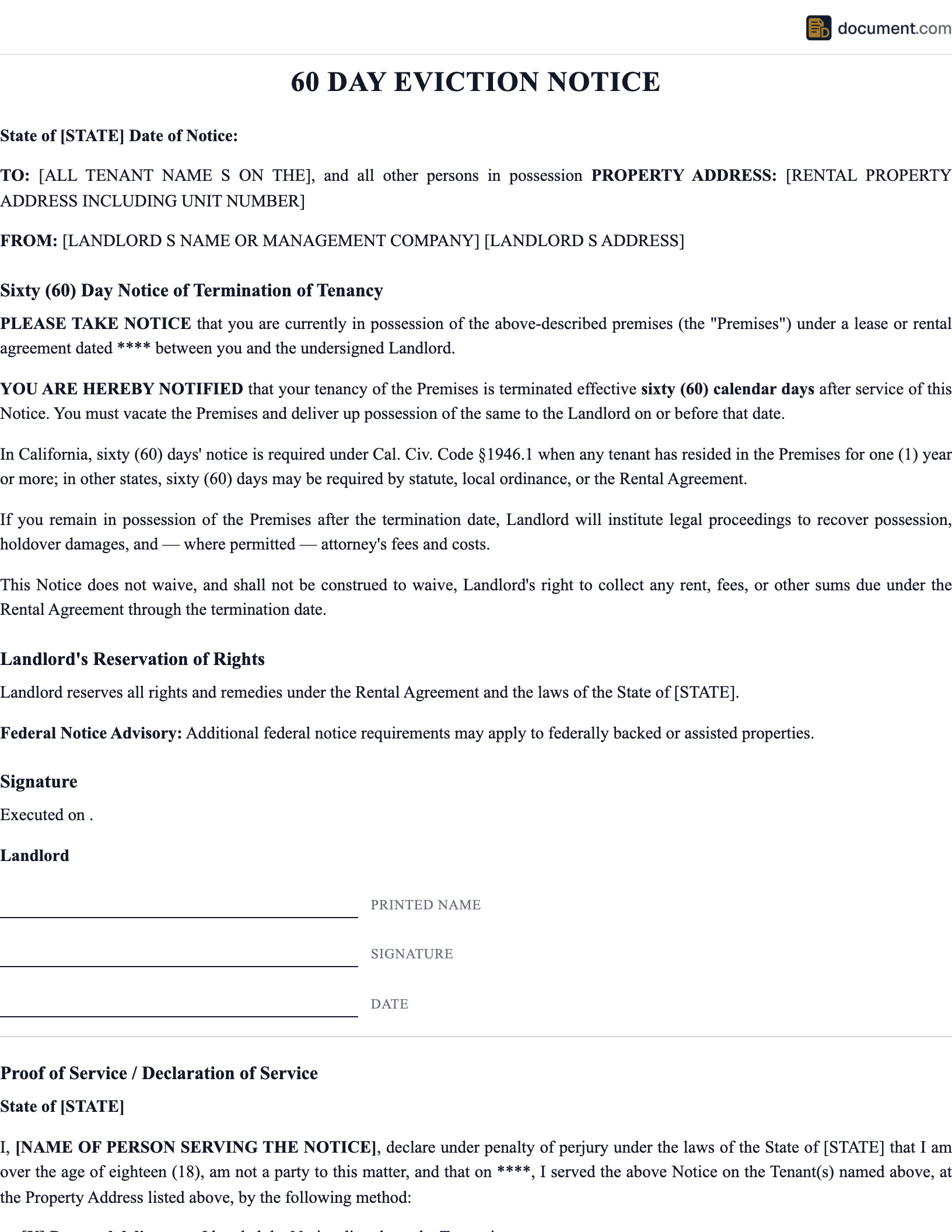
Below is a preview of our Georgia-specific 60-day termination notice template.
60-DAY NOTICE OF TERMINATION
STATE OF GEORGIA
Pursuant to O.C.G.A. 44-7-7
LANDLORD / PROPERTY OWNER:
Name: [Full Legal Name]
Address: [Georgia Mailing Address]
TENANT(S):
Name(s): [All Tenant Names]
Rental Address: [Full Property Address]
NOTICE OF TERMINATION:
You are hereby notified that your tenancy at the above premises will terminate on[Date — 60 days from service]. You must vacate and surrender possession by that date.
GEORGIA COMPLIANCE NOTE
Your security deposit will be returned within 30 days of vacating per O.C.G.A. 44-7-34, with an itemized list of any deductions. Please provide a forwarding address upon vacating.