



Florida 60-Day Notice Overview
Florida does not require a 60-day notice for standard residential tenancy terminations. Under the Florida Residential Landlord and Tenant Act (F.S. Chapter 83, Part II), month-to-month tenancies can be terminated with just 15 days written notice under F.S. 83.57. For annual leases, 30 days notice before the end of the annual period is standard. Florida's notice periods are among the shortest in the nation, reflecting the state's generally landlord-friendly legal framework.
Florida is the third most populous state and has one of the most active rental markets in the country, particularly in Miami-Dade, Broward, Orange, Hillsborough, and Palm Beach counties. The state has no rent control (preempted by F.S. 166.043), no just-cause eviction requirement, and a fast-track eviction court process. However, the tight housing market in South Florida and Central Florida means that providing 60 days notice for long-term tenants is increasingly viewed as a reasonable best practice, even when only 15 days is legally required.
15 Days
Statutory M2M default
$185
County Court filing
Written
Notice required
2-4 wks
Court process
When a 60-Day Notice Applies in Florida
Since Florida's statutory default for month-to-month termination is only 15 days, understanding when a 60-day notice is actually required or advisable is critical for Florida landlords.
Lease-Required Extended Notice
Many Florida property management companies, particularly in South Florida and the Orlando metro, include a 60-day non-renewal clause in their leases. When the lease specifies 60 days notice, the contractual obligation supersedes the 15-day statutory minimum, and the landlord must comply with the longer period.
Section 8 and Public Housing
Florida has numerous public housing authorities including Miami-Dade PHA, Jacksonville Housing Authority, and Orlando Housing Authority. Federal Section 8 regulations often require 60-90 days notice before non-renewal. LIHTC properties in Florida also frequently have extended notice requirements specified in regulatory agreements.
Long-Term Tenant Courtesy
In Florida's competitive rental markets — particularly Miami, Fort Lauderdale, Tampa, and Orlando — finding replacement housing within 15 days is extremely challenging. Providing 60 days notice for tenants who have lived in the property for years reduces legal challenges, improves tenant cooperation, and often results in a smoother transition.
Florida Legal Requirements
Florida's Residential Landlord and Tenant Act establishes specific requirements for termination notices.
Florida Condominium and HOA Considerations
Many rental properties in Florida are in condominiums or communities governed by HOAs. Under F.S. 718 (Condominium Act) and F.S. 720 (HOA Act), associations may impose additional restrictions on rentals including approval requirements, minimum lease terms, and waiting periods. Some associations require 60-day notice to the association before a new tenant moves in. Landlords should check their condo or HOA documents before serving a termination notice to ensure compliance with association rules.
Notice Content Requirements
- Written Notice: F.S. 83.57 requires written notice. Florida does not accept oral notice for terminating residential tenancies
- Tenant and Property ID: Include all tenant names from the lease and the complete property address including unit number, city, and county
- Termination Date: Clearly state the date at least 60 days from service, aligned with the end of the monthly rental period
- Service Method Compliance: Serve using a method authorized under F.S. 83.56(4): personal delivery, posting on the door and mailing, or certified mail
- Security Deposit Reference: F.S. 83.49 requires return within 15 days if no deductions, or notice of intent to impose a claim within 30 days
How to Serve a 60-Day Eviction Notice in Florida
Proper service is critical in Florida. F.S. 83.56(4) specifies the authorized methods of service for notices under the Residential Landlord and Tenant Act.
Prepare the Notice
Draft using a Florida-specific template referencing F.S. 83.57. Include all tenant names, property address, and the 60-day termination date
Personal Delivery (Preferred)
Hand-deliver to the tenant. Florida courts prefer personal service. Use a process server or bring a witness to confirm delivery
Post and Mail Alternative
Under F.S. 83.56(4), if personal delivery fails, post the notice on the door of the premises AND mail a copy by regular, certified, or registered mail
Retain Proof of Service
Document date, time, method, and location of service. Keep all postal receipts. This evidence is essential for the eviction complaint
File Eviction Complaint if Needed
After 60 days expire, file an eviction complaint in the County Court where the property is located under F.S. 83.59. The tenant has 5 days to respond after service
Florida Eviction Timeline
Florida's eviction process through the County Courts is relatively fast. After the complaint is filed and the tenant is served with a summons, the tenant has only 5 days (excluding weekends and legal holidays) to file a response or answer with the court.
If the tenant does not respond, the landlord can file a motion for default judgment, which is typically granted within days. If the tenant responds, a hearing or trial is scheduled, usually within 2-4 weeks. Florida County Courts in busy jurisdictions like Miami-Dade, Broward, and Hillsborough may have longer wait times due to heavy caseloads.
After judgment, the clerk issues a writ of possession. The sheriff posts a 24-hour notice on the door, then returns to physically remove the tenant if they remain. Total court process: 2-4 weeks uncontested, 4-8 weeks contested. Combined with the 60-day notice period, the full timeline is 10-16 weeks.
Florida Filing Fees & Costs
Eviction costs in Florida vary by county. Below are typical expenses for a residential eviction.
| Fee / Cost | Typical Amount |
|---|---|
| County Court Filing Fee | $185 |
| Service of Process (Sheriff) | $40 - $70 |
| Attorney Fees | $500 - $2,500 |
| Writ of Possession | $90 - $115 |
| Sheriff Enforcement | $90 - $115 |
Sample Florida 60-Day Notice
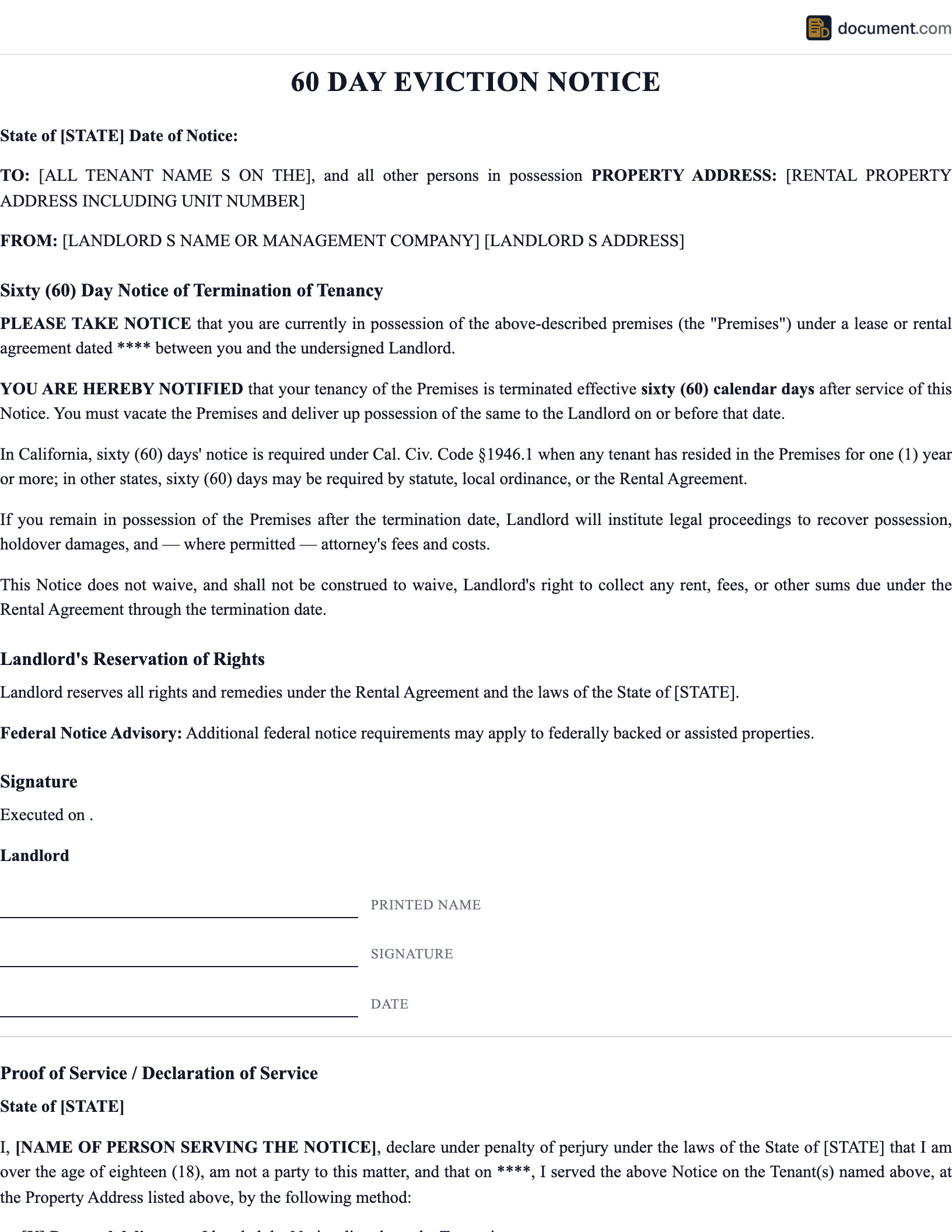
Below is a preview of our Florida-specific 60-day termination notice template.
60-DAY NOTICE OF TERMINATION
STATE OF FLORIDA
Pursuant to F.S. 83.57
LANDLORD / PROPERTY OWNER:
Name: [Full Legal Name]
Address: [Florida Mailing Address]
TENANT(S):
Name(s): [All Tenant Names]
Rental Address: [Full Property Address]
NOTICE OF TERMINATION:
You are hereby notified that your tenancy at the above premises will terminate on[Date — 60 days from service]. You must vacate and surrender possession by that date.
FLORIDA COMPLIANCE NOTE
Your security deposit will be handled per F.S. 83.49. If no deductions are claimed, the full deposit will be returned within 15 days of vacating. If deductions are claimed, you will receive written notice within 30 days with an itemized list.