
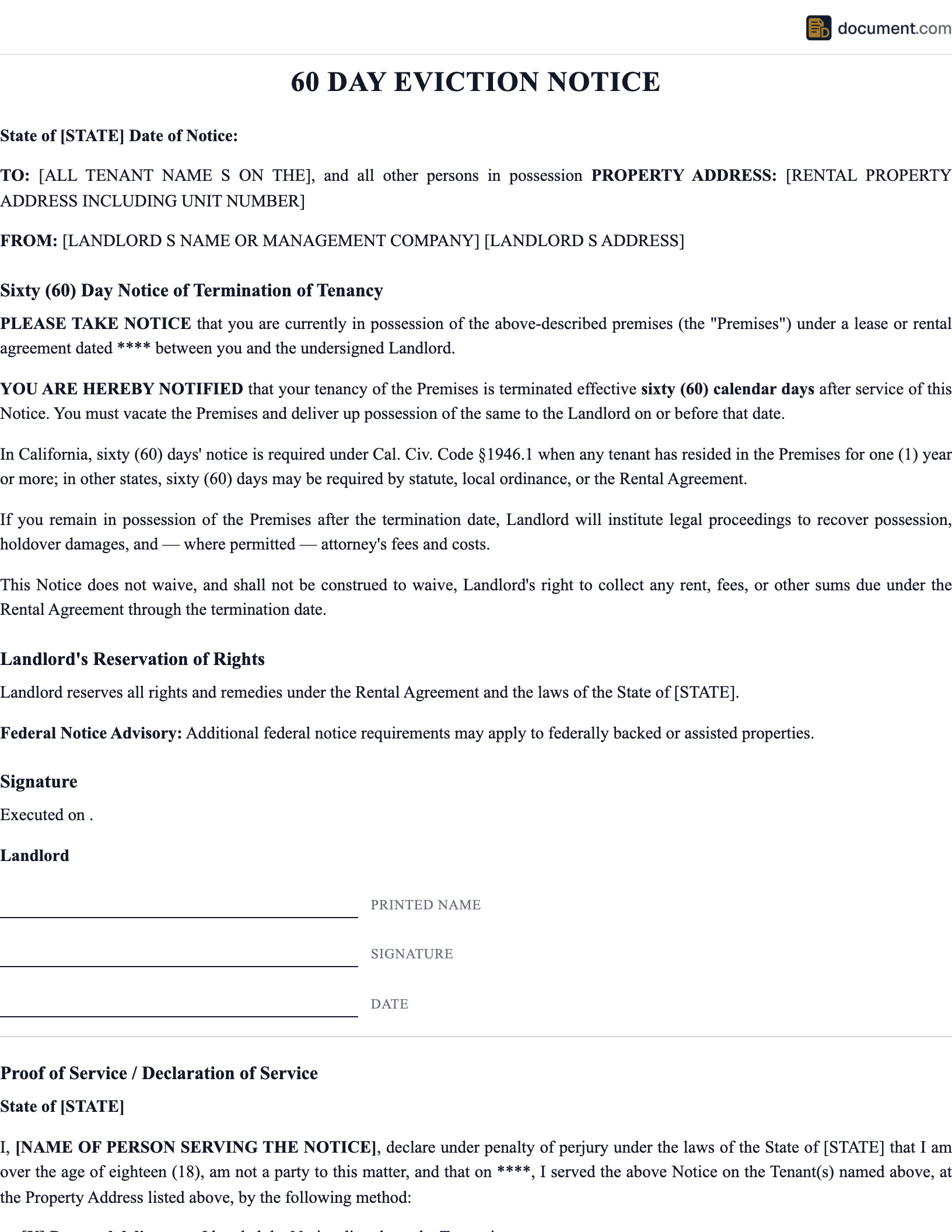



Delaware 60-Day Notice Overview
Delaware is one of the few states where a 60-day notice has direct statutory backing for terminating residential tenancies. Under the Delaware Residential Landlord-Tenant Code (25 Del. C. Chapter 51), landlords must provide at least 60 days written notice before the end of the lease year to terminate a year-to-year tenancy. For month-to-month tenancies, 60 days notice before the end of any monthly rental period is also required under 25 Del. C. 5106 when specified in the lease or when the tenancy has existed for more than one year.
Delaware provides moderate tenant protections compared to neighboring states. The state prohibits retaliatory evictions under 25 Del. C. 5516, limits security deposits to one month's rent for first-year tenants, and requires landlords to maintain habitable conditions. Delaware has no rent control and no just-cause eviction requirement for periodic tenancies, but the 60-day notice period provides tenants more time than the 30-day standard in most states. The Justice of the Peace Courts handle the majority of landlord-tenant disputes throughout Delaware's three counties.
60 Days
End of lease year
$35-$50
JP Court filing
Written
Notice required
2-5 wks
Court process
When a 60-Day Notice Applies in Delaware
Unlike most states where 60-day notices are purely contractual, Delaware law specifically contemplates 60-day notice periods in several residential tenancy scenarios.
Year-to-Year Tenancy Termination
Under 25 Del. C. 5106, a year-to-year tenancy requires at least 60 days written notice before the end of the lease year. If neither party provides this notice, the tenancy automatically renews for another year. This is the primary statutory scenario where 60 days is mandatory in Delaware.
Long-Term Month-to-Month Tenancies
When a month-to-month tenancy has existed for more than one year, many Delaware leases and courts recognize that 60 days provides reasonable relocation time. Landlords in Wilmington, Dover, and Newark frequently provide 60 days as standard practice even when shorter notice may be sufficient.
Subsidized Housing and Section 8
Federal housing programs administered through the Delaware State Housing Authority (DSHA) often require 60-90 days notice before termination. Housing Choice Voucher participants in Delaware are subject to federal notice requirements that may exceed state minimums.
Delaware Legal Requirements
Delaware's Residential Landlord-Tenant Code establishes detailed requirements for termination notices.
Delaware Retaliatory Eviction Protection
Under 25 Del. C. 5516, a landlord cannot terminate a tenancy in retaliation for a tenant's good-faith complaint to a government agency about code violations, participation in a tenant organization, or exercise of legal rights. If the termination notice is served within 90 days of such protected activity, the court will presume the notice is retaliatory. The landlord must then prove a legitimate, non-retaliatory reason. Violations can result in the eviction being dismissed and the landlord owing damages.
Notice Content Requirements
- Written Notice: 25 Del. C. 5106 requires written notice. Oral notice is insufficient under Delaware law for terminating any residential tenancy
- Tenant and Property ID: Include all tenant names as on the lease and the complete rental address including city, county, and ZIP code
- Termination Date: State the exact date at least 60 days from service, aligned with the end of the lease year or rental period
- Landlord Contact: Include landlord or property manager name, Delaware mailing address, and telephone number per 25 Del. C. 5105
- Security Deposit Notice: Reference 25 Del. C. 5514 requirements for deposit return within 20 days of termination and delivery of possession
How to Serve a 60-Day Eviction Notice in Delaware
Delaware law requires proper service of the termination notice. Improper service is the most common basis for dismissal in Delaware Summary Possession actions.
Prepare the Notice
Draft using a Delaware-specific template citing 25 Del. C. 5106. Include all tenant names, property address, and the 60-day termination date aligned with the lease year end
Personal Delivery (Preferred)
Hand-deliver to the tenant at the rental premises. Delaware courts strongly favor personal service. Use a witness or process server for documentation
Certified Mail Alternative
Send via certified mail with return receipt requested. Under Delaware practice, service by mail adds additional days to the notice period for transit time
Complete Proof of Service
Document date, time, method, and location of service. Retain all certified mail receipts and return cards for court proceedings
File Summary Possession if Needed
After 60 days expire, file a Summary Possession action in the Justice of the Peace Court for the district where the property is located under 25 Del. C. 5702
Delaware Eviction Timeline
Delaware's Summary Possession process is handled in the Justice of the Peace Courts, located in all three counties (New Castle, Kent, and Sussex). After the landlord files the complaint, the court issues a summons with a hearing date typically set 5-15 days from filing.
At the hearing, both parties present evidence. Delaware JP Court hearings are informal and do not require an attorney, though legal representation is permitted. If the landlord prevails, the court enters a judgment for possession. The tenant has 5 days to appeal to the Court of Common Pleas. If no appeal is filed, a writ of possession is issued and the constable enforces removal.
Total court timeline is approximately 2-5 weeks for uncontested cases. Contested cases with appeals to the Court of Common Pleas can extend 2-3 months. Combined with the 60-day notice period, the full process spans 10-17 weeks. Self-help evictions are prohibited under Delaware law.
Delaware Filing Fees & Costs
Eviction costs in Delaware are relatively low compared to neighboring states. Below are typical expenses.
| Fee / Cost | Typical Amount |
|---|---|
| JP Court Filing Fee | $35 - $50 |
| Service of Process (Constable) | $20 - $50 |
| Attorney Fees | $400 - $1,500 |
| Writ of Possession | $20 - $40 |
| Appeal to Court of Common Pleas | $45 - $75 |
Sample Delaware 60-Day Notice
Below is a preview of our Delaware-specific 60-day termination notice template.
60-DAY NOTICE OF TERMINATION
STATE OF DELAWARE
Pursuant to 25 Del. C. 5106
LANDLORD / PROPERTY OWNER:
Name: [Full Legal Name]
Address: [Delaware Mailing Address]
TENANT(S):
Name(s): [All Tenant Names]
Rental Address: [Full Property Address]
NOTICE OF TERMINATION:
You are hereby notified that your tenancy at the above premises will terminate on[Date — 60 days from service]. You must vacate and surrender possession by that date.
DELAWARE COMPLIANCE NOTE
Your security deposit will be returned within 20 days of termination and delivery of possession per 25 Del. C. 5514, provided you leave the unit in acceptable condition less normal wear and tear and supply a forwarding address.