



Connecticut 60-Day Notice Overview
Connecticut\'s eviction process is distinct from most states because it relies on a \"notice to quit\" framework under CGS 47a-23 rather than specifying a set number of days for each tenancy type. The notice to quit must specify a date by which the tenant must vacate, and courts evaluate whether the date provides \"reasonable\" notice. For month-to-month tenancies, Connecticut courts have generally interpreted this as requiring one rental period (typically 30 days), but there is no explicit statutory minimum for no-cause terminations.
Connecticut is a strongly tenant-protective state. It is one of the few states that requires just-cause for eviction in certain circumstances. Under CGS 47a-23c, tenants over age 62 or with disabilities cannot be evicted without cause. Connecticut also prohibits retaliatory evictions (CGS 47a-20) and has comprehensive habitability requirements. The summary process (eviction) is handled in Superior Court Housing Session, which operates in several Connecticut judicial districts. The process is more formal than in many states.
Notice to Quit
Statutory default
$35-$175
Court filing fees
Written
Notice required
3-8 wks
Court process
When a 60-Day Notice Applies in Connecticut
Since Connecticut's statutory default is notice to quit, understanding when 60 days is required or advisable is essential.
Month-to-Month Reasonable Notice
Connecticut\'s notice to quit system requires \"reasonable\" notice for month-to-month terminations. Courts typically consider 30 days reasonable, but a 60-day notice provides a significant safety margin and is less likely to be challenged as insufficient.
Elderly or Disabled Tenant Protections
If any tenant is 62+ or has a disability, CGS 47a-23c restricts no-cause evictions. The landlord must have a qualifying just-cause reason and provide adequate notice. A 60-day notice with a stated just-cause reason is the safest approach.
Lease Non-Renewal Provisions
Many Connecticut leases require 60 days notice before non-renewal. In New Haven, Hartford, Bridgeport, and other cities with tight rental markets, providing 60 days is standard practice even when not legally required.
Connecticut Legal Requirements
Connecticut's landlord-tenant statutes establish specific requirements for termination notices.
Connecticut Just-Cause Protections for Elderly and Disabled
Under CGS 47a-23c, Connecticut prohibits no-cause evictions of tenants who are 62 years of age or older or who are persons with disabilities, unless certain narrowly defined exceptions apply (such as owner occupancy or building demolition). Before serving a 60-day notice, determine whether any tenant qualifies for this protection. If they do, you must have one of the statutory just-cause reasons. Violating this provision can result in the notice being invalidated and potential liability.
Notice Content Requirements
- Notice to Quit Form: Connecticut uses a specific notice to quit format. The notice must comply with CGS 47a-23 and clearly state the reason for termination and the date by which the tenant must vacate
- Pretermination Notice (if applicable): For lease violations, CGS 47a-15 requires a pretermination notice giving the tenant an opportunity to cure before the notice to quit. This is not required for no-cause terminations
- Tenant Names and Address: Include all tenant names and the complete property address as identified in the rental agreement
- Termination Date: Specify the date by which the tenant must vacate, at least 60 days from service
- Service Compliance: The notice to quit must be served in compliance with CGS 47a-23a: personal delivery, leaving at usual abode, or certified mail
How to Serve a 60-Day Eviction Notice in Connecticut
Proper service ensures your notice will hold up in Connecticut courts.
Prepare the Notice to Quit
Draft a Connecticut notice to quit per CGS 47a-23. Include the reason for termination (or state no-cause), all tenant names, property address, and the 60-day termination date
Serve the Notice
Serve via personal delivery, by leaving at the tenant\'s usual place of abode, or by certified mail. Connecticut law (CGS 47a-23a) specifies the acceptable methods
Wait for the Quit Date
The tenant has until the specified date to vacate. If the tenant does not leave, proceed to file a summary process action
File Summary Process
After the quit date passes, file a summary process (eviction) complaint in the Superior Court Housing Session for the judicial district where the property is located
Attend Court Hearing
The Housing Session schedules a hearing. Connecticut allows mediation at the first hearing. If no resolution, the case proceeds to trial
Connecticut Eviction Timeline
Connecticut summary process actions are filed in the Superior Court Housing Session. After filing, the court serves the tenant with a summons and complaint. The return date is typically set 2-6 weeks out. Before trial, the court offers mediation services.
If mediation fails, the case goes to trial. The judge evaluates the notice to quit, proof of service, and any defenses. If the landlord prevails, an execution is issued. However, Connecticut law provides tenants with an automatic 5-day stay of execution (CGS 47a-35).
After the stay expires, the state marshal enforces the eviction. Total court process from filing to enforcement: 3-8 weeks for uncontested cases. Contested cases with elderly/disability protections or habitability defenses can take 8-16 weeks. Combined with 60-day notice, total timeline: 12-24 weeks.
Connecticut Filing Fees & Costs
Eviction costs in Connecticut vary by county and court type.
| Fee / Cost | Typical Amount |
|---|---|
| Summary Process Filing Fee | $35 - $175 |
| State Marshal Service | $40 - $80 |
| Attorney Fees | $1,000 - $3,000 |
| Execution of Eviction | $100 - $250 |
| Storage of Tenant Property | $50 - $300 |
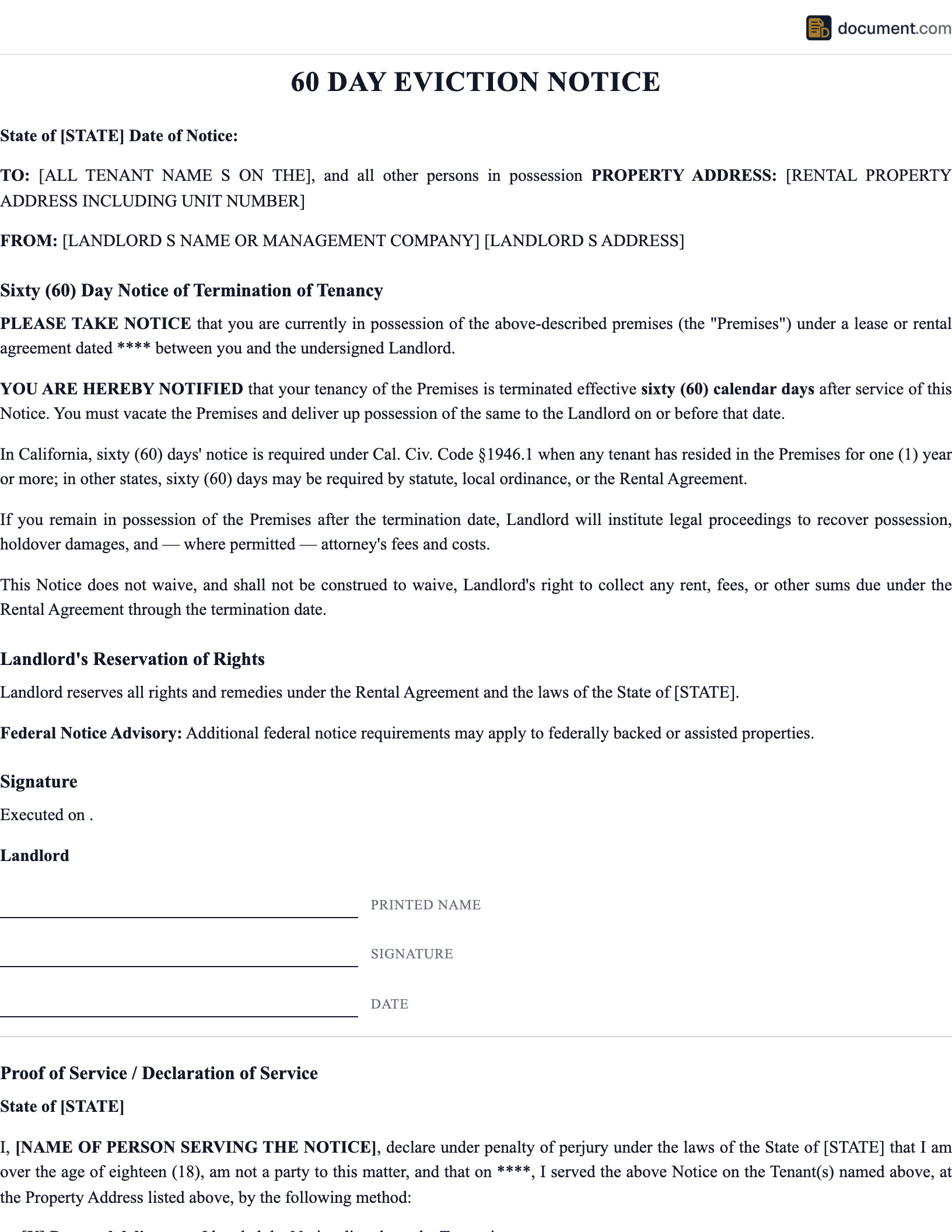
Sample Connecticut 60-Day Notice
Below is a preview of our Connecticut-specific 60-day termination notice.
60-DAY NOTICE OF TERMINATION
STATE OF CONNECTICUT
Pursuant to CGS 47a-23
LANDLORD / PROPERTY OWNER:
Name: [Full Legal Name]
Address: [Connecticut Mailing Address]
TENANT(S):
Name(s): [All Tenant Names]
Rental Address: [Full Property Address]
NOTICE OF TERMINATION:
You are hereby notified that your tenancy will terminate on [Date — 60 days from service]. You must vacate and surrender possession by that date.
CONNECTICUT COMPLIANCE NOTE
This notice to quit complies with Connecticut General Statutes Section 47a-23. [If elderly/disabled tenant: This notice is served pursuant to CGS 47a-23c for the following qualifying reason: ________.]