



Colorado 60-Day Notice Overview
Colorado\'s notice requirements changed significantly in recent years. Under CRS 13-40-107(1)(c), a landlord must provide 21 days written notice to terminate a month-to-month tenancy. Before legislative changes, Colorado required only 7-10 days for some terminations. The standard is now 21 days statewide, though Boulder\'s local ordinance requires 28 days and some leases specify 60 days.
Colorado enacted HB 23-1171 in 2023, which added significant tenant protections including a right to cure for lease violations and restrictions on retaliatory evictions. While Colorado does not require just-cause eviction statewide, the trend is toward greater tenant protections. Denver, Boulder, and other Front Range cities have considered additional local ordinances. Colorado\'s eviction process (Forcible Entry and Detainer under CRS 13-40) is moderately paced, with hearings typically set within 7-14 days of filing.
21-28 Days
Statutory default
$55-$224
Court filing fees
Written
Notice required
2-4 wks
Court process
When a 60-Day Notice Applies in Colorado
Since Colorado's statutory default is 21-28 days, understanding when 60 days is required or advisable is essential.
Lease-Required 60-Day Notice
Many Colorado leases, particularly in competitive markets like Denver, Boulder, Colorado Springs, and Fort Collins, include a 60-day non-renewal clause. When the lease specifies 60 days, the contractual obligation supersedes the 21-day statutory minimum.
Section 8 and CHFA Programs
Colorado Housing and Finance Authority (CHFA) programs and federal Section 8 vouchers often require extended notice periods. The Denver Housing Authority and other local PHAs have their own notice requirements that may exceed state law.
Best Practice for Long-Term Tenants
Colorado\'s tight rental market along the Front Range (Denver metro, Boulder, Fort Collins) means finding new housing can take months. Providing 60 days to long-term tenants reduces legal risk and facilitates a smoother transition.
Colorado Legal Requirements
Colorado's landlord-tenant statutes establish specific requirements for termination notices.
Colorado HB 23-1171 Protections
Colorado HB 23-1171 (2023) added new tenant protections including a requirement to provide tenants a right to cure certain lease violations before termination, restrictions on retaliatory evictions, and limitations on late fees. While this law does not change the notice period for no-cause terminations, it requires landlords to carefully document the basis for termination and comply with new procedural requirements. Consult a Colorado attorney to ensure your 60-day notice complies with the latest legislative changes.
Notice Content Requirements
- Written Notice: CRS 13-40-107 requires written notice. Colorado does not accept oral notice for tenancy terminations
- Tenant and Property ID: Include all tenant names and the complete property address with unit number, city, and ZIP code
- Termination Date: Specify the date at least 60 days from service, aligned with the end of a rental period
- HB 1171 Compliance: Ensure the notice does not conflict with the right-to-cure provisions of HB 23-1171 for any concurrent lease violations
- Landlord Contact: Include landlord name, mailing address, and phone number. Colorado requires disclosure of a local agent for service of process
How to Serve a 60-Day Eviction Notice in Colorado
Proper service ensures your notice will hold up in Colorado courts.
Draft the Notice
Use a Colorado-specific template referencing CRS 13-40-107. Include all tenant names, property address, and the 60-day termination date
Personal Service
Hand-deliver to the tenant. Colorado courts prefer personal service. Use a process server or bring a witness
Post and Mail Alternative
If personal service fails, post the notice on the main door and mail via certified and first-class mail. CRS 13-40-108 governs service methods
Document Service
Complete a proof of service. Keep copies of all mailed notices and postal receipts
File FED if Needed
After 60 days expire, file a Forcible Entry and Detainer action in Colorado county court under CRS 13-40-104
Colorado Eviction Timeline
Colorado FED actions are filed in county court. After filing, the court issues a summons requiring the tenant to appear within 5-10 business days. The court schedules a hearing within 7-14 days of the tenant\'s first appearance.
At trial, the landlord must prove proper notice, expiration of the notice period, and continued occupancy. If the court rules for the landlord, a judgment for possession is entered. The tenant has 48 hours to vacate after judgment unless the court grants a stay.
The sheriff enforces the writ of restitution if the tenant does not vacate. Total court process: 2-4 weeks for uncontested cases. Denver County and other Front Range counties may have longer scheduling. Combined with the 60-day notice period, total timeline is 10-13 weeks.
Colorado Filing Fees & Costs
Eviction costs in Colorado vary by county and court type.
| Fee / Cost | Typical Amount |
|---|---|
| County Court Filing Fee | $55 - $97 |
| Superior Court Filing | $200 - $224 |
| Service of Process | $30 - $75 |
| Attorney Fees | $500 - $2,500 |
| Sheriff Enforcement | $50 - $200 |
Sample Colorado 60-Day Notice
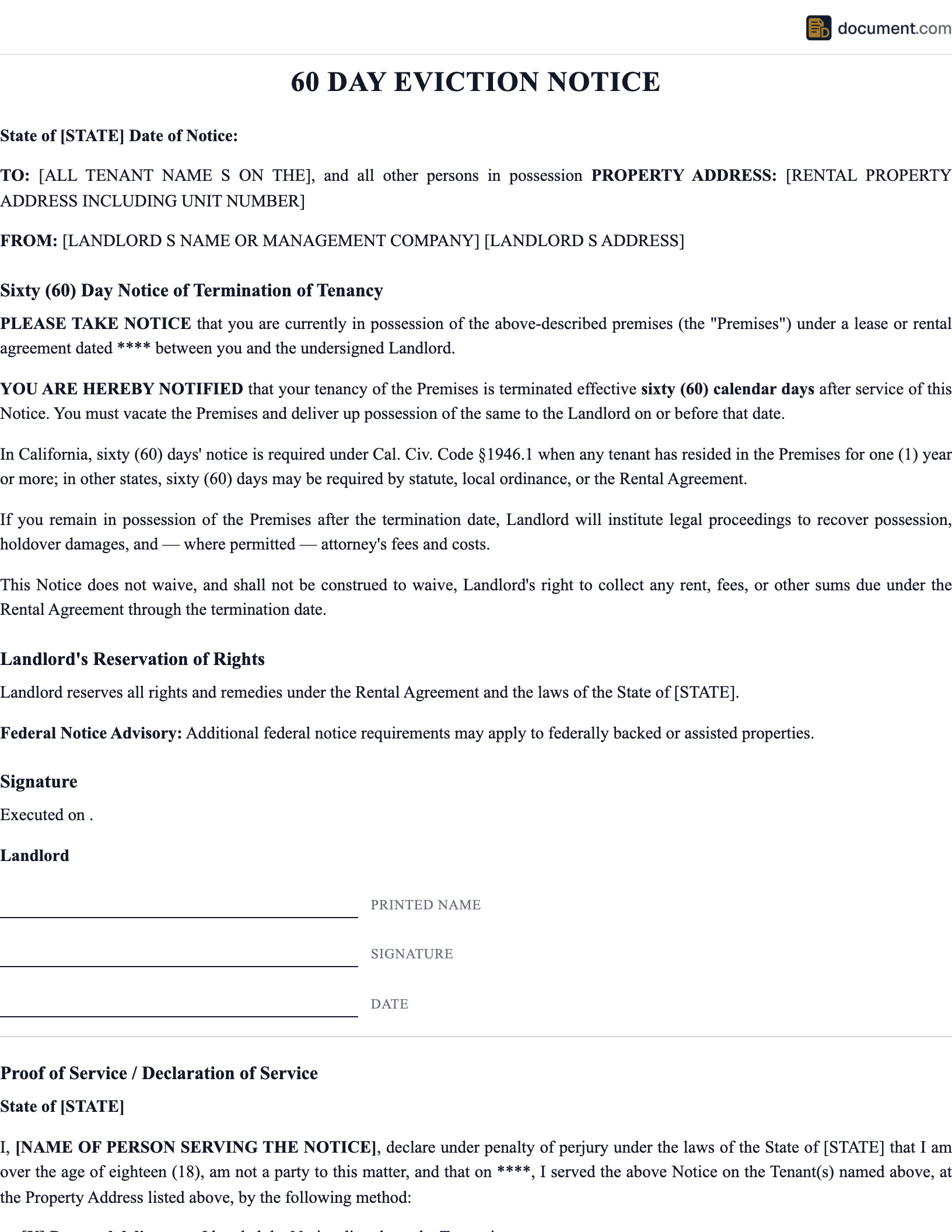
Below is a preview of our Colorado-specific 60-day termination notice.
60-DAY NOTICE OF TERMINATION
STATE OF COLORADO
Pursuant to CRS 13-40-107
LANDLORD / PROPERTY OWNER:
Name: [Full Legal Name]
Address: [Colorado Mailing Address]
TENANT(S):
Name(s): [All Tenant Names]
Rental Address: [Full Property Address]
NOTICE OF TERMINATION:
You are hereby notified that your tenancy will terminate on [Date — 60 days from service]. You must vacate and surrender possession by that date.
COLORADO COMPLIANCE NOTE
This notice complies with Colorado law including HB 23-1171 protections. Your security deposit will be returned within 60 days after termination per CRS 38-12-103, unless a shorter period is specified in the lease (minimum 30 days if agreed in writing).