



California 60-Day Notice Overview
California is the most prominent state requiring a 60-day notice for tenancy termination. Under Civil Code Section 1946.1, any tenant who has resided in a rental unit for one year or more is entitled to 60 days written notice before the landlord can terminate the tenancy without cause. For tenants who have occupied the unit for less than one year, the standard 30-day notice under Civil Code Section 1946 applies instead. This distinction based on occupancy duration is central to California landlord-tenant law.
The landscape shifted dramatically with the passage of AB 1482, the Tenant Protection Act of 2019 (now codified as Civil Code Section 1946.2). For covered properties, landlords can no longer issue no-cause termination notices. Instead, they must demonstrate a qualifying just-cause reason and, for no-fault reasons like owner move-in or substantial renovation, must pay the tenant relocation assistance equal to one month's rent. Understanding whether your property falls under AB 1482 is the first step before drafting any 60-day notice in California.
60 Days
Tenancy 1+ year
$240-$435
UD filing fees
AB 1482
Just-cause required
5-8 wks
UD court process
When a 60-Day Notice Is Required in California
The 60-day requirement under CC 1946.1 applies specifically to no-fault terminations of periodic tenancies where the tenant has been in possession for 12 months or longer. It does not apply to for-cause notices such as 3-day notices for non-payment of rent (CCP 1161) or material lease violations.
Month-to-Month Tenancies (1+ Year)
The most common scenario. A tenant started on a fixed-term lease that converted to month-to-month after expiration and has now been in the unit for at least 12 months total. The landlord must provide 60 days notice to end the tenancy, measured from the date of service.
Owner Move-In (AB 1482 Covered)
For properties covered by AB 1482, an owner or immediate family member intending to occupy the unit is a qualifying no-fault reason. The 60-day notice must state this reason, identify who will move in, and include a relocation assistance offer of one month's rent or waiver of the final month's rent.
Substantial Renovation or Demolition
Landlords planning major renovations that require the unit to be vacant for at least 30 days, or who intend to demolish the structure, must provide 60-day notice with relocation assistance. The notice must describe the planned work and include any required city permits.
AB 1482 Tenant Protection Act
AB 1482 (effective January 1, 2020) fundamentally changed no-fault evictions in California. The law covers most residential rental properties statewide and requires just cause for evicting tenants who have occupied a unit for 12 months or more. The law sunsets on January 1, 2030.
AB 1482 Exemption Requirements
Properties exempt from AB 1482 include: single-family homes and condos not owned by a corporation, REIT, or LLC with a corporate member (owner must provide written notice of exemption per CC 1946.2(e)); units built within the last 15 years (rolling date); owner-occupied duplexes; ADUs and junior ADUs where the owner occupies the primary residence; and housing subject to a local rent control ordinance adopted before September 1, 2019 that includes just-cause protections. If exempt, you may serve a standard 60-day no-cause notice under CC 1946.1 without stating a reason or paying relocation.
Relocation Assistance Requirements
For all no-fault terminations under AB 1482, the landlord must offer relocation assistance in the form of a direct payment equal to one month's rent, payable within 15 calendar days of service of the notice. Alternatively, the landlord may waive the tenant's obligation to pay rent for the final month of the tenancy. The notice itself must inform the tenant of their right to this assistance and specify which option the landlord is providing.
California 60-Day Notice Legal Requirements
California imposes strict content requirements on 60-day notices. An incomplete or defective notice will be rejected by the Superior Court during the unlawful detainer process, requiring the landlord to re-serve and restart the entire notice period.
Required Notice Content
- Full Property Address: Complete address including unit number, city, county, and ZIP code. The address must match the rental agreement and cannot use abbreviations the court might find ambiguous
- All Tenant Names: List every person named on the lease or rental agreement plus "and all others in possession." Omitting a named tenant can invalidate the notice as to that person
- 60-Day Termination Statement: A clear statement that the tenancy will terminate 60 days from the date of service. Specify the exact termination date to avoid ambiguity
- Just-Cause Reason (if AB 1482 applies): State the specific statutory reason from CC 1946.2 for the termination. General or vague language is insufficient
- Relocation Assistance Offer (if AB 1482 applies): State the amount of relocation assistance and the payment method, or specify that the final month rent is waived
- Local Ordinance Compliance: In rent-controlled cities (LA, SF, Oakland, Berkeley, San Jose, etc.), include any additional language or disclosures required by the local ordinance
How to Serve a 60-Day Notice in California
Service of the 60-day notice must comply with California Code of Civil Procedure Section 1162. The method of service affects when the 60-day clock begins and can determine whether the notice survives a challenge in the unlawful detainer proceeding.
Personal Service (CCP 1162(a))
Hand-deliver the notice directly to the tenant. The 60-day period begins immediately on the date of personal service. Use a registered process server or a person over 18 who is not a party to the action. This is the strongest service method in California courts
Substituted Service (CCP 1162(a))
If the tenant is not available, leave the notice with a competent member of the household who is at least 18 years old, then mail a copy via first-class mail to the tenant at the rental address. The 60-day period starts the day after mailing is complete
Post and Mail (CCP 1162(a))
As a last resort when personal and substituted service fail, post the notice in a conspicuous place on the property and mail a copy via first-class mail. Document all failed personal service attempts. The 60-day period starts the day after mailing
Complete a Proof of Service
The process server must complete a declaration of service (proof of service) documenting the date, time, location, method, and description of the person served. This document is filed with the unlawful detainer complaint
File UD Complaint if Tenant Does Not Vacate
After the 60-day period expires and the tenant remains, file an unlawful detainer complaint in the Superior Court of the county where the property is located. In AB 1482 cases, verify relocation assistance was paid before filing
California Unlawful Detainer Timeline
California's unlawful detainer (UD) process is designed as a summary proceeding, meaning it moves faster than standard civil litigation. However, in practice, California UD cases often take longer than the statutory minimums due to court backlogs, particularly in Los Angeles, San Francisco, and other high-volume jurisdictions.
After the 60-day notice period expires and the UD complaint is filed, the tenant has 5 calendar days to respond (15 days if served by substituted service). If the tenant files an answer, trial is set within 20 days. The entire UD court process typically takes 5 to 8 weeks from filing. If the tenant does not respond, the landlord can seek a default judgment in as few as 6 to 10 days.
Once judgment is entered, the clerk issues a writ of execution, and the sheriff posts a 5-day lockout notice. If the tenant does not leave, the sheriff returns to physically change the locks. In Los Angeles County, sheriff lockouts are often scheduled 3 to 4 weeks after the writ is issued due to high demand. Total timeline from initial 60-day notice service to final lockout is typically 4 to 5 months in contested cases.
California Court Fees & Costs
California unlawful detainer filing fees are set by the Judicial Council and vary based on the amount in controversy. Additional costs include service of process, sheriff lockout fees, and potentially relocation assistance under AB 1482.
| Fee / Cost | Typical Amount |
|---|---|
| UD Filing Fee (Superior Court) | $240 - $435 |
| Registered Process Server | $50 - $150 |
| Sheriff Lockout Fee | $125 - $250 |
| Attorney Fees (if hired) | $1,500 - $5,000 |
| AB 1482 Relocation Assistance | 1 month rent |
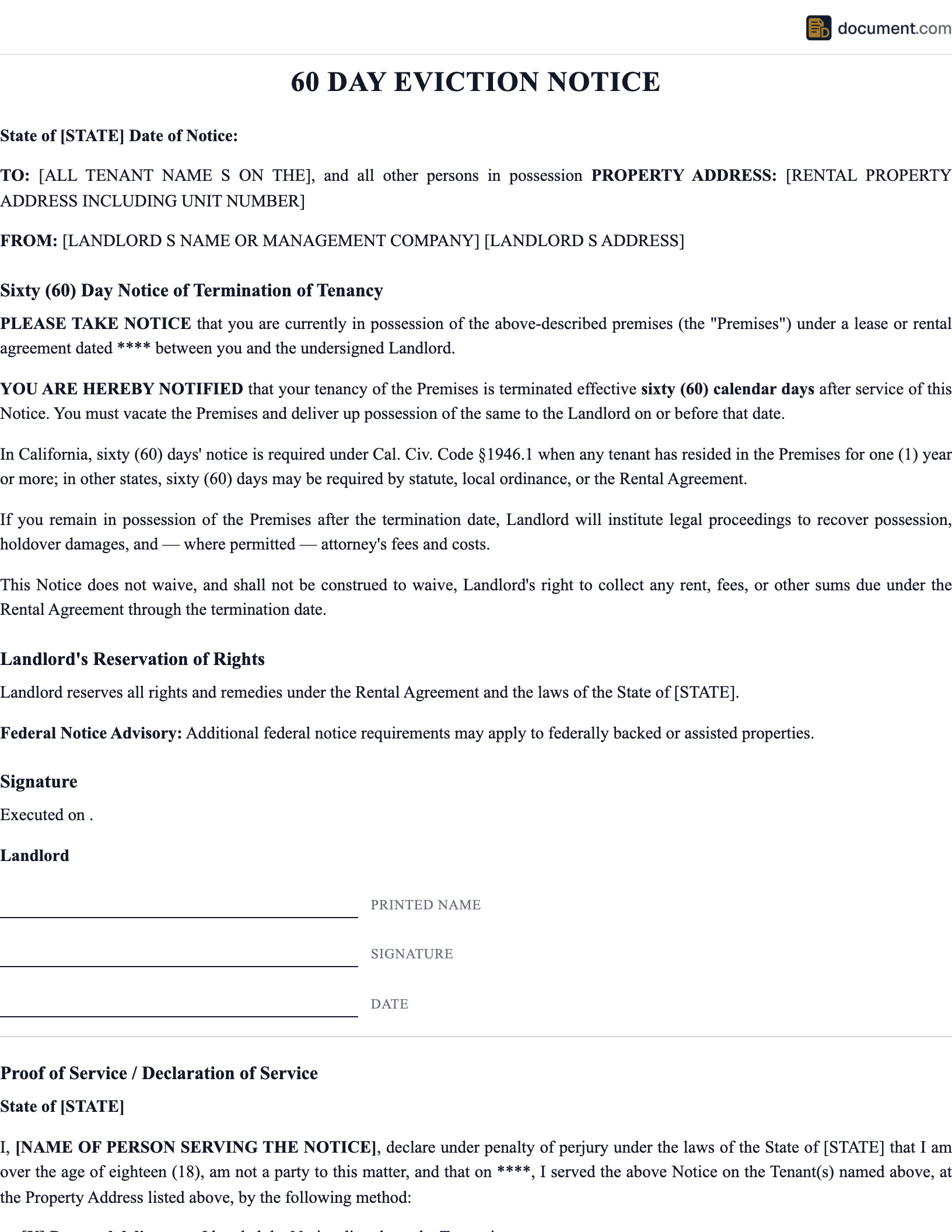
Sample California 60-Day Notice
Below is a preview of our California-specific 60-day notice template. This form references CC 1946.1 for the notice period, includes AB 1482 just-cause language where applicable, and incorporates relocation assistance provisions as required by state law.
60-DAY NOTICE TO TERMINATE TENANCY
STATE OF CALIFORNIA
Pursuant to Civil Code Section 1946.1
LANDLORD / PROPERTY OWNER:
Name: [Full Legal Name]
Address: [California Mailing Address]
TENANT(S) AND ALL OTHERS IN POSSESSION:
Name(s): [All Tenant Names]
Rental Address: [Full Property Address + Unit]
NOTICE OF TERMINATION:
You have occupied this unit for one year or more. Pursuant to California Civil Code Section 1946.1, you are hereby given 60 days written notice to vacate and surrender possession on or before [Date].
AB 1482 RELOCATION ASSISTANCE
Pursuant to Civil Code Section 1946.2, this property is [covered/exempt] under the Tenant Protection Act. [If covered: Relocation assistance of $____ (one month rent) will be paid within 15 days / final month rent is waived.]