



Alabama 60-Day Eviction Notice Overview
Alabama does not have a standalone 60-day eviction notice statute. Under the Alabama Uniform Residential Landlord and Tenant Act (Ala. Code Title 35, Chapter 9A), the standard notice period for terminating a month-to-month tenancy is 30 days. However, landlords in Alabama may need or choose to use a 60-day notice when the written lease agreement specifically requires it, when dealing with subsidized housing programs that mandate longer notice periods, or when local ordinances in certain Alabama municipalities impose extended timelines.
Alabama is widely regarded as one of the most landlord-friendly states in the Southeast. The state does not impose just-cause eviction requirements, rent control, or mandatory relocation assistance. Landlords can terminate a periodic tenancy for any lawful, non-discriminatory reason. That said, providing 60 days notice rather than the statutory minimum of 30 days can reduce legal disputes and give tenants sufficient time to find alternative housing, which often leads to a smoother transition for both parties.
30 Days
Statutory minimum
$47-$268
Court filing fees
Written
Notice required
2-4 wks
Court process
When a 60-Day Notice Applies in Alabama
Because Alabama's statutory default is 30 days for month-to-month tenancies, understanding when a 60-day notice is actually needed is critical. Using the wrong notice period can delay the entire eviction process if the matter goes to court.
Lease Clause Requires 60 Days
Many professionally drafted Alabama leases include a provision requiring 60 days written notice before non-renewal. If your lease has this clause, the contractual obligation overrides the statutory 30-day minimum, and you must comply with the longer period.
Section 8 and Subsidized Housing
Federal Housing Choice Voucher (Section 8) regulations and Alabama Housing Finance Authority programs often require landlords to provide longer notice periods, including 60 days or more, before terminating a tenancy. These rules apply on top of state law.
Long-Term Tenants (Best Practice)
While Alabama law does not require extra notice for long-term tenants, providing 60 days to a tenant who has lived in the property for several years is considered a best practice. Courts may view the landlord more favorably, and tenants are less likely to contest the eviction.
Alabama Legal Requirements
Alabama's Uniform Residential Landlord and Tenant Act governs eviction procedures across the state. While some Alabama counties have not adopted the Act (in which case common law rules apply), the following requirements represent standard practice for a valid termination notice in Alabama.
Alabama URLTA Adoption Warning
Not all Alabama counties have adopted the Uniform Residential Landlord and Tenant Act. Counties that have not adopted it rely on common law eviction rules, which may differ significantly. Before serving a 60-day notice, confirm whether your county follows the URLTA or common law. Counties including Jefferson (Birmingham), Madison (Huntsville), and Mobile have adopted the Act. Contact your local district court clerk for confirmation.
Notice Content Requirements
- Written Form: Alabama requires all termination notices to be in writing. Oral notice is insufficient even for month-to-month tenancies under Ala. Code 35-9A-441
- Tenant and Property Identification: Include the full legal names of all tenants on the lease and the complete street address of the rental unit, including apartment or unit number
- Termination Date: Clearly state the date by which the tenant must vacate. The date must be at least 60 days from the date of service and should coincide with a rent payment period
- Landlord Contact Information: Include the landlord's name, mailing address, and phone number as required for service of process purposes
- Security Deposit Instructions: Alabama law (Ala. Code 35-9A-201) requires landlords to return the security deposit within 60 days after termination. The notice should reference the deposit return process
How to Serve a 60-Day Eviction Notice in Alabama
Proper service is critical in Alabama. If the landlord cannot prove the notice was properly delivered, the court will dismiss the unlawful detainer action, requiring the landlord to start over.
Prepare the Notice Document
Draft the notice using an Alabama-specific template that references Ala. Code 35-9A-441. Include all tenant names, the full property address, the 60-day termination date, and a statement that the tenancy will not be renewed
Personal Delivery (Preferred)
Hand-deliver the notice directly to the tenant. Alabama courts strongly prefer personal service. Bring a witness who can later testify about the date and manner of delivery if needed
Alternative: Certified Mail + Posting
If personal delivery fails, send the notice via certified mail with return receipt requested and simultaneously post a copy on the main entry door. Alabama courts generally accept this dual-method approach
Create a Proof of Service Record
Complete a written proof of service documenting the date, time, method, and witness. Keep the certified mail receipt and return card. Photograph the posted notice if using that method
Wait the Full 60 Days
The notice period begins the day after service. Do not count the day of service itself. If the tenant does not vacate by the termination date, file an unlawful detainer action in Alabama district court
Alabama Eviction Timeline
Alabama has one of the faster eviction court processes in the country. Once a landlord files an unlawful detainer action after the notice period expires, Alabama district courts typically schedule a hearing within 6 to 14 days.
At the hearing, the landlord must present the original notice, proof of service, and evidence that the tenant remains in possession. If the court rules for the landlord, a writ of restitution is issued. The tenant then has 7 days to vacate. If the tenant still refuses, the county sheriff enforces the writ by physically removing the tenant and their belongings.
From the date of filing through sheriff enforcement, the Alabama court process typically takes 2 to 4 weeks for uncontested cases. Contested evictions, where the tenant raises defenses such as retaliation or habitability issues, can extend the timeline to 6 to 8 weeks. Adding the 60-day notice period, the entire process from initial notice to physical removal may span 10 to 14 weeks total.
Alabama Filing Fees & Costs
Alabama eviction costs vary by county. District courts handle unlawful detainer actions, and fees differ between small claims and regular civil divisions.
| Fee / Cost | Typical Amount |
|---|---|
| District Court Filing Fee | $47 - $268 |
| Service of Process (Sheriff) | $25 - $75 |
| Attorney Fees (if hired) | $400 - $2,000 |
| Writ of Restitution | $25 - $100 |
| Sheriff Enforcement | $50 - $200 |
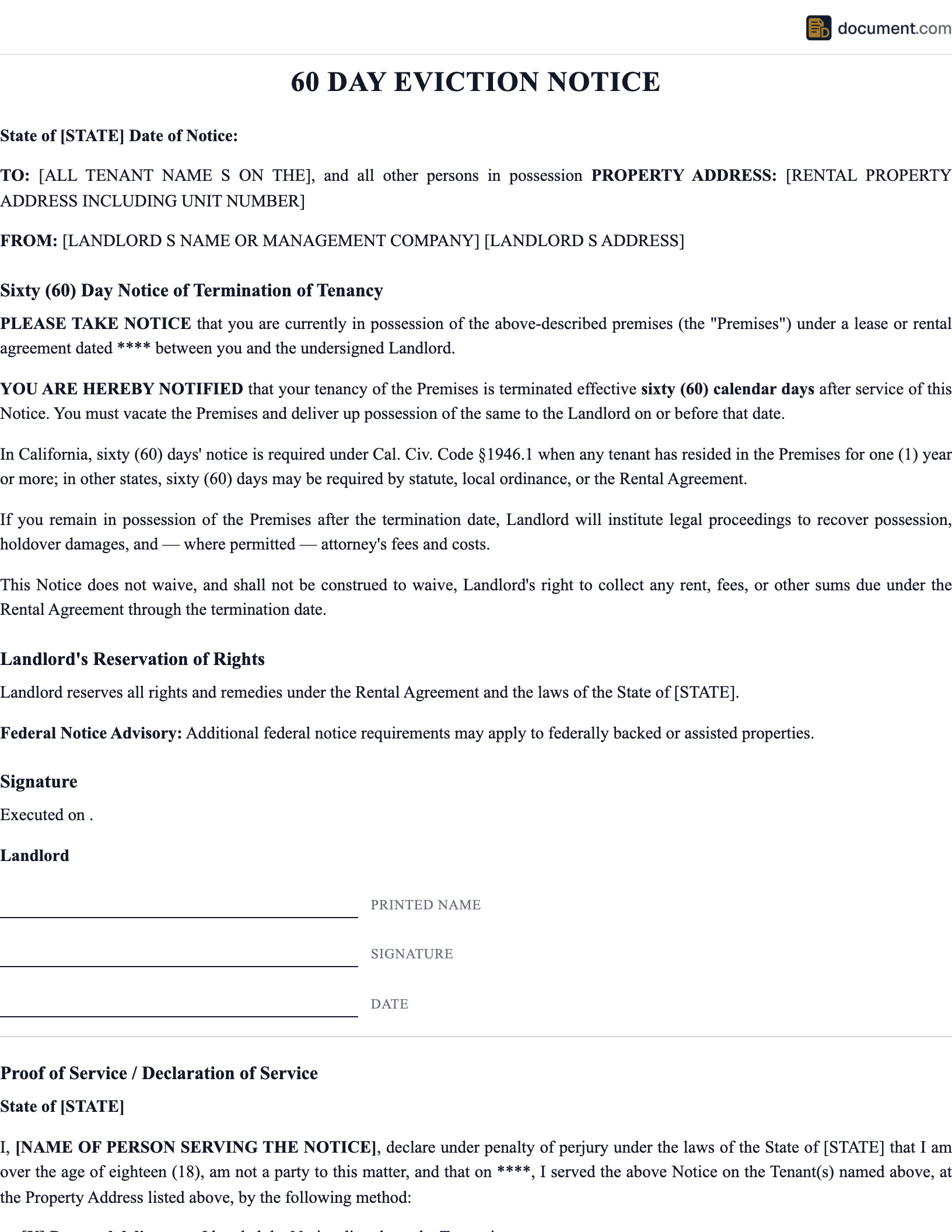
Sample Alabama 60-Day Eviction Notice
Below is a preview of our Alabama-specific 60-day termination notice. This template references Ala. Code 35-9A-441 and includes provisions for security deposit return under Ala. Code 35-9A-201.
60-DAY NOTICE OF TERMINATION
STATE OF ALABAMA
Pursuant to Ala. Code 35-9A-441
LANDLORD / PROPERTY OWNER:
Name: [Full Legal Name]
Address: [Alabama Mailing Address]
TENANT(S):
Name(s): [All Tenant Names]
Rental Address: [Full Property Address]
NOTICE OF TERMINATION:
You are hereby notified that your tenancy at the above premises will terminate on[Date — 60 days from service]. You must vacate and surrender possession by that date.
SECURITY DEPOSIT
Your security deposit will be handled pursuant to Ala. Code 35-9A-201. A forwarding address must be provided within 30 days of vacating to receive your deposit refund.